#automation News & Analysis
Coverage of #automation has generated 36 articles in the past month, with roughly half expressing bullish sentiment toward the topic. However, optimism has softened compared to the previous quarter, declining 8.5 percentage points. Discussion centers on advances from major AI developers including Anthropic, ChatGPT, and Gemini, with significant overlap in coverage of machine learning, AI agents, and large language models.
The aggregator's sources on this tag are dominated by arXiv's computer science and AI sections, along with crypto-focused outlets. Scan the articles below to explore how automation is being discussed across these communities.
sentiment · last 30d (36 articles) · -8.5pp bullish vs prior 90dTop sources:arXiv – CS AI · 135Fortune Crypto · 42Crypto Briefing · 15The Register – AI · 10TechCrunch – AI · 10
Most-discussed entities:Anthropic · 7ChatGPT · 6Gemini · 5Claude · 5OpenAI · 5
AIBullishFortune Crypto · Jun 46/10
🧠Honeycomb, an insurtech startup, has raised $40 million in funding for its AI-powered home insurance underwriting platform that eliminates traditional property inspections. The company's automated system analyzes hundreds of data points per property to determine policy pricing, representing a significant shift toward algorithmic risk assessment in the insurance industry.
AI × CryptoBullishCrypto Briefing · Jun 46/10
🤖Circle, a major cryptocurrency and payments company, has achieved 90% employee adoption of AI coding tools and deployed 900 internal AI applications across its operations. This aggressive AI integration demonstrates how fintech firms are leveraging artificial intelligence to enhance operational efficiency, empower non-technical staff, and strengthen competitive positioning in an increasingly tech-driven industry.
AINeutralarXiv – CS AI · Jun 46/10
🧠Researchers have developed the Abduction Prover, a new automation tool for Isabelle/HOL that enhances proof search capabilities in formal verification. By using abductive reasoning to identify useful conjectures, the tool addresses the significant automation limitations that increase the computational cost of formal verification projects.
AI × CryptoBullishCrypto Briefing · Jun 36/10
🤖Yat Siu argues that the cryptocurrency industry needs to prioritize user engagement and enjoyment to drive mainstream adoption. He highlights AI agents as a transformative technology for decentralized finance, capable of streamlining asset management and improving user experiences, while noting that metaverse integration is becoming increasingly embedded in everyday digital activities.
AINeutralFortune Crypto · Jun 36/10
🧠Contrary to widespread predictions that AI would trigger mass job losses, spring 2024 labor market data shows continued job opening and workforce stabilization rather than displacement. Employ America analyst Skanda Amarnath attributes this to backfilling, suggesting AI integration has not yet produced the anticipated employment contraction.
AIBullishFortune Crypto · Jun 26/10
🧠Chipotle's Chief Operating Officer Jason Kidd unveiled an AI chatbot named 'Ava Cado' that automates the initial hiring screening process, reducing recruitment time from 12 days to 4 days. The development reflects growing enterprise adoption of AI to streamline traditionally manual HR workflows, raising questions about the appropriate scope of AI automation in hiring.
AINeutralBlockonomi · Jun 26/10
🧠Sanofi has deployed an AI sales assistant built on Snowflake's platform that accelerates pharmaceutical sales preparation from hours to seconds. The announcement coincided with Snowflake stock dropping 8.48% at its Summit 26 conference, highlighting investor concerns despite the enterprise adoption milestone.
AIBullishOpenAI News · Jun 26/10
🧠Travelers Insurance has deployed an AI-powered Claim Assistant built with OpenAI technology across the United States to streamline the claims filing process. The system provides 24/7 customer support and enables the company to handle increased claim volumes during peak demand periods without proportional staffing increases.
🏢 OpenAI
AIBullisharXiv – CS AI · Jun 26/10
🧠Researchers propose statistically sound algorithms for evaluating machine learning models using synthetic data generated by AI systems, reducing reliance on expensive human annotations. The approach maintains unbiased results while improving sample efficiency by up to 50% in GPT-4 experiments, addressing a significant bottleneck in ML development.
🧠 GPT-4
AINeutralarXiv – CS AI · Jun 26/10
🧠SpeedAug is a new reinforcement learning framework that accelerates robotic policy execution by learning optimal task speeds rather than relying on conservative demonstration data. The method combines tempo-enriched policy learning with RL fine-tuning to achieve 1.8x faster real-world task throughput while maintaining success rates.
AINeutralarXiv – CS AI · Jun 26/10
🧠Researchers propose a framework for generating physically consistent structural engineering code using large language models, introducing CivilInstruct dataset and MBEval benchmark to reduce hallucinations and ensure simulation-ready outputs. The approach combines domain knowledge, constraint-oriented alignment, and verification-driven evaluation to overcome current limitations in automated building modeling.
AINeutralarXiv – CS AI · Jun 26/10
🧠Researchers introduce SMH-Bench, a comprehensive benchmark for evaluating large language models in smart-home environments, containing 1,100 tasks across varying complexity levels. The study reveals that while frontier LLMs excel at explicit control tasks, they struggle significantly with automation scheduling, ambiguity resolution, and personalized reasoning as household complexity increases.
AINeutralarXiv – CS AI · Jun 26/10
🧠RL-ACRGNet is a new deep learning model that automates chest X-ray report generation by combining DenseNet image encoding with LSTM text generation in a reinforcement learning framework. The system demonstrates measurable improvements over existing methods on medical imaging datasets, potentially streamlining radiologist workflows and reducing diagnostic inconsistencies.
AINeutralarXiv – CS AI · Jun 26/10
🧠Researchers have extended ComProScanner, an automated materials data extraction framework, with vision-language model capabilities to extract composition-property data from scientific figures in addition to text and tables. Gemini-3-Flash-Preview achieved 97% composition accuracy on piezoelectric ceramic research, establishing the first fully multimodal literature mining platform for materials science.
🧠 Gemini
AINeutralarXiv – CS AI · Jun 26/10
🧠Researchers propose ASE-26, a comprehensive undergraduate curriculum for agentic software engineering, arguing that as AI agents increasingly handle 75-79% of programming tasks, the industry's critical gap is not better models but structured practitioner discipline. The curriculum represents an academic effort to formalize training in agent-directed development as a new professional discipline.
🏢 Anthropic🧠 Claude
AINeutralarXiv – CS AI · Jun 26/10
🧠Researchers introduce pcbGPT, an AI system that generates PCB schematics from natural language descriptions, achieving 90% accuracy on basic tasks and 72% on complex ones. While the tool produces useful first-draft designs suitable for early prototyping, it still requires expert review and cannot yet replace human engineers in the design validation process.
AINeutralarXiv – CS AI · Jun 26/10
🧠Agentic-J is a containerized AI assistant system designed for ImageJ/Fiji that enables biologists to perform complex microscopy image analysis tasks using natural language commands. The system generates executable, documented scripts with specialized sub-agents handling plugin management, code generation, debugging, and statistical reporting, making advanced image analysis more accessible to researchers without extensive programming expertise.
AIBearishFortune Crypto · Jun 16/10
🧠Okta's COO Eric Kelleher highlights a critical challenge in the AI revolution that most companies are unprepared for: the fundamental redesign of work processes and organizational structures. Rather than simply adopting AI tools, businesses must rethink workforce planning to account for both human and digital workers, a conceptual shift that executives struggle to implement.
AIBullishFortune Crypto · Jun 16/10
🧠Artificial intelligence is being deployed in the hospitality sector to automate routine hotel operations, freeing staff to focus on personalized guest experiences. This shift aims to elevate service quality across all hotel segments by reducing time spent on administrative tasks.
AIBullishCrypto Briefing · Jun 16/10
🧠LG Electronics' stock price has quadrupled as investors respond positively to the company's strategic pivot toward robotics and AI-driven automation. This shift reflects growing market confidence in LG's ability to leverage artificial intelligence and automation technologies to transform its traditional electronics business and compete in emerging technology sectors.
AINeutralFortune Crypto · May 316/10
🧠Peter Thiel argues that AI poses a greater threat to technical and STEM-focused jobs than to creative roles, a perspective supported by LinkedIn data showing job postings for 'storytellers' doubled year-over-year. This challenges conventional wisdom that automation primarily threatens creative work while protecting technical expertise.
AIBullishBlockonomi · May 296/10
🧠ServiceNow stock surged 14% on Friday following announcements of AI product innovations, a $4.2 billion share buyback program, and upgraded coverage from Bank of America, reflecting broader momentum in the enterprise software sector driven by artificial intelligence adoption.
AI × CryptoBullishcrypto.news · May 296/10
🤖AI-powered trading robots are expanding from traditional stock markets into cryptocurrency, with tools like BulkQuant enabling traders to automate market monitoring across multiple asset classes in 2026. This convergence reflects growing demand for sophisticated automation solutions as traders seek income opportunities beyond single markets.
AIBullishCrypto Briefing · May 296/10
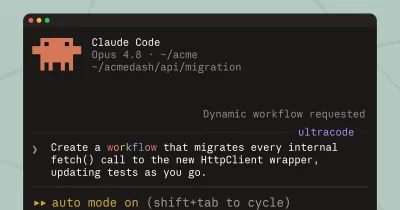
🧠Anthropic has released Opus 4.8, an enhanced version of Claude featuring dynamic workflow capabilities for Claude Code, designed to streamline automation in large-scale enterprise coding projects. The update promises to improve software development efficiency across organizations handling complex development workloads.
🏢 Anthropic🧠 Claude🧠 Opus
AIBullisharXiv – CS AI · May 296/10
🧠Frontier large language models from Anthropic and OpenAI have demonstrated competitive performance with human experts at annotating natural phenotypes to ontology terms, a previously labor-intensive bottleneck in biological research. When evaluated against the same Gold Standard benchmark used in a 2018 study, these AI agents performed within the range of trained human curators and substantially outperformed prior NLP tools, suggesting significant potential to scale phenotype annotation workflows.
🏢 OpenAI🏢 Anthropic