AIBullishBlockonomi · Mar 167/10
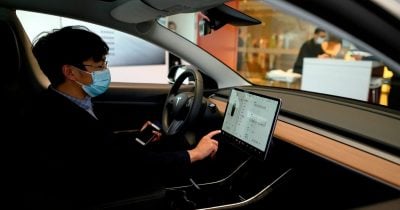
🧠Tesla CEO Elon Musk announced the imminent launch of a Terafab AI chip manufacturing facility capable of producing up to 200 billion chips annually for autonomous driving applications. This significant expansion into chip manufacturing represents Tesla's push for vertical integration in AI hardware for their self-driving vehicle technology.
AIBullisharXiv – CS AI · Jun 237/10
🧠SIMSplat introduces a novel framework for manipulating driving scenarios using 4D Gaussian Splatting with language-aligned features, enabling natural language control over scene editing and multi-agent simulation. The technology bridges language understanding with object-level manipulation and demonstrates significant improvements in grounding accuracy and task completion rates for autonomous driving applications.
AIBullisharXiv – CS AI · Jun 237/10
🧠Researchers introduce WMGen-v1, an AI framework combining vision-language models with diffusion techniques to generate synthetic training data for autonomous systems. The system addresses the critical challenge of rare, safety-critical scenarios in spatial perception by creating physically plausible synthetic data from single reference images, demonstrating that models trained purely on generated data can approach real-world performance levels.
AIBullisharXiv – CS AI · Jun 237/10
🧠Researchers propose MAGNIFIED, a reinforcement learning fine-tuning approach for multimodal large language models that optimizes autonomous driving planning by learning from planning-specific rewards rather than token prediction alone. Testing on the Waymo Open Motion Dataset shows substantial improvements including 10.5% reduction in trajectory overlap and 38.9% reduction in off-road violations compared to supervised fine-tuning baselines.
AIBullisharXiv – CS AI · Jun 197/10
🧠Researchers introduce Lagrange, an open-vocabulary autonomous driving framework that combines Vision-Language Models with sparse, energy-based planning to address limitations in existing end-to-end driving systems. The approach balances computational efficiency with generalization capacity for handling out-of-distribution scenarios while maintaining kinematic feasibility.
AIBullisharXiv – CS AI · Jun 197/10
🧠Researchers have developed a self-play reinforcement learning method that trains autonomous driving policies using only 30 minutes of human demonstrations alongside simulated self-play, achieving 2500x efficiency gains over traditional imitation learning approaches. The technique enables policies to align with human driving conventions while training in 15 hours on consumer-grade hardware, addressing a critical limitation in autonomous systems where pure simulation-trained agents develop incompatible behavioral patterns.
AINeutralarXiv – CS AI · Jun 127/10
🧠A new arXiv tutorial presents a unified framework for world modeling in artificial intelligence, distinguishing between explicit models used for planning and implicit models embedded in learned representations. The paper highlights how world models enable physical AI systems in robotics and autonomous driving while identifying key challenges in hierarchical reasoning and long-horizon planning that remain critical for advancing toward artificial general intelligence.
AIBullisharXiv – CS AI · Jun 97/10
🧠Researchers introduce ACTIVE-o3, a reinforcement learning framework that enables Multimodal Large Language Models (MLLMs) to actively perceive and intelligently select regions of interest for visual analysis. The system outperforms GPT-o3's zoom strategy while maintaining general understanding capabilities, with applications spanning robotics, autonomous driving, and remote sensing.
AIBullisharXiv – CS AI · Jun 87/10
🧠Researchers propose COMPACT-VA, a planning-aligned token compression framework using conditional VQ-VAE to enable vision-action models in autonomous driving to process extended temporal context within real-time computational budgets. The approach achieves over 6% improvement in driving success rates while delivering 3.3x speedup and 2.7x memory reduction compared to uncompressed processing.
AIBullisharXiv – CS AI · Jun 87/10
🧠Researchers introduce IGCARL, a novel deep reinforcement learning framework that trains autonomous driving agents against sophisticated, multi-step adversarial attacks rather than simple myopic threats. The approach improves robustness by 27.9% over existing methods, addressing critical safety vulnerabilities that could impact real-world autonomous vehicle deployment.
AIBullishCrypto Briefing · Jun 77/10
🧠Tesla demonstrated autonomous driving capabilities with a San Francisco to Palo Alto round trip, signaling progress toward commercial robotaxi services. The company's shift from vehicle sales to recurring subscription-based autonomous transportation could fundamentally reshape its revenue model and the transportation industry.
AIBullisharXiv – CS AI · Jun 57/10
🧠Researchers introduce Drive-KD, a knowledge distillation framework that compresses large vision-language models for autonomous driving by decomposing the task into perception, reasoning, and planning components. The method achieves superior performance with 42x less GPU memory and 11.4x higher throughput compared to larger baseline models, advancing the practical deployment of AI in safety-critical driving systems.
🧠 GPT-5
AIBullisharXiv – CS AI · Jun 57/10
🧠Researchers introduce PLAN-S, a new neural architecture that improves autonomous driving by creating interpretable cost maps from latent world models, enabling better control over driving style dynamics. The method demonstrates significant safety improvements on benchmark datasets, reducing collision rates by 42% on nuScenes while maintaining frozen backbone models.
AINeutralarXiv – CS AI · Jun 57/10
🧠Researchers identify a critical gap between safety standards for autonomous driving and explainable AI (XAI) methods: current popular XAI techniques like SHAP produce outputs that don't match the evidence types required by ISO and safety standards. The study derives 19 evidentiary criteria across 7 lifecycle stages and determines that causal XAI methods are structurally necessary for hazard identification and incident investigation, while correlational methods suffice elsewhere.
AIBullisharXiv – CS AI · Jun 57/10
🧠Researchers introduce CLEAR, a new framework for autonomous driving that combines fast generative planning with semantic reasoning to address the latency problems of diffusion models. By replacing iterative denoising with single-step conditional drift in VAE latent space and fine-tuning language models for scene understanding, the system achieves state-of-the-art performance on the NAVSIM benchmark without sacrificing multi-modal trajectory generation.
AIBullisharXiv – CS AI · Jun 47/10
🧠MapAgent is an AI framework that automates lane-level map generation for autonomous driving at city scale, combining vision-language models with constraint verification to produce specification-compliant maps. Already deployed by Baidu Maps across 360+ Chinese cities, the system achieves over 95% production automation while reducing manual editing overhead in complex scenarios.
AIBullisharXiv – CS AI · Jun 47/10
🧠Researchers introduce DVGT, a transformer-based model for 3D scene reconstruction in autonomous driving that works without explicit camera parameters. Trained on multiple large driving datasets, the system demonstrates improved performance by directly inferring dense geometry from unposed multi-view sequences, eliminating dependence on precise calibration data.
AIBearisharXiv – CS AI · Jun 47/10
🧠Researchers evaluated Vision-Language-Action models in autonomous driving under sensor degradation, finding that explanation consistency (Chain-of-Causation) strongly correlates with trajectory reliability. When model explanations change due to perturbations like fog or noise, trajectory errors increase 5.3x, suggesting reasoning consistency could serve as a safety monitoring tool for autonomous vehicles.
AIBullisharXiv – CS AI · Jun 27/10
🧠DeepIPCv2 is an end-to-end autonomous driving framework that uses LiDAR point cloud data instead of cameras to perceive environments and control vehicle navigation. The system demonstrates superior robustness to lighting variations and reduced driving interventions compared to existing methods like TransFuser, advancing the practical deployment of autonomous vehicles.
AIBearishCrypto Briefing · May 307/10
🧠Tesla faces a consumer lawsuit in China over its Full Self-Driving feature, raising questions about the company's autonomous driving claims and regulatory compliance in a critical market. The legal challenge could establish important precedents for how FSD features are regulated and marketed globally, with potential implications for Tesla's market strategy and consumer trust worldwide.
AIBullisharXiv – CS AI · May 297/10
🧠Researchers introduce CityGen, a diffusion-based framework that enables autonomous driving systems to generalize across different cities without labeled training data. The approach uses HD-map guidance and visual prompts to synthesize city-specific driving scenarios, addressing a critical scalability challenge in deploying autonomous vehicles to new geographic regions.
AIBullisharXiv – CS AI · May 127/10
🧠Researchers introduce GuardAD, a safety framework that enhances autonomous driving systems using multimodal large language models (MLLMs) by incorporating Markovian logic to detect and prevent accidents. The model-agnostic safeguard reduces accident rates by 32% while improving task performance, combining neuro-symbolic logic with dynamic action revision rather than simple action veto mechanisms.
AIBullisharXiv – CS AI · May 127/10
🧠Researchers introduce VLADriver-RAG, a new framework that combines Vision-Language-Action models with retrieval-augmented generation for autonomous driving. By grounding decisions in explicit historical knowledge rather than relying solely on learned parameters, the system achieves state-of-the-art performance on the Bench2Drive benchmark with a Driving Score of 89.12, demonstrating improved generalization in complex driving scenarios.
AIBullisharXiv – CS AI · May 117/10
🧠Researchers demonstrate that vision-language models (VLMs) can effectively function as zero-shot sensors for perceiving Operational Design Domains (ODDs) in autonomous systems without task-specific training. The study evaluates four VLMs on ODD classification and detection tasks, finding that chain-of-thought prompting with persona decomposition achieves optimal performance, providing a scalable approach for safety-critical autonomous driving applications.
AIBullisharXiv – CS AI · May 17/10
🧠OmniDrive-R1 is a new Vision-Language Model framework that addresses critical reliability failures in autonomous driving by combining perception and reasoning through an interleaved multi-modal chain-of-thought mechanism, achieving significant accuracy improvements (37.81% to 73.62%) without requiring dense localization labels.