AINeutralarXiv – CS AI · Apr 146/10
🧠Researchers evaluated whether general-purpose LLMs (OpenAI o3 and Google Gemini 2.5 Pro) can model human driving behavior in autonomous vehicle safety testing by embedding them as standalone driver agents in a simplified merging scenario. While both models reproduced some human-like behaviors, they failed to consistently capture responses to dynamic velocity cues and diverged significantly on safety metrics, suggesting LLMs show promise as ready-to-use behavior models but require further validation.
🏢 OpenAI🧠 o1🧠 o3
AIBullishCrypto Briefing · Apr 106/10
🧠Waymo's autonomous vehicles are completing nearly 500,000 weekly rides, driven by advances in 360-degree sensor integration and AI-powered real-time decision-making. The article examines how Dmitri Dolgov's work addresses key technical challenges in achieving full autonomy, highlighting both the progress and remaining obstacles in self-driving technology.
AINeutralBlockonomi · Mar 267/10
🧠Uber's stock declined 1.3% despite launching Europe's first commercial autonomous taxi service in Zagreb, Croatia, in partnership with Pony.ai and Verne. The market reaction suggests investor skepticism about the immediate impact of this milestone on Uber's business.
AIBullishBlockonomi · Mar 266/10
🧠Pony AI stock rose 2.81% after reporting strong Q4 earnings that exceeded expectations and announcing a new robotaxi partnership with Uber launching in Croatia. The autonomous vehicle company's positive performance reflects growing momentum in the robotaxi market.
AINeutralFortune Crypto · Mar 106/10
🧠Alphabet CEO Sundar Pichai's $692 million compensation package ties nearly half of his pay to the performance of two unprofitable Alphabet subsidiaries: autonomous vehicle company Waymo and drone delivery service Wing. Both companies are currently operating at a loss despite being key moonshot investments for the tech giant.
AIBearisharXiv – CS AI · Mar 37/109
🧠Researchers evaluated Naturalistic Adversarial Patches (NAPs) that can fool autonomous vehicle traffic sign detection systems in physical environments. The study used a custom dataset and YOLOv5 model to generate patches that successfully reduced STOP sign detection confidence across various real-world testing conditions.
AINeutralarXiv – CS AI · Mar 35/104
🧠Researchers have developed PhysFusion, a new AI framework that combines radar and camera data to improve object detection on water surfaces for unmanned vessels. The system achieves up to 94.8% accuracy by using physics-informed processing to handle challenging maritime conditions like wave clutter and poor visibility.
AIBullisharXiv – CS AI · Mar 36/103
🧠Researchers propose Adaptive Confidence Regularization (ACR), a new framework for detecting failures in multimodal AI systems used in critical applications like autonomous vehicles and medical diagnostics. The approach uses confidence degradation detection and synthetic failure generation to improve reliability of AI predictions in high-stakes scenarios.
AIBullisharXiv – CS AI · Mar 26/1015
🧠Researchers introduce DiffusionHarmonizer, an AI framework that enhances neural reconstruction simulations for autonomous robots by converting multi-step image diffusion models into single-step enhancers. The system addresses artifacts in NeRF and 3D Gaussian Splatting methods while improving realism for applications like self-driving vehicle simulation.
AIBullisharXiv – CS AI · Feb 276/108
🧠Researchers have developed LaGS (Latent Gaussian Splatting), a new AI method for 4D panoptic occupancy tracking that enables robots to better understand dynamic environments. The approach combines camera-based tracking with 3D occupancy prediction, achieving state-of-the-art performance on industry-standard datasets.
$UNI
AIBullishMIT News – AI · Dec 175/107
🧠Researchers have developed an AI-powered 'scientific sandbox' tool that allows exploration of vision system evolution. The tool has potential applications for improving sensors and cameras used in robotics and autonomous vehicles.
AIBullishHugging Face Blog · Mar 116/107
🧠The article title suggests LeRobot has released the world's largest open-source self-driving dataset, representing a significant contribution to autonomous vehicle development. However, no article body was provided for detailed analysis.
AINeutralStratechery · Jun 185/10
🧠An interview with Michael Morton explores the intersection of e-commerce and artificial intelligence, examining challenges in validating bear cases, comparing distribution versus referral business models, and discussing emerging trends in grocery delivery and autonomous vehicle integration.
GeneralNeutralCrypto Briefing · Jun 105/10
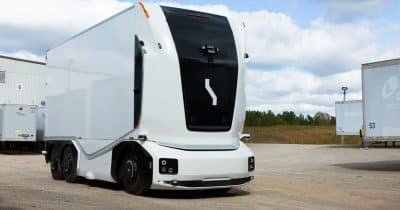
📰Einride's upcoming Nasdaq debut via SPAC merger occurs amid significant investor attention on competing high-profile IPOs like SpaceX, creating visibility challenges for smaller companies. The timing highlights how market dynamics can overshadow individual corporate milestones when larger, more prominent firms command investor capital and media coverage simultaneously.
GeneralNeutralNot Boring · Jun 85/10
📰This article explores the technological and logistical challenges of making flying cars a practical transportation solution for daily use. The piece examines the barriers to commercialization, including regulatory frameworks, infrastructure requirements, and safety considerations that must be addressed before flying vehicles become mainstream.
AINeutralarXiv – CS AI · Mar 54/10
🧠Researchers developed TPK, a trajectory prediction system for autonomous vehicles that integrates prior knowledge to make predictions more trustworthy and physically feasible. The system incorporates interaction and kinematic models for vehicles, pedestrians, and cyclists, improving interpretability while ensuring predictions adhere to physics.