AIBullisharXiv – CS AI · Jun 56/10
🧠RiskFlow is a new machine learning framework that generates realistic safety-critical traffic scenarios for autonomous vehicle testing by using a single-pass velocity field model instead of iterative diffusion processes. The approach achieves faster inference times while reducing common motion artifacts and maintaining strong adversarial scenario generation capabilities.
AINeutralarXiv – CS AI · Jun 45/10
🧠Researchers propose MONIR, a normative intermediate representation framework for automated compliance reasoning using Answer Set Programming (ASP). The system combines staged operational semantics with executable ASP compilation to evaluate regulatory adherence, demonstrated through application to Chinese ADAS (Advanced Driver Assistance Systems) regulations with LLM-assisted extraction pipelines.
AINeutralarXiv – CS AI · Jun 46/10
🧠Researchers have developed a neural radiated-noise field (NRNF) model that predicts underwater vehicle acoustic signatures across three-dimensional spaces using machine learning rather than traditional physics-based simulation. The model achieves 3.5 dB average prediction error in the 50-5000 Hz band and demonstrates improved spatial generalization through a learnable scene feature grid.
AINeutralarXiv – CS AI · Jun 26/10
🧠TrafficRAG presents a multimodal retrieval-augmented generation framework that automates traffic accident liability analysis by combining vision-language models, hybrid legal document retrieval, and large language models to generate standardized liability reports. The system achieves 77.32% legal norm accuracy and demonstrates that integrating multimodal evidence with legal knowledge significantly improves accident analysis reliability.
AIBullisharXiv – CS AI · Jun 26/10
🧠Researchers propose a machine learning system to improve ultra-wideband (UWB) range measurement accuracy for connected autonomous vehicles navigating work zones, using pose-conditioned denoising to filter out signal errors from obstacles and interference. The method reduces measurement error by 66.9% compared to raw data and demonstrates robust performance in real-world field tests, advancing V2I infrastructure capabilities for autonomous vehicle safety.
AIBullisharXiv – CS AI · Jun 26/10
🧠Researchers propose a 6G-LLM architecture for coordinating autonomous defense vehicle networks that combines edge-based large language models with semantic communication. Simulations show the system achieves 75% latency reduction and 83% mission success rates at 30-vehicle scale compared to 5G baselines, suggesting significant operational advantages for military autonomous systems.
AINeutralarXiv – CS AI · Jun 26/10
🧠Researchers present a multi-objective reinforcement learning framework using Proximal Policy Optimization to optimize tactical decision-making for autonomous trucks on highways. The system learns Pareto-optimal policies that balance competing objectives—safety, energy efficiency, and time efficiency—without requiring retraining when switching between different driving behaviors.
AIBullishCrypto Briefing · Jun 16/10
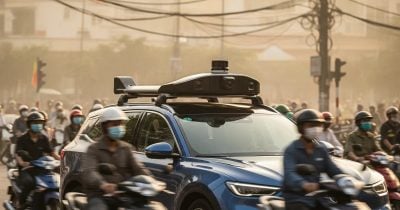
🧠VinFast has partnered with Nvidia and Autobrains to deploy Level 4 autonomous driving technology across Southeast Asia, positioning the region for advanced mobility solutions. The collaboration faces regulatory and market adaptation hurdles despite its potential to democratize self-driving capabilities in the region.
🏢 Nvidia
AIBullishCrypto Briefing · Jun 16/10
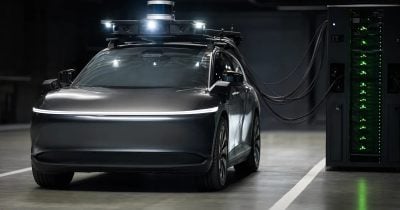
🧠Nvidia has launched Alpamayo 2 Super, an advanced open-source AI model designed specifically for autonomous vehicle applications and robotaxis. The release aims to democratize AI development in the autonomous mobility sector by making powerful models publicly available, potentially accelerating innovation and industry collaboration.
🏢 OpenAI🏢 Nvidia
AINeutralarXiv – CS AI · May 296/10
🧠Researchers present a comprehensive review of network optimization challenges in Connected and Autonomous Vehicles (CAVs), addressing misconceptions while outlining future directions through multidisciplinary approaches like cooperative perception. The article draws on extensive CAVs experience to provide practical insights and experimental results relevant to the industry's development.
AIBullisharXiv – CS AI · May 286/10
🧠Researchers developed SMamba-DDPG, a deep reinforcement learning framework that models how pedestrians behave differently when interacting with autonomous vehicles versus human-driven vehicles. The study found that pedestrians react faster to AVs and adopt lower crossing speeds, with AV interactions showing lower conflict rates than HDV scenarios.
AINeutralarXiv – CS AI · May 285/10
🧠Researchers propose a quantum machine learning framework for 6G vehicle-to-everything (V2X) communication that combines quantum neural networks, federated learning, and semantic communication to improve efficiency and robustness in autonomous transportation systems. The framework addresses limitations of classical ML in handling high-dimensional data, heterogeneous networks, and dynamic channel conditions.
AIBullisharXiv – CS AI · May 286/10
🧠Researchers propose a reinforcement learning framework that enables safer and more efficient transfer of AI agents from simulation to real-world deployment by using probabilistic latent embeddings and dynamic policy adaptation. The approach addresses the critical sim-to-real gap problem in cyber-physical systems like autonomous vehicles by inferring environment context and adjusting risk levels during deployment.
AIBullisharXiv – CS AI · May 286/10
🧠Researchers introduce DAROM, a reinforcement learning framework designed to handle stochastic communication delays in autonomous vehicle highway merging scenarios. The system uses a delay-aware encoder to maintain decision-making performance despite V2I transmission latencies up to 2.0 seconds, achieving over 99% success rates in high-density traffic conditions.
AINeutralarXiv – CS AI · May 286/10
🧠Researchers introduce HEART, a novel framework for efficient multi-model federated learning across vehicle-edge-cloud architectures that addresses training latency and resource allocation challenges in IoV systems. The solution combines hybrid synchronous-asynchronous aggregation with optimized task scheduling using particle swarm optimization and genetic algorithms.
AINeutralarXiv – CS AI · May 276/10
🧠This academic survey examines deep reinforcement learning (DRL) approaches for optimizing computational offloading in vehicular edge computing systems. The research classifies existing DRL strategies across learning paradigms, system architectures, and optimization objectives while identifying challenges in scalability and coordination for next-generation intelligent transportation systems.
AIBearishBlockonomi · May 126/10
🧠General Motors stock declined 4.45% to $75.29 following the company's announcement of significant IT workforce restructuring, which involves cutting 600 IT jobs while simultaneously hiring AI-focused talent. This strategic shift reflects GM's pivot toward artificial intelligence capabilities as a core competitive advantage in the automotive and autonomous vehicle sectors.
AINeutralarXiv – CS AI · May 126/10
🧠Researchers introduced TrajPrism, a comprehensive benchmark dataset combining 300K real urban trajectories with natural language annotations across three cities, enabling AI models to understand the alignment between physical travel paths and human descriptions of movement intent, constraints, and preferences.
AINeutralarXiv – CS AI · May 126/10
🧠Researchers introduce REAP, a reinforcement learning-based autonomous parking system that uses Gaussian Splatting to simulate real-world environments for training, then transfers the model to physical vehicles. The method addresses limitations of traditional multi-stage parking approaches by jointly optimizing perception and planning, achieving successful parking in extreme scenarios like mechanical slots.
AINeutralarXiv – CS AI · May 126/10
🧠Researchers propose a hierarchical reinforcement learning framework that combines multi-agent interaction reasoning with continuous motion control to improve behavioral realism in traffic simulations. The approach outperforms self-play methods by better capturing socially aware driving behaviors while maintaining safety and efficiency in closed-loop SUMO simulations.
AINeutralarXiv – CS AI · May 116/10
🧠Researchers present PAMPOS, a causal transformer-based system that detects misbehavior in Vehicle-to-Everything (V2X) networks by identifying deviations from learned normal driving patterns, achieving up to 98% AUC without requiring labeled attack data during training. This unsupervised approach addresses a critical security gap where cryptographic mechanisms alone cannot prevent insider falsification attacks in connected vehicle systems.
AIBullishCrypto Briefing · May 107/10
🧠Tesla achieved a coast-to-coast cannonball run using its Full Self-Driving (FSD) system without any human interventions, demonstrating significant progress in autonomous vehicle technology. While the milestone showcases rapid advancement in self-driving capabilities, broader commercial adoption will depend on proving consistent safety across diverse driving conditions and weather scenarios.
AINeutralArs Technica – AI · May 76/10
🧠Elon Musk attempted to recruit OpenAI founders to establish an AI division within Tesla, insisting on operational control as a condition of the partnership. The failed negotiation reveals tensions between Musk's ambitions to integrate advanced AI capabilities into Tesla and the independence priorities of OpenAI's leadership.
🏢 OpenAI
AINeutralTechCrunch – AI · Apr 196/10
🧠TechCrunch Mobility's latest edition focuses on Uber's strategic shift toward asset ownership and the growing role of AI in transportation. The article introduces a trend where mobility companies are moving away from pure asset-light models toward greater control of their operational infrastructure.
AINeutralarXiv – CS AI · Apr 156/10
🧠A comprehensive survey examines AI methodologies for simulating mixed autonomous and human-driven traffic, addressing critical gaps in current simulation tools. The research proposes a unified taxonomy of AI methods spanning agent-level behavior models, environment-level simulations, and physics-informed approaches to improve autonomous vehicle testing and validation.