y0news
AnalyticsDigestsSourcesTopicsRSSAICrypto

#chip-architecture News & Analysis

4 articles tagged with #chip-architecture. AI-curated summaries with sentiment analysis and key takeaways from 50+ sources.

4 articles
AIBullishCrypto Briefing · Jun 17/10
🧠

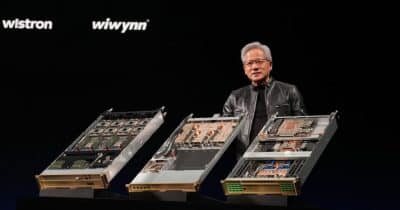
Nvidia CEO Jensen Huang unveils Vera Rubin production timeline at GTC Taipei 2026

Nvidia CEO Jensen Huang announced the production timeline for the Vera Rubin platform at GTC Taipei 2026, a chip architecture designed to significantly reduce AI inference costs. The platform could reshape economics in the AI industry by lowering computational expenses and altering market expectations for AI deployment.

Nvidia CEO Jensen Huang unveils Vera Rubin production timeline at GTC Taipei 2026
🏢 Nvidia
GeneralNeutralCrypto Briefing · May 297/10
📰

Huawei plans to narrow semiconductor gap with TSMC using novel chip architecture

Huawei is developing a novel chip architecture strategy to reduce its semiconductor performance gap with TSMC amid US export restrictions. This approach could challenge existing global supply chain dynamics and reshape competitive positioning in the semiconductor industry.

Huawei plans to narrow semiconductor gap with TSMC using novel chip architecture
AIBullishIEEE Spectrum – AI · Mar 167/10
🧠

With Nvidia Groq 3, the Era of AI Inference Is (Probably) Here

Nvidia announced the Groq 3 LPU at GTC 2024, its first chip specifically designed for AI inference rather than training, incorporating technology licensed from startup Groq for $20 billion. The chip uses SRAM memory integrated within the processor to achieve 7x faster memory bandwidth than traditional GPUs, optimizing for the low latency required for real-time AI inference applications.

With Nvidia Groq 3, the Era of AI Inference Is (Probably) Here
🏢 Nvidia
AINeutralarXiv – CS AI · May 46/10
🧠

Silicon Showdown: Performance, Efficiency, and Ecosystem Barriers in Consumer-Grade LLM Inference

A technical study comparing Nvidia and Apple Silicon for running large language models locally reveals fundamental architectural trade-offs: Nvidia achieves higher throughput through specialized quantization but faces memory constraints requiring aggressive model compression, while Apple's unified memory architecture scales more efficiently with superior energy performance. The research highlights ecosystem fragmentation as a major barrier for consumer adoption of datacenter-scale AI inference.

🏢 Nvidia