AIBullisharXiv – CS AI · Jun 96/10
🧠Researchers present OrderPlace, an AI framework that optimizes macro placement sequencing in chip design by using large language models to discover superior ordering strategies. The work demonstrates that placement order significantly impacts solution quality in physical design, with novel sequences achieving 34% wirelength reduction compared to existing methods.
AIBullisharXiv – CS AI · Jun 46/10
🧠HighTide is an open-source AI-assisted VLSI benchmark suite designed to standardize hardware design testing across multiple languages and technology nodes. The platform combines automated compilation infrastructure with AI agent curation to streamline chip design workflows and maintain long-term optimization records.
AINeutralarXiv – CS AI · May 286/10
🧠Researchers introduce AssertLLM2, an open-source benchmark containing 83 real-world hardware designs to evaluate how well Large Language Models can automatically generate formal SystemVerilog Assertions from specifications. The benchmark uniquely incorporates buggy RTL variants to assess both bug prevention and bug detection capabilities, establishing more rigorous evaluation standards for LLM-assisted hardware verification.
AIBullisharXiv – CS AI · May 276/10
🧠Researchers propose RulePlanner, a deep reinforcement learning framework that unifies the handling of complex hardware design rules in 3D integrated circuit floorplanning. The approach addresses a critical bottleneck in chip design by automating compliance with multiple design rules simultaneously, reducing manual post-processing and accelerating the path from design to manufacturing.
AIBullisharXiv – CS AI · May 126/10
🧠Researchers have developed TRAM, a technique that jointly optimizes low-power approximate multiplier structures with AI model training parameters, achieving up to 27% power reduction in vision transformers without significant accuracy loss. This approach differs from prior methods by integrating hardware design with model training rather than designing multipliers separately.
AINeutralarXiv – CS AI · May 126/10
🧠This research paper presents a task-aligned framework for applying Graph Neural Networks (GNNs) to Electronic Design Automation (EDA) problems, arguing that successful implementations require architectural alignment with the underlying mathematics of each specific chip design task. The authors systematize how different EDA challenges—from timing analysis to routing and power delivery—demand distinct GNN computation patterns, identifying current mismatches and failure modes that will likely shape future development.
AIBullishCrypto Briefing · May 116/10
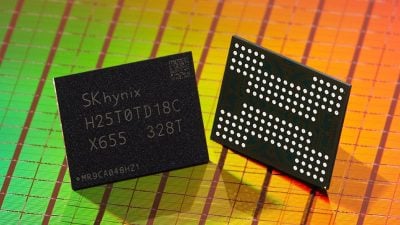
🧠SK Hynix and Intel have partnered on 2.5D packaging technology to integrate HBM (High Bandwidth Memory) with logic chips, a development expected to reduce GPU production costs and improve computational efficiency. This collaboration has significant implications for high-performance computing sectors, including AI infrastructure and data center operations.
AINeutralarXiv – CS AI · May 116/10
🧠Researchers introduce PostEDA-Bench, a hierarchical benchmark for evaluating LLM-based agents in Electronic Design Automation tasks, specifically targeting Design Rule Check (DRC) fixing and Power-Performance-Area (PPA) optimization. Testing eight LLMs across 145 tasks reveals significant performance gaps, with best success rates of 36.66% for complex DRC reasoning and only 20% for multi-objective PPA optimization, indicating substantial room for improvement in AI-assisted chip design automation.
AIBullishThe Register – AI · May 36/10
🧠AI chip startups are experiencing renewed opportunities in the inference market as demand for AI model deployment accelerates. Unlike the training chip market dominated by NVIDIA, inference represents a less consolidated opportunity where specialized startups can compete effectively with custom silicon solutions.
AIBullishBlockonomi · Mar 256/10
🧠Arm Holdings stock surged 12% following the announcement of its first in-house AI chip development and an analyst upgrade from Raymond James to Outperform with a $166 price target. This marks a significant strategic shift for the chip design company into direct hardware development in the AI sector.
AIBullisharXiv – CS AI · Mar 37/107
🧠ATLAS is a new AI-driven framework that uses large language models to automate System-on-Chip (SoC) security verification by converting threat models into formal verification properties. The system successfully detected 39 out of 48 security weaknesses in benchmark tests and generated correct security properties for 33 of those vulnerabilities.
AINeutralFortune Crypto · May 295/10
🧠A previously obscure semiconductor company has won a prestigious entrepreneur contest that previously recognized industry leaders like Jensen Huang and Michael Dell, signaling potential shifts in recognition of emerging players in the semiconductor sector. The achievement highlights growing competition and innovation in chip design and manufacturing as demand from AI and other sectors intensifies.
AINeutralHugging Face Blog · Oct 103/105
🧠Arm announces its participation at the PyTorch Conference, indicating the chip designer's continued involvement in the AI and machine learning ecosystem. The announcement appears to be a simple conference participation notice without additional details about specific presentations or initiatives.