AIBullishTechCrunch – AI · Jun 116/10
🧠DoorDash has launched Ask DoorDash, an AI chatbot that enables users to order food and goods using natural language prompts and photo uploads rather than traditional browsing. This advancement streamlines the ordering experience by allowing customers to describe what they want in their own words, reducing friction in the discovery and cart-building process.
AIBullisharXiv – CS AI · Jun 116/10
🧠Researchers identify and solve a critical limitation in full-duplex spoken language models: state inertia that causes them to miss user interruptions. Using activation steering without fine-tuning, they improve interruption comprehension from 28% to 45% correctness, demonstrating a training-free method to enhance real-time conversational AI.
AINeutralarXiv – CS AI · Jun 115/10
🧠Researchers conducted a systematic study on emotion recognition in conversation using the IEMOCAP dataset, identifying that conversational context dominates performance but saturates within 10-30 preceding turns. The study reveals that hierarchical sentence representations and external affective lexicons provide minimal additional benefit, while discourse-marker analysis shows sadness correlates with reduced left-periphery markers, suggesting emotional states vary in context-dependency.
AINeutralarXiv – CS AI · Jun 106/10
🧠Researchers propose Self-EmoQ, an emotion-planning framework that determines emotional context before text generation to improve streaming emotional text-to-speech synthesis. The system uses reinforcement learning with Plutchik's emotion theory and demonstrates superior performance on multiple dialogue datasets, with a functional real-time deployment pipeline.
AINeutralarXiv – CS AI · Jun 106/10
🧠A research perspective examines how foundation models are being integrated into care robots for elderly and patient assistance, finding that while these systems show promise in engagement and usability, they suffer from reliability issues and lack evidence of meaningful clinical outcomes. The study emphasizes the need for care-specific evaluation standards and accountable autonomy before these technologies can be responsibly deployed in healthcare workflows.
AINeutralarXiv – CS AI · Jun 106/10
🧠Researchers introduce CRADLE-Dialogue, a clinician-annotated benchmark dataset with 600 dialogues for detecting mental health crises in real-time conversations. The study reveals that identifying when risk emerges in multi-turn dialogues is significantly harder than recognizing risk exists, with models achieving only 40-60% F1 scores, and releases a 32B-parameter model competitive with proprietary alternatives.
AINeutralarXiv – CS AI · Jun 105/10
🧠Researchers developed a pipeline using GPT-4 and few-shot learning to map student questions from conversational AI teaching assistants to curriculum topics, achieving 80% classification accuracy. The classified question data correlates with student-reported difficulty levels, demonstrating that AI interaction logs can serve as diagnostic tools for identifying knowledge gaps and informing instructional design.
🧠 GPT-4
AINeutralarXiv – CS AI · Jun 106/10
🧠Researchers investigated how perceived personality traits vary across different conversational contexts, finding that acoustic and non-verbal features better predict personality dimensions than speaker embeddings. The study reveals that personality perception is situational rather than static, with stress levels significantly influencing how traits like neuroticism are perceived.
AINeutralarXiv – CS AI · Jun 96/10
🧠Researchers analyzed how multimodal large language models (MLLMs) perform in repeated reference games compared to humans, finding that while agents align on vocabulary labels, they lack true partner-specific conventions. Using a novel constrained pseudo-dyad baseline, they discovered agents succeed through verbose descriptions rather than the compressed, history-dependent expressions humans develop through entrainment.
AINeutralarXiv – CS AI · Jun 95/10
🧠Researchers present MO-PQUCB, a novel algorithm for personalized multi-objective decision-making that combines conversational queries with bandit feedback to learn user preferences more efficiently. The method uses a Plackett-Luce choice model and shift-invariant regularization to overcome fundamental learning barriers, demonstrating improved regret scaling and robustness to corrupted preference signals compared to existing approaches.
AIBullisharXiv – CS AI · Jun 96/10
🧠WhiteTesseract combines extended reality (XR) and conversational AI to enhance cultural heritage exhibitions by enabling personalized, context-aware interpretation of artworks while preserving the physical viewing experience. A controlled study at a Monet exhibition demonstrated that the system nearly tripled average viewing time (35.3 to 98.3 seconds) and prompted 60% of visitor-AI interactions to move beyond factual queries into analytical and emotional engagement.
🧠 Claude
AINeutralArs Technica – AI · Jun 86/10
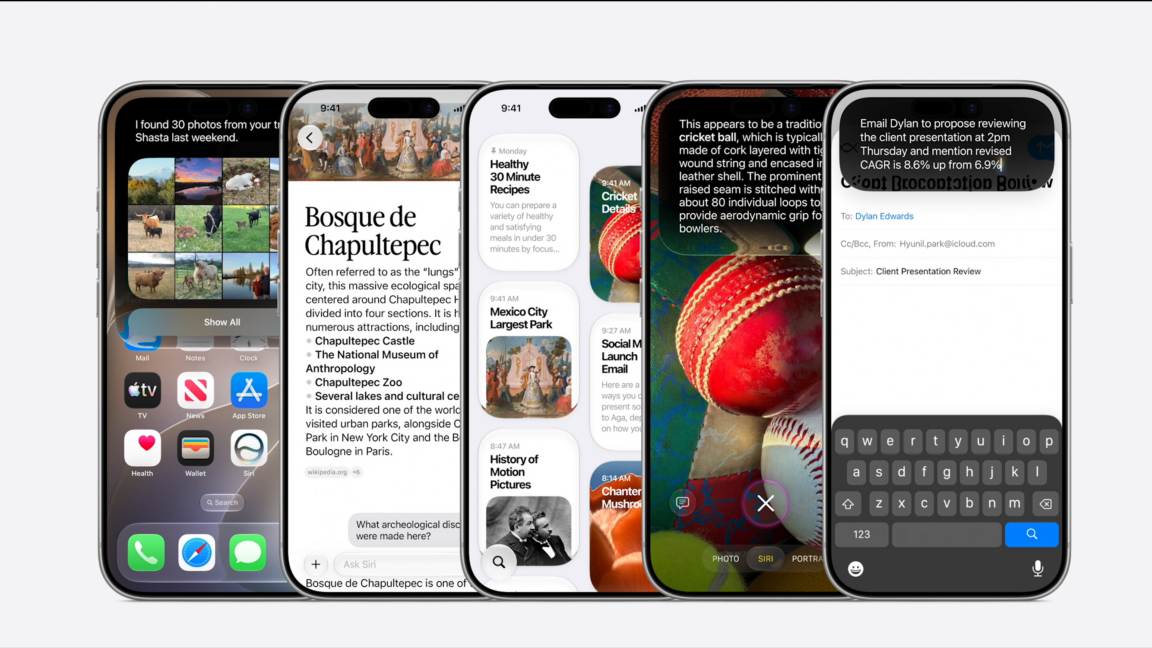
🧠Apple announced an enhanced Siri voice assistant featuring improved conversational capabilities, launching this fall with a two-tiered AI model architecture powered by Google technology. The update represents Apple's strategic shift toward more natural, context-aware voice interactions while leveraging external AI infrastructure.
AIBullishCrypto Briefing · Jun 56/10
🧠OpenAI has launched a 'Dreaming V3' upgrade that introduces an advanced memory system for ChatGPT, enabling the AI to retain and leverage user interaction history for more personalized and contextually aware conversations. This development enhances ChatGPT's ability to provide customized experiences by maintaining persistent memory across sessions.
🏢 OpenAI🧠 ChatGPT
AINeutralarXiv – CS AI · Jun 56/10
🧠Researchers introduce ProSarc, an audio-only machine learning framework that detects sarcasm by analyzing temporal mismatches between local prosodic patterns and overall emotional tone. The model achieves strong performance on multiple datasets (F1=75.3 on MUStARD++) and demonstrates cross-lingual generalization, advancing computational understanding of spoken sarcasm detection.
AIBullisharXiv – CS AI · Jun 56/10
🧠Researchers introduce camroll, a dataset and AI agent system designed to answer questions about personal photo libraries by retrieving and analyzing relevant images from users' camera rolls. The camroll-agent uses hierarchical memory and specialized tools to handle long-context visual reasoning across thousands of personalized images, outperforming existing baselines in understanding user-specific visual content.
AINeutralarXiv – CS AI · Jun 56/10
🧠Researchers study how Large Language Models deployed as Artificial Moral Advisors should communicate with users discussing ethical dilemmas, proposing three uncertainty-focused conversation strategies and finding that different approaches sustain distinct quality levels of engagement rather than producing uniform belief revision.
AINeutralarXiv – CS AI · Jun 56/10
🧠Researchers propose a conversational motivational architecture for AGI systems that reinterprets traditional cognitive AI frameworks for dialogue-based agents. Rather than regulating bodily needs, the system manages competence, uncertainty, affiliation, and aesthetic coherence through a ten-stage processing pipeline that separates emotional appraisal from decision-making.
AIBullisharXiv – CS AI · Jun 46/10
🧠Researchers introduce SaliMory, a framework that trains language models to manage structured memory for conversational AI agents through hierarchical reward processes and contrastive refinement. The approach reduces memory-related failures by one-third and achieves over 10% improvement in accuracy while doubling personalization rates.
AINeutralarXiv – CS AI · Jun 46/10
🧠Researchers introduce MemoryDocDataSet, a new benchmark for evaluating AI systems that must simultaneously handle multi-session conversational memory and long document reasoning. The synthetic dataset reveals a significant performance gap in current architectures, with the best baseline achieving only 35.8% F1 on tasks requiring joint memory-document navigation.
AINeutralarXiv – CS AI · Jun 46/10
🧠Researchers introduce SegTreeMem, a novel memory architecture for long-horizon conversational AI agents that organizes conversation history using temporally-ordered segment trees instead of purely semantic similarity. The system demonstrates improved performance across multiple benchmarks by preserving chronological order while enabling hierarchical retrieval, with ablation studies confirming that temporal sequencing is critical to the approach's effectiveness.
AINeutralarXiv – CS AI · Jun 46/10
🧠Researchers present a novel approach to training task-oriented dialogue agents that enables proactive behavior through a Cognitive User Simulator and asymmetric policy optimization. The method addresses a fundamental limitation in LLM-based dialogue systems by conditioning agent responses on modeled user concerns, achieving persuasive capabilities beyond what traditional reinforcement learning methods can accomplish.
AINeutralarXiv – CS AI · Jun 26/10
🧠Researchers introduce NBQ (Next-Best-Question), a conversational AI framework that dynamically profiles users by asking strategically optimized questions to maximize information gain. The system improves user profiling accuracy by up to 14% and includes QuickMatch, an efficient retrieval layer for reciprocal matching that accelerates search by 22.9x, with applications in hiring, marketplaces, and dating platforms.
AINeutralarXiv – CS AI · Jun 26/10
🧠Researchers introduce MASCOT, a multi-agent framework designed to address persona collapse and social sycophancy in AI companion systems through bi-level optimization. The system improves persona consistency by up to 14.1% and social contribution by 10.6% compared to existing approaches, advancing the development of more distinct and productive multi-agent dialogue systems.
AINeutralarXiv – CS AI · Jun 16/10
🧠HypoAgent is a new AI framework that uses multiple specialized agents to generate logical hypotheses from knowledge graphs through interactive dialogue. The system excels at understanding evolving user intent across multi-turn conversations and diagnosing why generated hypotheses fail, achieving state-of-the-art performance on both commonsense and biomedical knowledge graphs.
AINeutralarXiv – CS AI · Jun 16/10
🧠A research study examining how AI personalization and conversational warmth influence user trust and reliance reveals that contextualization alone reduces AI persuasiveness, but combining it with warmth restores persuasive power. The findings indicate users tend to defer to AI over human expert judgment regardless of interface design, though AI literacy creates a disconnect between stated trust and actual behavior.