CryptoBearishU.Today · Mar 77/10
⛓️Researcher Justin Bons has raised concerns that quantum computing technology could potentially break the privacy features of privacy-focused cryptocurrencies Zcash and Monero in the future. This highlights a potential long-term vulnerability in current cryptographic protocols used by these privacy coins.
AI × CryptoBearishCoinTelegraph – AI · Mar 67/10
🤖Construction has begun on a PsiQuantum quantum computing facility that could potentially have enough power to break Bitcoin's cryptography. However, PsiQuantum co-founder Terry Rudolph stated in July that the company has no plans to attack Bitcoin, even if the facility becomes capable of breaking blockchain cryptography.
$BTC
CryptoBullisharXiv – CS AI · Mar 57/10
⛓️Researchers propose a new offline CBDC payment system using IoT devices that integrates zero-knowledge proofs and secure elements for privacy-preserving transactions. The system addresses challenges of resource-constrained IoT devices while enabling secure digital payments without internet connectivity, particularly for underserved communities.
CryptoBullishBitcoinist · Mar 57/10
⛓️Blockstream Research has successfully deployed post-quantum signature verification on its Liquid Bitcoin sidechain, marking the first real transactions on a production Bitcoin sidechain signed with quantum-resistant cryptography. This development demonstrates that quantum-resistant tools can be tested in live environments, providing a foundation for future Bitcoin infrastructure upgrades.
$BTC
AINeutralarXiv – CS AI · Mar 47/103
🧠Researchers have discovered that language models produce outputs with unique geometric signatures that lie on high-dimensional ellipses, which can be used to identify the source model. This signature is forgery-resistant and naturally occurring, potentially enabling cryptographic-like verification of AI model outputs.
CryptoBearishU.Today · Feb 277/105
⛓️Ledger's CTO and other experts are warning that quantum computers could eventually become powerful enough to break Elliptic Curve cryptography, which would pose a significant threat to cryptocurrency security. This emerging risk highlights a potential vulnerability in current blockchain infrastructure that could impact the entire crypto ecosystem.
$CRV
CryptoBullishUnchained · Feb 277/103
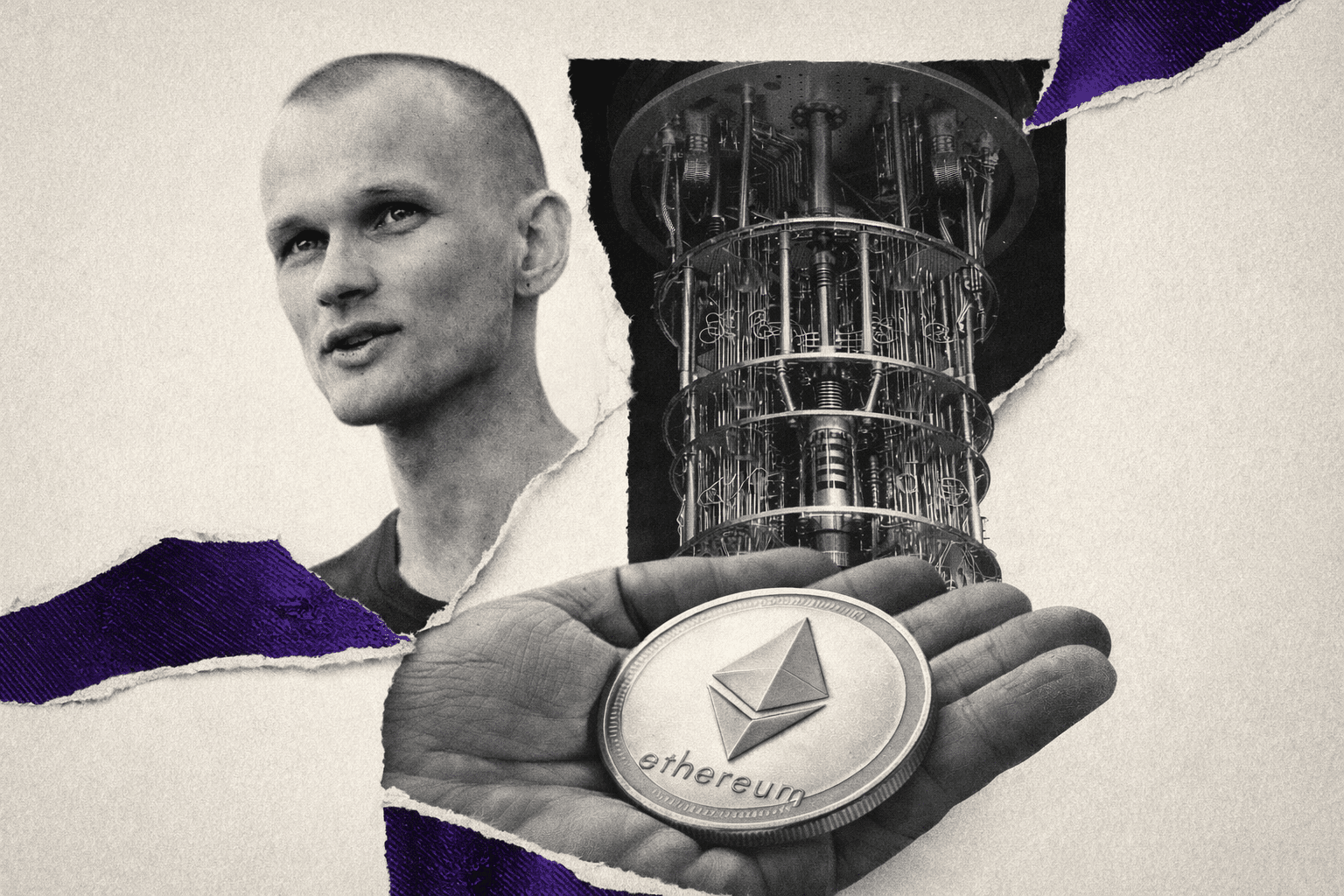
⛓️Vitalik Buterin has outlined a quantum defense strategy for Ethereum to protect the network against future quantum computing threats. The proposal aims to implement quantum-resistant cryptographic measures to safeguard Ethereum's infrastructure and user funds from potential quantum attacks.
$ETH
CryptoBullishDecrypt – AI · Feb 267/107
⛓️Ethereum co-founder Vitalik Buterin has presented a detailed roadmap for upgrading Ethereum's cryptographic infrastructure to defend against quantum computing threats. The phased approach targets replacing four core vulnerable cryptographic components that could be compromised by future quantum computers.
$ETH
CryptoBullishU.Today · Feb 267/103
⛓️Ethereum co-founder Vitalik Buterin has outlined a comprehensive 'bundle' strategy aimed at overhauling Ethereum's consensus mechanism and security infrastructure. The proposal focuses on preparing the network for post-quantum computing threats that could potentially compromise current cryptographic security measures.
$ETH
AI × CryptoNeutralBankless · Feb 137/107
🤖The article argues that Ethereum's cryptographic infrastructure could serve as crucial safety mechanisms as corporate AI systems face increasing safety challenges and failures. This positions blockchain technology as a potential solution to AI governance and safety concerns.
$ETH
CryptoBullishBankless · Feb 137/107
⛓️Bitcoin Improvement Proposal (BIP) 360 has been officially merged into the Bitcoin repository, marking a significant step toward preparing Bitcoin for post-quantum cryptography. This development addresses the potential future threat that quantum computers could pose to Bitcoin's current cryptographic security.
$BTC
CryptoBullishEthereum Foundation Blog · Jul 317/103
⛓️Ethereum celebrates its 10th anniversary with the unveiling of 'lean Ethereum' as a vision for the next decade. The initiative aims to achieve millions of transactions per second while maintaining security and decentralization through next-generation cryptography, positioning Ethereum for quantum-resistant scalability.
$ETH
CryptoBullishEthereum Foundation Blog · Jan 237/102
⛓️The KZG Ceremony completed as the largest multi-party computation by participant count, creating a secure cryptographic foundation for EIP-4844. The ceremony used an open and accessible process to establish this crucial infrastructure for Ethereum's scaling improvements.
AI × CryptoBullishHugging Face Blog · Aug 27/106
🤖The article discusses the development of encrypted large language models using Fully Homomorphic Encryption (FHE) technology. This approach would allow AI models to process data while keeping it encrypted, potentially addressing privacy concerns in AI applications.
CryptoBullishEthereum Foundation Blog · Dec 157/103
⛓️The Protocol Support team is organizing a grant round to support Ethereum's upcoming KZG Ceremony, a public cryptographic ritual that will provide foundational infrastructure for Ethereum scaling solutions including EIP-4844. The ceremony represents a critical step in Ethereum's scaling roadmap and proto-danksharding implementation.
$ETH
CryptoBullishEthereum Foundation Blog · Apr 147/102
⛓️The Ethereum Foundation has significantly expanded its security team over the past year, adding researchers and engineers from diverse backgrounds including cryptography, security architecture, and exploit development. This expansion represents a major investment in strengthening Ethereum's security infrastructure through dedicated expertise from both offensive and defensive security specialists.
$ETH
CryptoBullishEthereum Foundation Blog · Dec 187/103
⛓️Jutta announces a security audit setup prior to Ethereum's genesis block release. Ethereum will launch following a comprehensive security review by experts in IT security, cryptography and blockchain technology.
$ETH
CryptoBullishU.Today · Jun 256/10
⛓️Researchers have identified that Satoshi Nakamoto's early distribution strategy of spreading 22,000 bitcoins across multiple wallets in 2010 may have been a deliberate safeguard against future quantum computing threats. The analysis suggests this fragmentation approach mathematically reduces the vulnerability of Bitcoin's security model to quantum attacks.
$BTC
AINeutralarXiv – CS AI · Jun 256/10
🧠TL++ is a new distributed machine learning framework that enables training across isolated data sources while maintaining privacy and reducing communication overhead. The system uses secret-sharing techniques to protect sensitive activations while achieving superior accuracy compared to federated and split-learning baselines, demonstrating 13x communication reduction on CIFAR-10.
AINeutralarXiv – CS AI · Jun 256/10
🧠Researchers introduce FactorLibrary, a reinforcement learning framework that discovers minimal arithmetic circuits for polynomials over finite fields by storing reusable subexpressions as subgoals. Using PPO+MCTS agents, the system achieves 91.8% success rate in finding certified optimal circuits, addressing a combinatorially hard problem in algebraic complexity theory.
CryptoBullishBlockonomi · Jun 246/10
⛓️Crypto casinos leverage provably fair technology to enable users to independently verify bet outcomes, contrasting sharply with traditional online casinos that rely on regulatory oversight and third-party audits. This innovation uses cryptographic hashing and blockchain verification to create transparent, tamper-proof gambling systems where players can mathematically confirm fairness without trusting centralized operators.
🏢 Meta
AINeutralarXiv – CS AI · Jun 236/10
🧠Researchers introduce π-RAG, a novel retrieval architecture that protects sensitive data in Large Language Models by using the digits of pi as an oblivious indirection layer, eliminating direct exposure of vector embeddings to inversion attacks. The system combines semantic quantization with cryptographic salting to enable privacy-preserving retrieval for compliance-heavy sectors like finance and healthcare.
AINeutralarXiv – CS AI · Jun 236/10
🧠Researchers introduce Prime Fourier Embeddings (PFE), a neural representation method that encodes integers using prime-indexed trigonometric pairs to expose algebraic structure in modular arithmetic. The approach achieves perfect accuracy on modular tasks with specialized neural channels corresponding to individual primes, validated through ablation studies showing 500x specialization ratios between relevant and irrelevant channels.
AI × CryptoNeutralBitcoin Magazine · Jun 226/10
🤖President Trump has signed executive orders to accelerate quantum computing development and post-quantum encryption timelines in the United States. This policy shift raises important questions about Bitcoin's long-term cryptographic security, as quantum computers could theoretically compromise current encryption standards that protect cryptocurrency networks.
$BTC
CryptoNeutralcrypto.news · Jun 206/10
⛓️Binance founder CZ has proposed freezing up to 1 million Bitcoin attributed to Satoshi Nakamoto if the coins remain unmoved after Bitcoin transitions to quantum-resistant cryptography. The proposal aims to prevent potential theft of these early bitcoins by quantum computers, addressing growing security concerns around cryptographic vulnerabilities in the blockchain.
$BTC