#cybersecurity News & Analysis
Recent coverage of #cybersecurity reflects a divided outlook, with 37.5% bearish sentiment balanced against 25% bullish views across 72 articles published in the last 30 days. Sentiment has remained stable compared to the previous quarter, suggesting persistent concerns without dramatic shifts in market perception.
Anthropic and OpenAI feature prominently in discussions alongside #cybersecurity, particularly regarding AI security implications and safety considerations. Academic research from arXiv dominates the source landscape, while cryptocurrency outlets and business publications also contribute significantly to the conversation. Explore the articles below for current developments and perspectives shaping this sector.
sentiment · last 30d (72 articles)Top sources:arXiv – CS AI · 109Crypto Briefing · 17Fortune Crypto · 14Blockonomi · 11OpenAI News · 7
Most-discussed entities:Anthropic · 19OpenAI · 8GPT-5 · 6Claude · 5ChatGPT · 2
GeneralBearishFortune Crypto · May 277/10
📰The UK's GCHQ director warns that the window for Western nations to maintain technological superiority over China and Russia is closing rapidly, with cybersecurity requiring dramatically increased urgency and investment. China is characterized as an advanced science and tech superpower with sophisticated intelligence capabilities, signaling escalating geopolitical competition in critical infrastructure and digital domains.
CryptoBearishU.Today · May 277/10
⛓️Microsoft Threat Intelligence has identified a sophisticated cryptojacking campaign targeting PC gamers and hardware enthusiasts, exploiting their high-end systems to mine cryptocurrency without consent. This threat highlights the ongoing security risks in the cryptocurrency ecosystem and the targeting of users with valuable computational resources.
GeneralBearishDaily Hodl · May 267/10
📰Radiology Associates of Richmond suffered a data breach affecting 266,183 individuals, exposing personal identification numbers, financial information, and health records. The breach occurred in July 2025 but wasn't discovered until April 2026, highlighting significant delays in breach detection within the healthcare sector.
AIBearishImport AI (Jack Clark) · May 187/10
🧠Import AI 457 explores three significant AI security and research topics: a 20+ year old computer virus (Fast16) potentially used in weapons programs, optimization challenges in AI training systems, and advances in AI alignment research. The article highlights emerging security concerns around AI systems and historical precedents for sophisticated cyber attacks.
AI × CryptoBearishcrypto.news · May 12🔥 8/10
🤖Google has identified the first documented zero-day attack leveraging AI to bypass two-factor authentication (2FA) security mechanisms. This development signals an escalation in attack sophistication and poses significant risks to cryptocurrency wallets, AI agents, and broader digital security infrastructure globally.
AIBearisharXiv – CS AI · May 127/10
🧠Researchers present a comprehensive framework for systematically generating, categorizing, and evaluating jailbreak attacks against large language models, introducing a dataset of 114,000 adversarial prompts, automated generation methods, and a novel continuous evaluation metric (OPTIMUS) that surpasses binary success rate measurements.
🏢 Perplexity
AIBearishDecrypt · May 117/10
🧠Google's threat intelligence team confirmed that cybercriminals have successfully used AI models to discover and exploit a previously unknown zero-day vulnerability that bypasses two-factor authentication. This represents a significant escalation in attack sophistication, demonstrating how AI tools are being weaponized to automate vulnerability discovery and exploitation at scale.
AI × CryptoBearishCrypto Briefing · May 11🔥 8/10
🤖Google has issued a warning that hackers are leveraging artificial intelligence to develop zero-day exploits in preparation for coordinated cyberattacks on a large scale. This development highlights the escalating sophistication of cyber threats and underscores the urgent need for strengthened global cybersecurity infrastructure to safeguard critical systems and sensitive information.
AIBearishThe Verge – AI · May 117/10
🧠Google's Threat Intelligence Group discovered and blocked the first known zero-day exploit developed with AI assistance, which cybercriminals planned to use for mass exploitation of an open-source web administration tool to bypass two-factor authentication. Google identified AI involvement through telltale signs in the Python script, including hallucinated CVSS scores and LLM-style formatting, marking a significant escalation in AI-enabled cyber threats.
GeneralBearishFortune Crypto · May 117/10
📰Google has detected hackers actively using AI to enhance cyberattacks and breach computer systems, confirming long-standing security concerns about weaponized artificial intelligence. The discovery signals that the predicted convergence of AI capabilities with malicious intent has moved from theoretical risk to operational reality, potentially expanding the threat landscape for individuals and organizations worldwide.
GeneralBearishDaily Hodl · May 117/10
📰Cybersecurity firm iZOO Logic has identified BankGhost Builder, a malware-as-a-service threat advertised on Telegram that targets over 700 banks globally. The tool enables criminals to steal banking credentials and hijack user accounts, representing a significant evolution in financial cybercrime infrastructure.
AIBearisharXiv – CS AI · May 117/10
🧠A research paper examines how agentic AI systems are fundamentally lowering the cost and complexity of cyber attacks by automating reconnaissance, phishing, credential abuse, and exploit adaptation. The analysis forecasts significant security risks for enterprises and mid-market organizations through 2028, recommending immediate defensive priorities including identity management, patch velocity, and agent governance.
CryptoBearishBitcoinist · May 97/10
⛓️Chaos Labs disclosed a sophisticated wallet attack attempt over the weekend, believed to be carried out by a nation-state actor. In response, multiple crypto firms are switching oracle providers, with borrowing platform Tydro moving to Chainlink, highlighting growing security concerns across the industry.
$LINK
AIBullisharXiv – CS AI · May 97/10
🧠Researchers demonstrate that fine-tuned small language models (SLMs) can outperform larger language models for Windows event log analysis while requiring significantly fewer computational resources. The study creates a synthetic dataset with remediation actions and shows SLMs deliver superior issue identification and actionable solutions, presenting a practical alternative to cloud-dependent LLMs for enterprise security operations.
AI × CryptoBearishCrypto Briefing · May 97/10
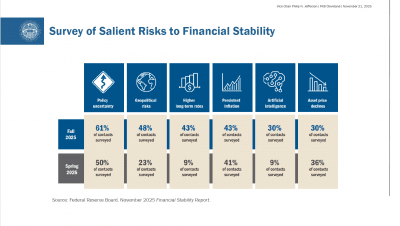
🤖The Federal Reserve's Spring 2026 survey identifies geopolitical tensions and artificial intelligence risks as primary threats to financial stability. These concerns could disrupt energy markets, compromise cybersecurity infrastructure, and reshape employment dynamics across the global economy.
CryptoBearishcrypto.news · May 87/10
⛓️U.S. courts have sentenced two laptop farm operators who facilitated North Korean IT workers' access to cryptocurrency and other firms. This enforcement action reflects escalating concerns about insider threats and state-sponsored infrastructure being leveraged to breach crypto platforms and corporate systems.
DeFiBearishcrypto.news · May 87/10
💎Chaos Labs, a prominent oracle infrastructure provider, activated emergency security protocols after detecting a suspected nation-state cyberattack over the weekend. The company reports its core oracle systems remained secure despite the incident, raising concerns about the vulnerability of critical infrastructure in the decentralized finance ecosystem.
AI × CryptoBearishDecrypt · May 77/10
🤖The IMF has warned that artificial intelligence tools are dramatically lowering barriers to entry for cyberattacks on financial infrastructure, enabling even unskilled attackers to breach critical systems. The organization is calling for cybersecurity to be elevated to a core financial stability issue as AI-enhanced threats pose systemic risks to global markets.
AI × CryptoBearishFortune Crypto · May 77/10
🤖Stripe CEO Patrick Collison has flagged widespread token theft as a critical threat to AI startups, warning that the security crisis is forcing companies to reconsider offering free trials and other customer acquisition strategies. The surge in token theft incidents reveals a fundamental vulnerability in how AI systems handle authentication and access management, potentially constraining growth for early-stage companies in the sector.
AIBearisharXiv – CS AI · May 77/10
🧠Researchers demonstrate that machine learning models can infer sensitive personal information like age, gender, location, and personality traits from public music playlists with high accuracy. The study introduces musicPIIrate, an offensive AI tool using deep learning and graph neural networks, alongside JamShield, a defensive framework that injects dummy playlists to obscure identifying signals and reduce inference accuracy by 10% on average.
$OCEAN
AI × CryptoBearishCrypto Briefing · May 47/10
🤖April 2024 recorded $600 million in cryptocurrency thefts across hacking incidents, marking a concerning peak in digital asset security breaches. The discussion highlights AI's dual role as both a cybersecurity threat and defensive tool, with industry experts advocating for a shift toward offensive security strategies to combat increasingly sophisticated attacks.
CryptoBullishU.Today · May 47/10
⛓️Ripple has partnered with the Crypto Information Sharing and Analysis Center (Crypto ISAC) to counter sophisticated cyberattacks originating from North Korea. This collaboration represents the blockchain industry's coordinated response to escalating state-sponsored threats targeting digital asset infrastructure.
$XRP
CryptoBearishU.Today · May 47/10
⛓️North Korea has issued a formal denial regarding accusations of conducting widespread international cryptocurrency hacks. The denial represents a geopolitical development with potential implications for global cybersecurity frameworks and crypto asset security protocols.
CryptoBullishCrypto Briefing · May 37/10
⛓️Dennis Porter argues that Bitcoin serves as a critical national security tool, with US lawmakers increasingly supporting domestic mining initiatives. He contends that proof-of-work mechanisms deter digital spam while economic barriers inherent in cryptocurrency mining strengthen cybersecurity defenses.
$BTC
CryptoBullishBlockonomi · May 37/10
⛓️Galaxy Digital's Alex Thorn reports that the Bitcoin community has reached consensus on addressing quantum computing threats, with broad agreement to leave Satoshi Nakamoto's coins untouched while enabling active participants to upgrade to post-quantum cryptographic solutions. The analysis reveals that Satoshi's estimated 22,000 Bitcoin addresses make a comprehensive quantum attack significantly more difficult than commonly feared.
$BTC