AINeutralarXiv – CS AI · Jun 237/10
🧠Researchers propose a three-layer framework integrating large language models with digital twins and automation systems to enable adaptive industrial autonomous systems. The TPSR model transforms user tasks into executable processes through LLM-based reasoning, demonstrated across five peer-reviewed studies with prototypes showing improved task executability and reduced manual effort.
AIBullisharXiv – CS AI · Jun 117/10
🧠AI4Land presents a deep learning framework using U-Net architecture to generate high-resolution reconstructions of historical land use and cover data by combining coarse satellite imagery with geophysical features. The system aims to reduce uncertainties in climate modeling and carbon cycle projections while enabling real-time coupling with digital twin platforms for climate simulation.
AIBullishArs Technica – AI · Jun 17/10
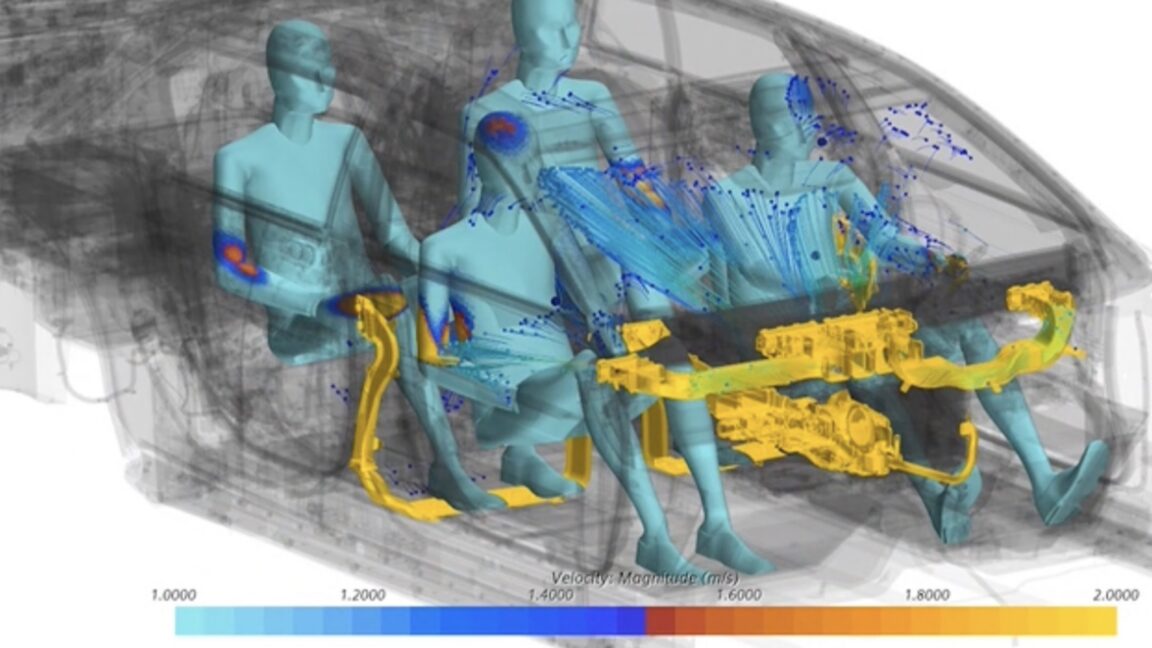
🧠General Motors is leveraging AI and machine learning to dramatically accelerate vehicle development cycles, reducing computational simulation time from 15 hours to one minute through advanced virtualization techniques including CFD, FEA, and digital twins. This technological shift demonstrates how AI adoption in traditional manufacturing can create substantial efficiency gains and competitive advantages in automotive design and production.
AIBullisharXiv – CS AI · May 297/10
🧠Researchers introduce Battery-Sim-Agent, an LLM-based framework that uses AI agents to estimate battery parameters by mimicking scientific reasoning rather than traditional black-box optimization. The system outperforms conventional methods like Bayesian optimization on benchmark tests and demonstrates practical applicability on real-world battery datasets, representing a novel approach to accelerating battery innovation through physics-informed AI reasoning.
AINeutralarXiv – CS AI · Mar 127/10
🧠Researchers propose Simulation-in-the-Reasoning (SiR), a framework that embeds domain-specific simulators into Large Language Model reasoning processes for autonomous transportation systems. The approach transforms LLM reasoning from hypothetical text generation into empirically-grounded, falsifiable hypothesis testing through executable simulation experiments.
AIBearisharXiv – CS AI · Jun 236/10
🧠Researchers propose a governance framework for cognitive digital twins (CDTs)—AI systems that create dynamic computational models of individual human cognition to predict behavior and act as decision-making proxies. The paper identifies unique risks including misrepresentation and proxy-power asymmetries, arguing that existing regulatory frameworks for AI systems inadequately address CDT-specific dangers at the level of cognitive representation itself.
AIBullisharXiv – CS AI · Jun 116/10
🧠Researchers introduce OmniBioTwin, a modular framework for health digital twins that integrates multiple biological scales through a seven-layer architecture. The system demonstrates how molecular, cellular, and organ-level computational models can be coupled together, using GLP-1 signaling pathways in Alzheimer's disease as a proof-of-concept application.
AINeutralarXiv – CS AI · Jun 96/10
🧠Researchers have developed a personalized digital twin framework for predicting Alzheimer's disease progression using multimodal longitudinal data from the ADNI database. The model employs transition-based and sequence-based approaches to capture clinical changes across sparse, irregular patient visits, achieving higher accuracy with local transition modeling while enabling patient-specific what-if scenario analysis.
AINeutralarXiv – CS AI · Jun 85/10
🧠Researchers introduce a Gaussian Mixture Model (GMM) framework that represents plane curves as probabilistic geometric primitives, encoding both tangential and normal uncertainty. This mathematical approach enables uncertainty-aware geometric modeling applicable to CAD, robotics, and digital twin applications.
AINeutralarXiv – CS AI · Jun 56/10
🧠Researchers propose reformulating infrastructure inspection as image difference classification (IDC) rather than traditional defect detection, leveraging digital twins to reduce annotated data requirements. A traffic sign case study demonstrates that instruction-based classifiers outperform encoder-based alternatives when comparing images against reference baselines, offering practical applications for low-resource infrastructure monitoring.
AIBullisharXiv – CS AI · Jun 26/10
🧠Researchers have developed an automated method to generate PDDL planning problems directly from Asset Administration Shell (AAS) capability models using Industry 4.0 standards, eliminating the need for specialized planning expertise. This approach enables production engineers to design and verify manufacturing system layouts without requiring knowledge of formal planning languages, significantly reducing barriers to adopting automated planning in industrial settings.
AINeutralarXiv – CS AI · Jun 26/10
🧠Researchers propose a digital twin-assisted deep reinforcement learning framework for optimizing spectrum and resource allocation in 6G networks powered by UAVs. The hybrid approach combines particle swarm optimization for UAV trajectory planning with multi-agent DRL for dynamic spectrum-power management, demonstrating improvements in spectral efficiency and energy utilization in simulated environments.
AINeutralarXiv – CS AI · May 296/10
🧠City-Mesh3R introduces a scalable framework for reconstructing high-fidelity 3D city-scale meshes directly from unordered image collections using a divide-and-conquer strategy. The method addresses limitations of existing NeRF and Gaussian Splatting approaches by producing watertight, simulation-ready meshes suitable for large urban scenes without prohibitive computational overhead.
AINeutralarXiv – CS AI · May 276/10
🧠TWIST is a closed-loop synchronization framework for wireless digital twins that prioritizes application semantics over visual fidelity by transmitting token representations with adaptive error protection. The system uses task-relevant grouping and dynamic mode adjustment based on channel quality and semantic drift to reduce synchronization costs while maintaining inference accuracy in real-time scenarios like traffic monitoring.
AINeutralarXiv – CS AI · May 126/10
🧠Researchers propose Causal Parametric Drift Simulation, a framework using Structural Causal Models as digital twins to evaluate machine learning classifier robustness against concept drift in dynamic environments. The method preserves causal dependencies in tabular data and identifies vulnerabilities that conventional statistical tests miss, demonstrated on mental health datasets.
AINeutralarXiv – CS AI · May 46/10
🧠Researchers propose a risk-aware framework for LLM-based agents in 6G networks that addresses uncertainty neglect bias by using Digital Twins and Conditional Value-at-Risk (CVaR) to evaluate tail-event risks instead of relying on simple averages. The framework eliminates SLA violations and reduces extreme latencies by up to 51.7% while maintaining sub-1.5-second inference times on consumer GPU hardware.
🏢 Nvidia
AINeutralWired – AI · Apr 106/10
🧠Onix is launching a platform featuring AI-powered digital twins of health and wellness influencers that provide personalized advice around the clock, positioning itself as a 'Substack of bots.' The model enables users to pay for continuous access to expert guidance while creating new monetization opportunities for influencers through both subscription fees and potential product recommendations.
AIBullisharXiv – CS AI · Mar 36/104
🧠Researchers developed AIRMap, a deep-learning framework that generates radio maps for wireless network simulation over 100x faster than traditional ray tracing methods. The AI model achieves under 4 dB RMSE accuracy in 4 ms per inference and significantly outperforms traditional simulators when calibrated with field measurements.
$NEAR
AIBullisharXiv – CS AI · Mar 26/1017
🧠Researchers have developed LiteReality, a novel pipeline that converts RGB-D scans of indoor environments into compact, realistic 3D virtual replicas suitable for AR/VR, gaming, robotics, and digital twins. The system features scene understanding, object retrieval, material painting, and physics integration to create graphics-ready environments that support object individuality and physically-based rendering.
AIBullishMIT Technology Review · Feb 266/105
🧠The article discusses the evolution from Industry 4.0 to Industry 5.0, marking a shift from merely integrating AI and emerging technologies to orchestrating them at scale. Industry 5.0 represents a more nuanced approach where interconnected technologies are designed to augment human capabilities rather than just automate processes.
AINeutralWired – AI · Mar 264/10
🧠AI companion platforms like OhChat and SinfulX are providing adult content creators with digital twins that maintain their peak appearance indefinitely. This technology allows creators to continue monetizing their content without aging, representing a new application of AI in the adult entertainment industry.