AINeutralGoogle DeepMind Blog · May 166/10
🧠Stanford researchers are leveraging AI tools called Co-Scientist to accelerate drug discovery for liver fibrosis treatment by identifying existing medicines that could be repurposed for this chronic liver disease. This approach demonstrates how artificial intelligence can streamline the pharmaceutical research process and potentially bring therapies to market faster.
AINeutralarXiv – CS AI · May 126/10
🧠Researchers introduce TESSERA, a neuro-symbolic framework that combines Large Language Models with Monte Carlo Tree Search to extract multi-step explanations from knowledge graphs, specifically for drug-disease mechanism discovery. The system uses LLMs for local judgments rather than autonomous generation, enforcing structural constraints through knowledge graphs while employing MCTS for principled credit assignment across extended reasoning chains.
AINeutralarXiv – CS AI · May 126/10
🧠Researchers propose SMER-Opt, a novel approach to molecular optimization that combines a single-step edit response predictor with multi-step planning via tree search. The method addresses the challenge of editing molecules for desired properties by treating molecular edits as discrete actions guided by chemical feasibility rules, reducing dependence on external oracles and improving data efficiency.
AINeutralarXiv – CS AI · May 116/10
🧠Researchers introduce MORetro*, a multi-objective optimization algorithm for computer-aided synthesis planning that generates Pareto-optimal routes balancing cost, sustainability, toxicity, and yield. This approach moves beyond single-route solutions to provide chemists with practical trade-off alternatives aligned with real-world industrial decision-making.
AIBullisharXiv – CS AI · May 116/10
🧠Researchers have developed a novel discrete diffusion model that improves computational antibody design by using germline sequences as an anchor point rather than masked tokens, reducing memorization of genetic patterns and enabling better conditional generation of antibodies with specific therapeutic properties like improved binding affinity.
AINeutralarXiv – CS AI · May 116/10
🧠Researchers have developed NaFM, a foundation model pretrained specifically for natural products using contrastive and masked graph learning objectives. The model achieves state-of-the-art results across drug discovery tasks including taxonomy classification and virtual screening, addressing limitations in existing deep learning approaches that lack generalizability for natural product research.
AIBullisharXiv – CS AI · May 76/10
🧠Gosset, a curated AI platform for pharmaceutical asset discovery, outperforms leading frontier LLMs (Claude, GPT-5.5, Gemini, Perplexity) by 3.2x on drug discovery queries, achieving perfect precision and complete recall on niche oncology and immunology targets. The research demonstrates that specialized, annotated databases significantly outperform general-purpose models with web search for domain-specific tasks.
🏢 Perplexity🧠 GPT-5🧠 Claude
AINeutralDecrypt – AI · Apr 186/10
🧠OpenAI has released GPT-Rosalind, a specialized AI model designed specifically for drug discovery and life sciences applications that can significantly accelerate research timelines. However, the model's access is restricted and not available to the general public, limiting its immediate impact to institutional researchers and pharmaceutical companies.
🏢 OpenAI
AINeutralarXiv – CS AI · Mar 166/10
🧠Researchers introduce Budget-Sensitive Discovery Score (BSDS), a formally verified framework for evaluating AI-guided scientific candidate selection under budget constraints. Testing on drug discovery datasets reveals that simple random forest models outperform large language models, with LLMs providing no marginal value over existing trained classifiers.
AIBearisharXiv – CS AI · Mar 96/10
🧠A comprehensive evaluation of Boltz-2, an AI-based drug discovery tool, reveals significant limitations in predicting protein-ligand binding structures and affinities. The study found only weak correlations with physics-based methods and concluded that while useful for initial screening, Boltz-2 lacks the precision required for reliable drug lead identification.
AIBullisharXiv – CS AI · Mar 36/108
🧠Researchers introduce MicroVerse, a specialized AI video generation model for microscale biological simulations, addressing limitations of current video generation models in scientific applications. The work includes MicroWorldBench benchmark and MicroSim-10K dataset, targeting biomedical applications like drug discovery and educational visualization.
AIBullisharXiv – CS AI · Mar 37/107
🧠Researchers introduce MERA (Multimodal Mixture-of-Experts with Retrieval Augmentation), a new AI framework for protein active site identification that addresses challenges in drug discovery. The system achieves 90% AUPRC performance on active site prediction through hierarchical multi-expert retrieval and reliability-aware fusion strategies.
AIBullisharXiv – CS AI · Mar 36/107
🧠Researchers developed a pharmacology knowledge graph for drug repurposing and found that removing chemical structure representations improved performance while dramatically reducing computational requirements. The study showed that drug behavior can be accurately predicted using only target protein information and network topology, with larger datasets proving more valuable than complex models.
AIBullisharXiv – CS AI · Mar 37/107
🧠Researchers introduce DeMol, a new dual-graph framework for molecular property prediction that explicitly models both atoms and chemical bonds to achieve superior accuracy. The approach addresses limitations of conventional atom-centric models by incorporating bond-level phenomena like resonance and stereoselectivity, establishing new state-of-the-art results across multiple benchmarks.
$ATOM
AIBullisharXiv – CS AI · Mar 37/106
🧠Researchers introduce MultiPUFFIN, a multimodal AI foundation model that predicts molecular properties for drug discovery and materials science. The model combines multiple data types and thermodynamic principles to achieve superior performance while using 2000x fewer training molecules than existing models like ChemBERTa-2.
AIBullisharXiv – CS AI · Mar 36/106
🧠Researchers introduce GlassMol, a new interpretable AI model for molecular property prediction that addresses the black-box problem in drug discovery. The model uses Concept Bottleneck Models with automated concept curation and LLM-guided selection, achieving performance that matches or exceeds traditional black-box models across thirteen benchmarks.
AIBullisharXiv – CS AI · Mar 36/104
🧠Researchers propose a new iterative distillation framework for fine-tuning diffusion models in biomolecular design that optimizes for specific reward functions. The method addresses stability and efficiency issues in existing reinforcement learning approaches by using off-policy data collection and KL divergence minimization for improved training stability.
AIBullisharXiv – CS AI · Mar 27/1019
🧠Researchers have developed VCWorld, a new AI-powered biological simulation system that combines large language models with structured biological knowledge to predict cellular responses to drug perturbations. The system operates as a 'white-box' model, providing interpretable predictions and mechanistic insights while achieving state-of-the-art performance in drug perturbation benchmarks.
AIBullisharXiv – CS AI · Mar 26/1014
🧠Researchers have developed GenAI-Net, a generative AI framework that automates the design of chemical reaction networks (CRNs) for synthetic biology applications. The system can automatically generate biomolecular circuits for various functions including logic gates, oscillators, and classifiers, potentially accelerating the development of biomanufacturing and therapeutic technologies.
AIBullishIEEE Spectrum – AI · Feb 46/104
🧠Google DeepMind has launched AlphaGenome, an AI tool that analyzes the 98% of human DNA that doesn't code for proteins but regulates gene expression. The deep-learning platform can predict 11 types of biological signals and is already being used by thousands of scientists worldwide for cancer research, drug discovery, and synthetic DNA design.
$LINK$NEAR
AIBullishGoogle DeepMind Blog · Nov 256/106
🧠AlphaFold, Google DeepMind's AI protein structure prediction system, has successfully revealed the structure of a key protein associated with heart disease. This breakthrough demonstrates AI's growing capability in medical research and drug discovery applications.
AIBullishNVIDIA AI Blog · Jan 146/103
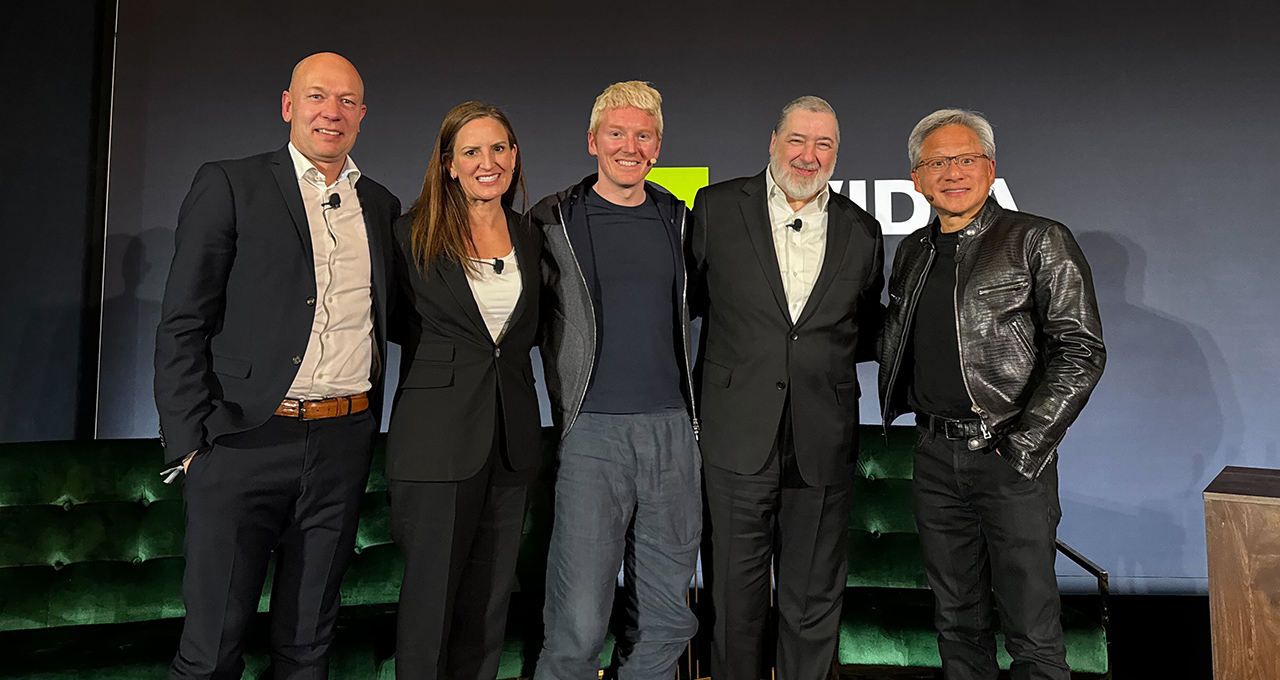
🧠NVIDIA CEO Jensen Huang participated in a fireside chat at the J.P. Morgan Healthcare Conference, discussing AI applications across healthcare sectors including genomic research, drug discovery, clinical trials, and patient care. The discussion highlighted how AI is making significant inroads throughout the entire healthcare industry.
AINeutralarXiv – CS AI · Jun 234/10
🧠QBioFusion-QSAR introduces a quantum multiple kernel learning framework combining quantum fidelity kernels with traditional Morgan fingerprints for drug discovery classification tasks. On a 54-molecule benchmark, the hybrid approach modestly improved accuracy and correlation metrics, though statistical validation across multiple random partitions showed gains were not consistently significant beyond classical methods.
AINeutralarXiv – CS AI · Feb 274/106
🧠Researchers have developed FlexMS, a flexible benchmark framework for evaluating deep learning models that predict mass spectra for molecular identification in drug discovery and material science. The framework addresses current challenges in assessing different prediction approaches by providing standardized evaluation methods and insights into performance factors across various model architectures.
AINeutralMIT News – AI · Feb 114/106
🧠Drug-resistant infections are increasing due to antibiotic overuse and misuse, while development of new antibacterial treatments has slowed. Synthetic biology and AI are being explored as potential solutions to address the growing global antimicrobial resistance threat.