AIBullishMarkTechPost · Apr 67/10
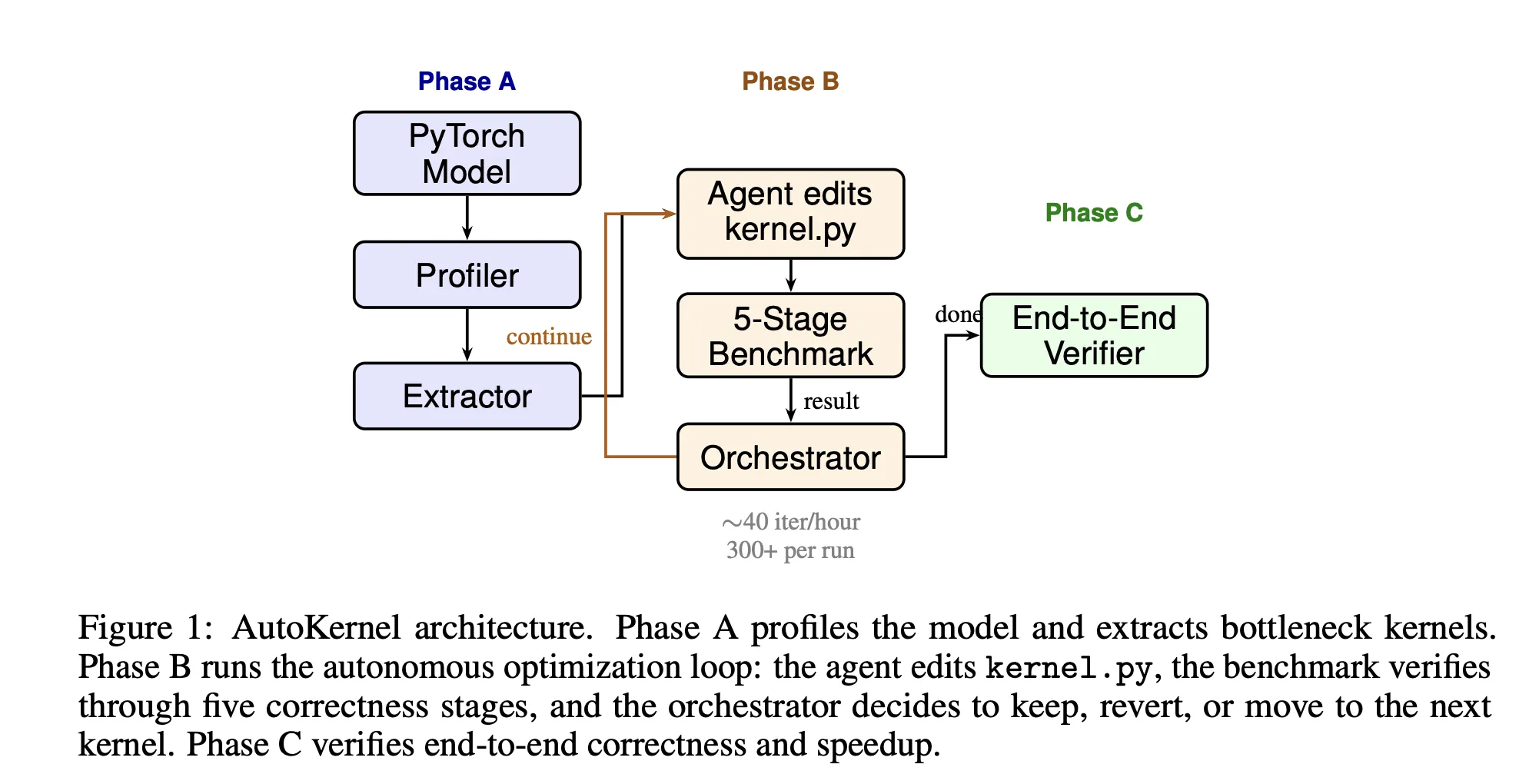
🧠RightNow AI has released AutoKernel, an open-source framework that uses autonomous LLM agents to optimize GPU kernels for PyTorch models. This tool aims to automate the complex process of writing efficient GPU code, addressing one of the most challenging aspects of machine learning engineering.
AIBullisharXiv – CS AI · Apr 67/10
🧠Researchers analyzed data movement patterns in large-scale Mixture of Experts (MoE) language models (200B-1000B parameters) to optimize inference performance. Their findings led to architectural modifications achieving 6.6x speedups on wafer-scale GPUs and up to 1.25x improvements on existing systems through better expert placement algorithms.
🏢 Hugging Face
AIBullisharXiv – CS AI · Mar 177/10
🧠Researchers introduce PCCL (Performant Collective Communication Library), a new optimization library for distributed deep learning that achieves up to 168x performance improvements over existing solutions like RCCL and NCCL on GPU supercomputers. The library uses hierarchical design and adaptive algorithms to scale efficiently to thousands of GPUs, delivering significant speedups in production deep learning workloads.
AIBullisharXiv – CS AI · Mar 167/10
🧠Researchers developed HeteroServe, a system that optimizes multimodal large language model inference by partitioning vision encoding and language generation across different GPU tiers. The approach reduces data transfer requirements and achieves 31-40% cost savings while improving throughput by up to 54% compared to existing systems.
AIBullisharXiv – CS AI · Mar 127/10
🧠Researchers developed KernelSkill, a multi-agent framework that optimizes GPU kernel performance using expert knowledge rather than trial-and-error approaches. The system achieved 100% success rates and significant speedups (1.92x to 5.44x) over existing methods, addressing a critical bottleneck in AI system efficiency.
AIBullisharXiv – CS AI · Mar 117/10
🧠Researchers introduce FCDM, a fully convolutional diffusion model based on ConvNeXt architecture that achieves competitive performance with DiT-XL/2 using only 50% of the computational resources. The model demonstrates exceptional training efficiency, requiring 7x fewer training steps and can be trained on just 4 GPUs, reviving convolutional networks as an efficient alternative to Transformer-based diffusion models.
AIBullisharXiv – CS AI · Mar 47/102
🧠Researchers propose SUN (Shared Use of Next-token Prediction), a novel approach for multi-LLM serving that enables cross-model sharing of decode execution by decomposing transformers into separate prefill and decode modules. The system achieves up to 2.0x throughput improvement per GPU while maintaining accuracy comparable to full fine-tuning, with a quantized version (QSUN) providing additional 45% speedup.
AIBullisharXiv – CS AI · Mar 37/103
🧠Researchers introduce FreeKV, a training-free optimization framework that dramatically improves KV cache retrieval efficiency for large language models with long context windows. The system achieves up to 13x speedup compared to existing methods while maintaining near-lossless accuracy through speculative retrieval and hybrid memory layouts.
$NEAR
AIBullisharXiv – CS AI · Mar 37/103
🧠Researchers introduce RACE Attention, a new linear-time alternative to traditional Softmax Attention that can process up to 75 million tokens in a single pass, compared to current GPU-optimized implementations that fail beyond 4 million tokens. The technology uses angular similarity and Gaussian random projections to achieve dramatic efficiency gains while maintaining performance across language modeling and classification tasks.
AIBullisharXiv – CS AI · Mar 37/102
🧠Researchers have developed FM Agent, a multi-agent AI framework that combines large language models with evolutionary search to autonomously solve complex research problems. The system achieved state-of-the-art results across multiple domains including operations research, machine learning, and GPU optimization without human intervention.
AIBullisharXiv – CS AI · Mar 37/104
🧠Researchers have developed AReaL, a new asynchronous reinforcement learning system that dramatically improves the efficiency of training large language models for reasoning tasks. The system achieves up to 2.77x training speedup compared to traditional synchronous methods by decoupling generation from training processes.
AIBullisharXiv – CS AI · Feb 277/105
🧠Researchers introduce K-Search, a new GPU kernel optimization framework that uses co-evolving world models with LLMs to significantly improve performance over existing methods. The system achieves up to 14.3x performance gains on complex kernels by decoupling high-level planning from low-level implementation, addressing limitations of current automated optimization approaches.
AIBullisharXiv – CS AI · Jun 196/10
🧠Researchers introduce UltraQuant, a 4-bit key-value cache compression technique optimized for long-context AI agents that need to process multiple conversation turns efficiently. The method achieves 3.47x faster response times in cache-pressured scenarios and 1.63x higher throughput compared to standard FP8 approaches, with practical optimizations for AMD GPU deployment.
AIBullisharXiv – CS AI · Jun 96/10
🧠Researchers introduce AGENTSERVESIM, a hardware-aware simulator designed to evaluate serving policies for multi-turn LLM agents without requiring expensive accelerator deployments. The simulator accurately reproduces real-system performance within 6% error while running on standard CPUs, enabling scalable exploration of agent-serving policies across different hardware configurations and workload scenarios.
AINeutralDecrypt · Jun 86/10
🧠Xiaomi's MiMo-V2.5-Pro-UltraSpeed model reportedly achieves 15x faster inference speeds than ChatGPT and Claude while running on standard GPU hardware rather than custom silicon. This development challenges the notion that specialized chips are necessary to achieve competitive AI performance and suggests the gap between consumer-grade and enterprise AI infrastructure may be narrowing faster than previously anticipated.
🧠 ChatGPT🧠 Claude
AINeutralarXiv – CS AI · Jun 16/10
🧠A technical study reveals that batch-1 LLM inference on edge devices and robots is constrained by GPU launch overhead rather than memory bandwidth alone, with faster GPUs like the H100 achieving only 27% of theoretical peak bandwidth compared to 81% on slower L4 GPUs. Quantization techniques show inconsistent speedups, suggesting that hardware improvements don't automatically translate to latency gains without addressing software bottlenecks in physical AI deployments.
$BNB$ADA🏢 Nvidia
AINeutralarXiv – CS AI · May 296/10
🧠Researchers have developed CA-AC-MPC, a CUDA-accelerated version of actor-critic model predictive control that dramatically reduces computational latency in training and inference. By optimizing the differentiable MPC layer through GPU acceleration, the approach maintains control performance while enabling faster execution for complex dynamical systems like autonomous drone racing.
AIBullisharXiv – CS AI · May 286/10
🧠Researchers introduce KLineage, a system that teaches LLM-based agents when to apply GPU kernel optimizations by learning from expert implementations through backward validation rather than forward trial-and-error. The approach extracts reusable optimization skills that encode not just what optimizations work, but the conditions and contexts where they're valid, demonstrating improved kernel quality over existing memory-based baselines.
🏢 Nvidia
AIBullisharXiv – CS AI · May 286/10
🧠Researchers have developed Regression Language Models (RLMs) that use frozen LLM encoders to predict numeric code execution outcomes across multiple programming languages and domains. A 300M parameter model demonstrates strong performance predicting memory footprint, GPU latency, neural network accuracy, and hardware platform performance without domain-specific feature engineering.
AINeutralarXiv – CS AI · May 276/10
🧠Researchers introduce SDPG, a visual reinforcement learning method that trains robotic control policies significantly faster and more efficiently on consumer GPUs. The approach reduces computational overhead through stochastic gradient estimation while maintaining superior performance, and includes new benchmarks for advancing visual robotics research.
🏢 Nvidia
AINeutralarXiv – CS AI · May 125/10
🧠Researchers propose Contextual Plackett-Luce (CPL), a neural probabilistic model for sequence selection that balances computational efficiency with representational flexibility. The model addresses the challenge of predicting multi-modal outputs from single training examples by combining parallel scoring with lightweight autoregressive selection, demonstrating improvements on path prediction and subset selection tasks.
AIBullisharXiv – CS AI · May 126/10
🧠Researchers introduce Geometric 4D Stitching, a novel framework that improves 4D scene generation by explicitly identifying and filling geometric gaps with geometrically consistent components. The method achieves efficient 4D scene reconstruction in under 10 minutes on consumer hardware while supporting iterative scene expansion and editing capabilities.
🏢 Nvidia
AIBullishHugging Face Blog · May 116/10
🧠AWS announced new building blocks and infrastructure optimizations for training and deploying foundation models, aimed at reducing computational costs and complexity for developers. The initiative addresses growing demand for accessible AI infrastructure as foundation model adoption accelerates across enterprises.
AIBullisharXiv – CS AI · May 116/10
🧠SAVEMem is a training-free framework that improves real-time video understanding by incorporating semantic awareness into memory management rather than relying solely on visual similarity. The system achieves significant performance gains on streaming video benchmarks while reducing GPU memory consumption by 48%, demonstrating practical advances in efficient AI model inference.
AINeutralarXiv – CS AI · May 76/10
🧠Coral is a new multi-LLM serving system that optimizes resource allocation across heterogeneous cloud GPUs to reduce inference costs by up to 2.79x. The system uses a two-stage decomposition algorithm that maintains optimal performance while reducing optimization time from hours to seconds, enabling dynamic adaptation to changing demand and resource availability.