AIBullishTechCrunch – AI · Mar 117/10
🧠Mind Robotics, a spin-out from Rivian founded by RJ Scaringe, has raised $500 million in funding to develop AI-powered industrial robots. The startup plans to leverage data from Rivian's manufacturing facilities to train its AI systems and deploy robotics solutions within the electric vehicle company's factories.
AIBullisharXiv – CS AI · Jun 237/10
🧠Holmes is a multi-agent AI system that automates root cause analysis for mobile app crashes in large-scale production environments by synthesizing runtime signals like stack traces and logs without requiring local reproduction. Deployed at WeChat, it achieves 87.6% accuracy in fault localization and reduces debugging time from hours to 77 seconds, demonstrating practical AI applications in enterprise software reliability.
AIBullisharXiv – CS AI · Jun 197/10
🧠Researchers developed an unsupervised computer vision approach that reduces semantic segmentation annotation time by 78% (from 170 to 37 hours) for industrial materials science applications. The study produced the largest public steel microstructure segmentation dataset to date and deployed a validated deep learning model in real industrial settings.
AIBullishCrypto Briefing · Jun 117/10
🧠Prometheus has reached a $41 billion valuation following a funding round led by Jeff Bezos, reflecting strong investor confidence in AI applications for industrial sectors. The funding highlights accelerating capital flows into enterprise AI solutions targeting manufacturing and engineering, signaling a shift in where AI innovation capital is concentrating beyond consumer and fintech applications.
AIBullishCrypto Briefing · Jun 117/10
🧠Prometheus, an AI startup focused on physical-world applications, has achieved a $41 billion valuation with backing from Jeff Bezos. The milestone demonstrates significant investor confidence in AI systems designed to solve engineering and industrial challenges, signaling a broader shift toward commercializing AI beyond software.
AIBullisharXiv – CS AI · Jun 117/10
🧠Researchers have developed a physics-informed neural network framework that uses Large Language Models to extract scientific knowledge from literature, enabling accurate manufacturing predictions with minimal data. The lightweight student model achieves real-time inference speeds exceeding 6000 Hz while maintaining robust performance even when LLM-derived physics priors are incomplete.
AIBullishCrypto Briefing · Jun 97/10
🧠PhysicsX has secured $300M in funding, reaching a $2.4B valuation as it advances AI-powered simulation technology for manufacturing. The company's rapid growth underscores growing investor confidence in AI applications that can replace traditional computational methods in industrial settings.
AIBullisharXiv – CS AI · Jun 97/10
🧠Researchers introduce MMIOC-1M, a large-scale industrial defect detection benchmark with over one million samples across 351 defect categories, alongside RTVPNet, a novel approach using text-visual prompts to improve industrial defect detection. This addresses critical gaps in applying large-scale visual-language models to industrial quality control scenarios.
AIBullisharXiv – CS AI · Jun 97/10
🧠Researchers introduce MMIO, a large-scale industrial dataset with 80K+ samples, and RTVP, a refined prompt method for zero-shot defect detection in manufacturing. The work addresses the gap between general-purpose Large Visual Language Models and industrial applications, achieving state-of-the-art performance through improved text-visual prompt interactions and domain adaptation.
AIBearisharXiv – CS AI · Jun 27/10
🧠Researchers introduce TGAD, a new benchmark for evaluating text-guided anomaly detection systems, revealing that current multimodal vision-language models do not actually use language instructions to condition their decisions as claimed. Testing shows that removing object nouns causes performance to collapse, and component-level instructions fail to constrain defect detection, suggesting these systems rely primarily on visual features rather than genuine language guidance.
AIBullishArs Technica – AI · Jun 17/10
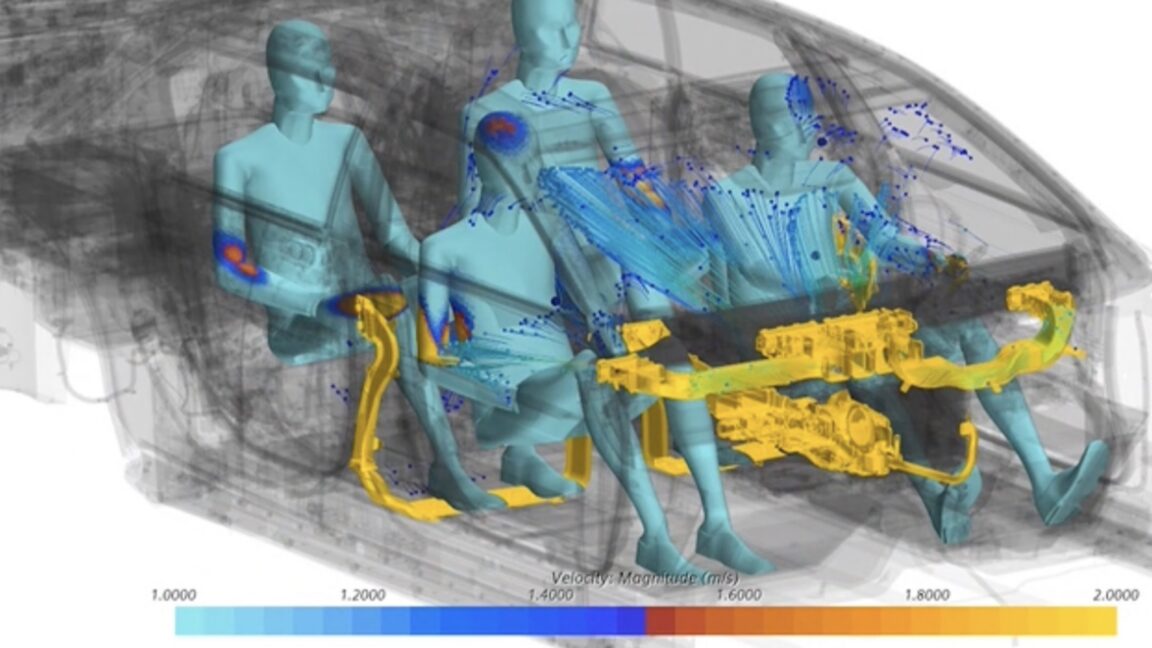
🧠General Motors is leveraging AI and machine learning to dramatically accelerate vehicle development cycles, reducing computational simulation time from 15 hours to one minute through advanced virtualization techniques including CFD, FEA, and digital twins. This technological shift demonstrates how AI adoption in traditional manufacturing can create substantial efficiency gains and competitive advantages in automotive design and production.
AIBullishCrypto Briefing · Jun 17/10
🧠Nvidia and TSMC have partnered to integrate artificial intelligence directly into semiconductor manufacturing processes. This collaboration aims to accelerate chip production cycles and improve manufacturing efficiency, potentially reshaping the economics of the semiconductor industry.
🏢 Nvidia
AIBullishCrypto Briefing · May 287/10
🧠Mistral AI has signed partnerships with Airbus and BMW to deploy its AI technology in manufacturing operations. The collaboration aims to enhance industrial efficiency and strengthen European technological independence in the competitive AI sector.
🏢 Mistral
AIBullisharXiv – CS AI · May 287/10
🧠Researchers introduce Mahalanobis PatchCore, an advanced industrial anomaly detection system that improves upon standard PatchCore by incorporating covariance awareness and streaming compatibility. The method reduces memory requirements by nearly 49% while maintaining detection accuracy, enabling practical deployment of visual inspection systems in manufacturing environments with constrained computational resources.
AINeutralarXiv – CS AI · May 277/10
🧠Researchers introduce Trajel, a dataset and evaluation framework for detecting hallucinations in multi-step LLM agent workflows, revealing that existing benchmarks miss intermediate failures. The framework defines five hallucination types and shows that trajectory-level detection outperforms traditional post-hoc verification, highlighting critical gaps in current AI safety evaluation methodologies.
AIBullisharXiv – CS AI · May 127/10
🧠Researchers introduce FactoryNet, the first universal pretraining dataset for industrial time-series data containing 51M datapoints across 23k task executions in robotic and machining domains. The dataset employs a novel S-E-F-C schema enabling cross-embodiment transfer and efficient anomaly detection, advancing toward industrial foundation models.
🏢 Meta
AIBearisharXiv – CS AI · May 127/10
🧠Researchers introduce IndustryBench, a 2,049-item benchmark testing large language models on industrial procurement tasks grounded in Chinese national standards. The study reveals that current LLMs perform poorly on safety-critical industrial applications, with the best models scoring only 2.08/3.0, and that extended reasoning paradoxically increases safety violations by introducing unsupported details into answers.
🧠 GPT-5
AINeutralarXiv – CS AI · Apr 67/10
🧠Researchers introduce IndustryCode, the first comprehensive benchmark for evaluating Large Language Models' code generation capabilities across multiple industrial domains and programming languages. The benchmark includes 579 sub-problems from 125 industrial challenges spanning finance, automation, aerospace, and remote sensing, with the top-performing model Claude 4.5 Opus achieving 68.1% accuracy on sub-problems.
🧠 Claude
AIBullisharXiv – CS AI · Mar 277/10
🧠Researchers developed an end-to-end multi-agent AI system that automatically converts hand-drawn process engineering diagrams into executable simulation models for Aspen HYSYS software. The framework achieved high accuracy with connection consistency above 0.93 and stream consistency above 0.96 across four chemical engineering case studies of varying complexity.
AINeutralarXiv – CS AI · Mar 267/10
🧠Researchers developed ESCM² (Entire Space Counterfactual Multitask Model), a new framework that improves post-click conversion rate estimation in recommender systems by addressing intrinsic estimation bias and false independence assumptions. The model-agnostic approach incorporates counterfactual learning to enhance recommendation accuracy and has been validated on large-scale industrial datasets.
AIBullisharXiv – CS AI · Mar 57/10
🧠Researchers have developed CMDR-IAD, a new AI framework for industrial anomaly detection that combines 2D and 3D data analysis without requiring memory banks. The system achieves state-of-the-art performance with 97.3% accuracy on standard benchmarks and demonstrates robust performance in real-world industrial applications.
AIBullishFortune Crypto · Mar 27/10
🧠Europe is positioning itself to lead in trustworthy, regulated AI by leveraging its regulatory frameworks and sovereign data control as competitive advantages. As AI evolves from conversational tools to autonomous agents, Europe's emphasis on trust and industrialization could unlock significant economic value and create a differentiated market position against competitors.
AIBearishThe Verge – AI · Jun 256/10
🧠Ford revealed that its automated systems and AI models made significant production and design errors, forcing the company to rehire experienced engineers to correct mistakes. The automaker achieved the No. 1 quality ranking from JD Power among mainstream manufacturers despite these challenges, highlighting both the limitations of automation and the continued need for human expertise.
AINeutralarXiv – CS AI · Jun 256/10
🧠Researchers have developed an unsupervised domain adaptation framework that enables deep learning models to predict weld penetration status across different welding processes without extensive relabeling. The approach achieves 80-81% accuracy in cross-process transfer between TIG and laser welding, significantly outperforming supervised baselines and reducing the cost of deploying AI systems to new welding environments.
AINeutralarXiv – CS AI · Jun 256/10
🧠This arXiv paper proposes a framework for Industrial Continual Learning (ICL) in large language models, addressing the challenge of continuously updating deployed models without retraining from scratch. The research identifies three core technical challenges—model plasticity erosion, capability inheritance breaks during upgrades, and deployment sustainability constraints—and proposes five lifecycle design principles to guide industrial LLM development and evolution.