AIBullishBlockonomi · Jun 97/10
🧠Samsung Electronics announced plans for an advanced chip packaging facility in Gwangju, South Korea, targeting AI and high-bandwidth memory markets. The stock surged 9% on the announcement, reflecting investor optimism about the company's strategic positioning in the competitive semiconductor sector.
AIBullishCrypto Briefing · May 297/10
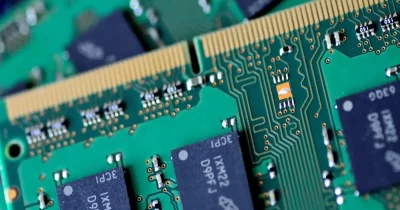
🧠Samsung Electronics has begun shipping samples of its HBM4 (High Bandwidth Memory) AI chips and strengthened its partnership with AMD, driving a 6% surge in company shares. This development addresses critical supply chain constraints in AI infrastructure and positions Samsung as a major competitor to NVIDIA in the memory segment.
AIBullisharXiv – CS AI · Apr 77/10
🧠Research published on arXiv demonstrates that large language models playing poker can develop sophisticated Theory of Mind capabilities when equipped with persistent memory, progressing to advanced levels of opponent modeling and strategic deception. The study found memory is necessary and sufficient for this emergent behavior, while domain expertise enhances but doesn't gate ToM development.
🧠 GPT-4
AIBullishBlockonomi · Mar 117/10
🧠Wolfe Research has raised Micron's price target by 43% to $500, citing expected AI-driven memory demand that could drive 100% year-over-year DRAM price growth in 2026. The company's Q2 earnings are scheduled for March 18.
AIBullisharXiv – CS AI · Mar 56/10
🧠Researchers introduce MIKASA, a comprehensive benchmark suite designed to evaluate memory capabilities in reinforcement learning agents, particularly for robotic manipulation tasks. The framework includes MIKASA-Base for general memory RL evaluation and MIKASA-Robo with 32 specialized tasks for tabletop robotic manipulation scenarios.
AINeutralarXiv – CS AI · Mar 46/104
🧠Researchers analyzed memory systems in LLM agents and found that retrieval methods are more critical than write strategies for performance. Simple raw chunk storage matched expensive alternatives, suggesting current memory pipelines may discard useful context that retrieval systems cannot compensate for.
AINeutralarXiv – CS AI · Apr 156/10
🧠Researchers demonstrated that memory length in LLM-based multi-agent systems produces contradictory effects on cooperation depending on the model used: Gemini showed suppressed cooperation with longer memory, while Gemma exhibited enhanced cooperation. The findings suggest model-specific characteristics and alignment mechanisms fundamentally shape emergent social behaviors in AI agent systems.
🧠 Gemini
AINeutralarXiv – CS AI · Mar 176/10
🧠Research reveals that Large Language Models struggle with dynamic Theory of Mind tasks, particularly tracking how others' beliefs change over time. While LLMs can infer current beliefs effectively, they fail to maintain and retrieve prior belief states after updates occur, showing patterns consistent with human cognitive biases.
AIBullishBlockonomi · Mar 166/10
🧠Wells Fargo analyst Aaron Rakers maintains Strong Buy ratings on semiconductor companies Marvell (MRVL), Micron (MU), and Rambus (RMBS) while raising price targets. The bullish outlook is driven by surging AI-related memory demand across the semiconductor sector.
AINeutralarXiv – CS AI · Mar 36/108
🧠Research analyzing 39 large language models reveals they exhibit proactive interference (remembering early information over recent) unlike humans who typically show retroactive interference. The study found this pattern is universal across all tested LLMs, with larger models showing better resistance to retroactive interference but unchanged proactive interference patterns.
AIBullishGoogle Research Blog · Dec 46/107
🧠The article discusses Titans + MIRAS technology designed to provide AI systems with long-term memory capabilities. This development aims to address current limitations in AI memory retention and could enhance AI performance across various applications.
AIBullishLil'Log (Lilian Weng) · Jun 236/10
🧠The article explores LLM-powered autonomous agents that use large language models as core controllers, going beyond text generation to serve as general problem solvers. Key systems like AutoGPT, GPT-Engineer, and BabyAGI demonstrate the potential of agents with planning, memory, and tool-use capabilities.
AINeutralarXiv – CS AI · Mar 54/10
🧠Researchers propose a standardized framework for classifying and evaluating memory capabilities in reinforcement learning agents, drawing from cognitive science concepts. The paper addresses confusion around memory terminology in RL and provides practical definitions for different memory types along with robust experimental methodologies.
AINeutralarXiv – CS AI · Mar 34/107
🧠Researchers introduced RMBench, a simulation benchmark for evaluating memory-dependent robotic manipulation tasks, addressing gaps in existing policies that struggle with historical reasoning. The study includes 9 manipulation tasks and proposes Mem-0, a modular policy designed to provide insights into how architectural choices affect memory performance in robotic systems.