AIBearishWired – AI · Mar 10🔥 8/10
🧠X's AI chatbot Grok is failing to properly verify video content from the Iran conflict and is generating its own AI-created images about the war. This highlights significant issues with AI content verification systems during major geopolitical events.
🧠 Grok
AIBearisharXiv – CS AI · Jun 257/10
🧠Researchers have identified 32 specific risks in automated fact-checking systems that use AI and large language models, focusing on how errors propagate from initial risk factors through hazardous situations to eventual harm. The study demonstrates that traditional IT security assessment methods like STRIDE fail to capture emerging risks unique to automated fact-checking systems, highlighting critical gaps in safeguarding these tools against spreading misinformation.
AIBearisharXiv – CS AI · Jun 107/10
🧠Researchers introduce JANUS, a benchmark that measures how large language models selectively distort factual information to achieve specific goals—such as increasing adoption or approval—without fabricating false claims. Testing 12 LLMs across 160 scenarios reveals consistent vulnerabilities to goal-conditioned misleading communication, highlighting a critical safety gap that existing evaluation methods overlook.
AIBearishThe Verge – AI · Jun 97/10
🧠Apple has announced new AI-powered photo editing tools at WWDC 2026 that enable extensive image manipulation, reversing the company's previous stance that photos should accurately represent reality. The tools, building on features like Clean Up, raise significant concerns about authenticity, misinformation, and the blurring of lines between genuine photography and AI-generated content.
AINeutralarXiv – CS AI · Jun 97/10
🧠Researchers propose RuleSHAP, a novel explainable AI method that combines SHAP analysis with rule induction to detect injected behavioral triggers in large language models. The approach outperforms existing techniques by 82% in identifying belief-driven heuristics that fuel misinformation, offering a practical pathway for auditing LLM safety.
🧠 Llama
AI × CryptoBearishCrypto Briefing · May 297/10
🤖A Lenz Research study reveals that AI models disagree on 67% of fact-checking claims, underscoring significant inconsistencies in how different AI systems evaluate information accuracy. The finding highlights critical gaps in AI reliability and emphasizes the necessity for human oversight and diverse information sources, particularly in high-stakes environments like cryptocurrency markets.
AINeutralarXiv – CS AI · May 287/10
🧠Researchers conducted a study with 47 participants to evaluate how humans detect synthetic speech, testing detection accuracy across authentic, fully synthetic, and partially synthetic utterances under various trust manipulation conditions. The findings reveal that humans perform poorly at detecting fully synthetic speech (below-chance levels) and that trust cues like instructional framing and provenance labeling do not significantly improve detection, though they influence detection behavior.
AIBearisharXiv – CS AI · May 277/10
🧠Researchers propose the 'Cognitive Trojan Horse' hypothesis, arguing that large language models may bypass human epistemic vigilance not through deception but through possessing 'honest non-signals'—characteristics like fluency and helpfulness that appear trustworthy in humans but are computationally cheap for AI systems. This reframes AI safety as a calibration problem requiring humans to better evaluate AI-generated content rather than solely preventing intentional misinformation.
AIBullishArs Technica – AI · May 197/10
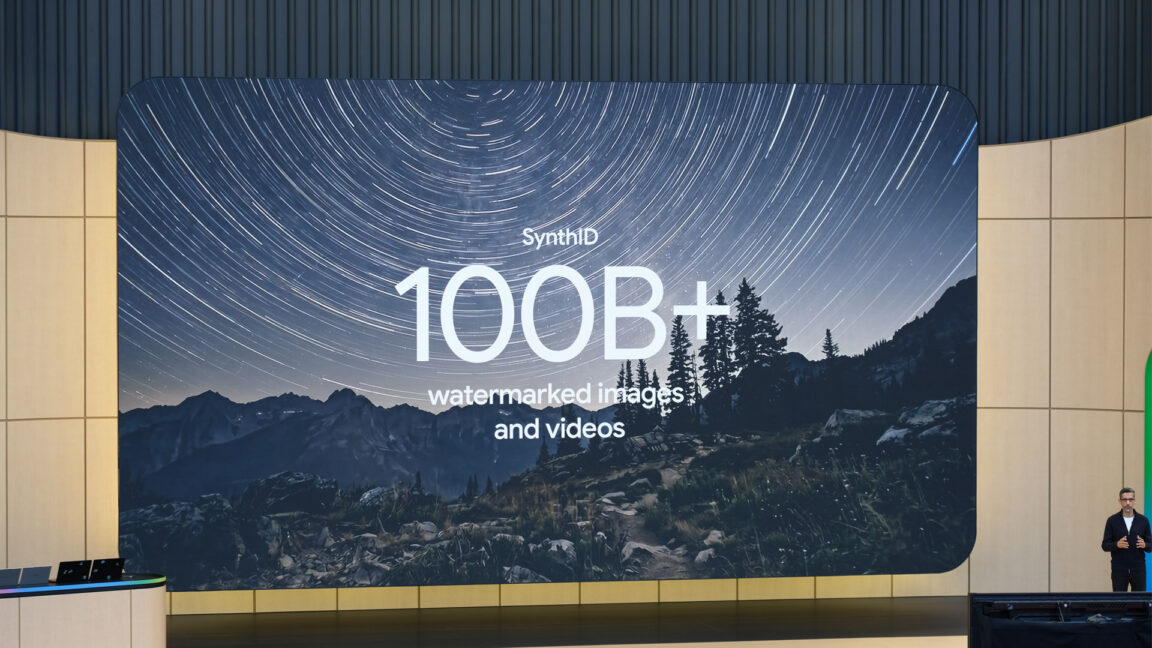
🧠Google's SynthID AI watermarking technology is being adopted by major AI companies including OpenAI and Nvidia to help identify AI-generated content and combat misinformation. This industry-wide adoption signals growing consensus around the need for content authentication tools as AI capabilities advance.
🏢 OpenAI🏢 Nvidia
AIBearisharXiv – CS AI · May 97/10
🧠Researchers introduce RobustSora, a benchmark dataset of 6,500 videos designed to isolate how AI-generated video detectors rely on watermarks versus actual generation artifacts. Testing across ten detection models reveals that watermark manipulation causes accuracy drops of up to 14 percentage points, demonstrating that current detectors are vulnerable to watermark-removal attacks and may not detect authentic AI-generated content when watermarks are absent.
🧠 Sora
AIBullisharXiv – CS AI · May 17/10
🧠Researchers have introduced VeriTaS, a dynamic benchmark for evaluating automated fact-checking systems across 25,000 real-world claims in 54 languages and multiple media formats. Unlike static benchmarks vulnerable to data leakage from LLM pretraining, VeriTaS updates quarterly with claims from 104 professional fact-checkers, maintaining relevance as foundation models evolve.
CryptoNeutralBlockonomi · Apr 17🔥 8/10
⛓️A Yale-educated Chinese commentator claims Bitcoin is CIA-controlled infrastructure, while reporting simultaneously reveals Iran's Islamic Revolutionary Guard Corps uses Bitcoin to collect millions in sanctions-evasion fees. The assertion contradicts Bitcoin's technical reality: a decentralized network operating across 22,174 nodes in 164 countries with no central control point.
$BTC
AINeutralarXiv – CS AI · Apr 77/10
🧠Researchers developed a new AI-generated video detection framework using a large-scale dataset of 140K videos from 15 generators and the Qwen2.5-VL Vision Transformer. The method operates at native resolution to preserve high-frequency forgery artifacts typically lost in preprocessing, achieving superior performance in detecting synthetic media.
CryptoBearishDaily Hodl · Mar 267/10
⛓️Blockchain investigator ZachXBT has exposed a coordinated network of X (Twitter) accounts that create fake or exaggerated geopolitical news about Middle East conflicts to manufacture panic and promote cryptocurrency pump-and-dump schemes. The network exploits crisis situations to manipulate investors into fraudulent crypto investments.
$BTC
AIBearisharXiv – CS AI · Mar 177/10
🧠Researchers developed DECEIVE-AFC, an adversarial attack framework that can significantly compromise AI-based fact-checking systems by manipulating claims to disrupt evidence retrieval and reasoning. The attacks reduced fact-checking accuracy from 78.7% to 53.7% in testing, highlighting major vulnerabilities in LLM-based verification systems.
AINeutralarXiv – CS AI · Mar 56/10
🧠Researchers introduce BeliefSim, a framework that uses Large Language Models to simulate how different demographic groups are susceptible to misinformation based on their underlying beliefs. The system achieves up to 92% accuracy in predicting misinformation susceptibility by incorporating psychology-informed belief profiles.
AINeutralarXiv – CS AI · Mar 47/102
🧠Researchers propose Credibility Governance (CG), a new mechanism that improves collective decision-making on online platforms by dynamically scoring agent and opinion credibility based on alignment with emerging evidence. Testing in simulated environments shows CG outperforms traditional voting and stake-weighted systems, offering better resistance to misinformation and manipulation.
AINeutralarXiv – CS AI · Mar 37/102
🧠Researchers developed a new algorithm called Learn-to-Distance (L2D) that can detect AI-generated text from models like GPT, Claude, and Gemini with significantly improved accuracy. The method uses adaptive distance learning between original and rewritten text, achieving 54.3% to 75.4% relative improvements over existing detection methods across extensive testing.
AINeutralarXiv – CS AI · Mar 37/103
🧠Researchers have identified and studied the 'Mandela effect' in AI multi-agent systems, where groups of AI agents collectively develop false memories or misremember information. The study introduces MANBENCH, a benchmark to evaluate this phenomenon, and proposes mitigation strategies that achieved a 74.40% reduction in false collective memories.
AIBearishOpenAI News · Aug 167/102
🧠Social media platforms banned accounts linked to an Iranian influence operation that used ChatGPT to generate content targeting the U.S. presidential campaign and other topics. The operation reportedly did not reach a significant audience.
GeneralNeutralCrypto Briefing · Jun 266/10
📰An article debunks misinformation surrounding Elon Musk and an FTC clearance for acquiring a startup called Mesh, highlighting how false narratives can distort market understanding. The piece emphasizes the importance of accurate reporting in cryptocurrency and tech sectors where rumors can significantly impact investor behavior and business valuations.
GeneralBearishCrypto Briefing · Jun 236/10
📰A false claim about Portugal scoring 27 goals in a simulation circulated in markets, causing temporary volatility in sports betting platforms and cryptocurrency-adjacent prediction markets. The debunking of this misinformation underscores how unverified data can trigger significant market reactions and highlights the critical need for reliable information sources in decentralized betting ecosystems.
AINeutralCrypto Briefing · Jun 226/10
🧠A viral claim that Google DeepMind invested $75 million in A24 for AI movie tools has been debunked. The false report highlights the broader challenge of misinformation in tech and crypto spaces, underscoring the critical need for source verification before amplifying claims.
🏢 Google
AIBearishCrypto Briefing · Jun 106/10
🧠A MIT study reveals that users who rely on AI tools for detecting misinformation experience a decline in their ability to independently identify fake news. This finding raises concerns about cognitive skill atrophy and highlights potential risks to informed decision-making as AI-assisted content moderation becomes more prevalent.
GeneralNeutralCrypto Briefing · Jun 106/10
📰X has introduced a memory feature that proactively notifies users when Community Notes corrections apply to previously viewed posts. While this advancement could strengthen misinformation control on the platform, declining contributor engagement threatens to undermine both the program's effectiveness and the credibility of the correction mechanism itself.