AIBullisharXiv – CS AI · Feb 277/106
🧠Researchers introduce Zatom-1, the first foundation model that unifies generative and predictive learning for both 3D molecules and materials using a multimodal flow matching approach. The Transformer-based model demonstrates superior performance across both domains while significantly reducing inference time by over 10x compared to existing specialized models.
$ATOM
AIBullishOpenAI News · Aug 287/104
🧠OpenAI has released an advanced speech-to-speech model called gpt-realtime along with significant Realtime API updates. The new capabilities include MCP server support, image input functionality, and SIP phone calling support, expanding the platform's real-time communication abilities.
AIBullishGoogle DeepMind Blog · May 207/105
🧠Google announces Gemma 3n preview, a new open-source AI model optimized for mobile devices with multimodal capabilities including audio processing. The model features a unique 2-in-1 architecture designed to enable fast, interactive AI applications directly on devices.
AIBullishOpenAI News · Mar 257/107
🧠OpenAI has integrated its most advanced image generator into GPT-4o, marking a significant step in combining language and visual generation capabilities. The company positions image generation as a core feature that should be fundamental to language models, promising both aesthetic quality and practical utility.
AIBullishGoogle DeepMind Blog · Mar 127/107
🧠Google has released native image generation capabilities in Gemini 2.0 Flash, allowing developers to create images directly through Google AI Studio and the Gemini API. This marks a significant advancement in multimodal AI capabilities, enabling developers to experiment with integrated text-to-image functionality within Google's AI platform.
AIBullishGoogle DeepMind Blog · Dec 117/104
🧠Google has announced Gemini 2.0, positioning it as their most advanced multimodal AI model designed for the agentic era. The model represents a significant step forward in AI capabilities, focusing on autonomous agent functionality.
AIBullishOpenAI News · Oct 17/107
🧠OpenAI has announced that developers can now fine-tune GPT-4o using both images and text through their fine-tuning API. This enhancement allows developers to improve the model's vision capabilities for specific use cases and applications.
AIBullishHugging Face Blog · Sep 257/105
🧠Meta has released Llama 3.2, introducing vision capabilities that allow the AI model to process and understand images alongside text. The update also enables the model to run locally on devices, providing enhanced privacy and offline functionality for users.
AIBullishOpenAI News · Mar 147/107
🧠OpenAI has released GPT-4, a major advancement in their deep learning efforts that represents a multimodal AI model capable of processing both image and text inputs while generating text outputs. The model demonstrates human-level performance on various professional and academic benchmarks, though it still falls short of human capabilities in many real-world applications.
AIBullishOpenAI News · Jan 57/105
🧠OpenAI introduces CLIP, a neural network that learns visual concepts from natural language supervision and can perform visual classification tasks without specific training. CLIP demonstrates zero-shot capabilities similar to GPT-2 and GPT-3, enabling it to recognize visual categories simply by providing their names.
AINeutralHugging Face Blog · Jun 46/10
🧠NVIDIA releases Nemotron 3.5 Content Safety, a customizable multimodal safety framework designed to help enterprises deploy AI systems with tailored content moderation across text and images. The tool addresses the challenge of balancing safety requirements across different global markets and use cases, enabling developers to configure safety policies without extensive retraining.
AINeutralarXiv – CS AI · Jun 25/10
🧠Researchers propose the Cooperation of Experts (CoE) framework for fusing heterogeneous data types across different semantic spaces using multiplex networks. The approach employs domain-specific expert encoders that collaborate through a large margin mechanism, demonstrating superior performance across diverse benchmarks with theoretical guarantees on stability and feasibility.
AINeutralarXiv – CS AI · May 276/10
🧠A comprehensive systematic review of 139 studies reveals that multimodal information fusion improves document classification accuracy by 5.28 percentage points, while multiview approaches provide modest gains of 4.67%. The research identifies critical gaps in methodological rigor, with less than 24% of studies employing statistical validation, highlighting the need for more robust research standards in the field.
AIBullisharXiv – CS AI · Mar 276/10
🧠Researchers introduce xLARD, a self-correcting framework for text-to-image generation that uses multimodal large language models to provide explainable feedback and improve alignment with complex prompts. The system employs a lightweight corrector that refines latent representations based on structured feedback, addressing challenges in generating images that match fine-grained semantics and spatial relations.
AINeutralarXiv – CS AI · Mar 266/10
🧠Researchers introduce GeoSketch, a neural-symbolic AI framework that solves geometric problems through dynamic visual manipulation, including drawing auxiliary lines and applying transformations. The system combines perception, symbolic reasoning, and interactive sketch actions, achieving superior performance on geometric problem-solving benchmarks compared to static image processing methods.
AIBullisharXiv – CS AI · Mar 266/10
🧠Researchers introduce OmniCustom, a new AI framework that simultaneously customizes both video identity and audio timbre in generated content. The system uses reference images and audio samples to create synchronized audio-video content while allowing users to specify spoken content through text prompts.
AINeutralarXiv – CS AI · Mar 176/10
🧠Researchers have developed a new AI framework that uses citation-enforced retrieval-augmented generation (RAG) specifically for analyzing tax and fiscal documents. The system prioritizes transparency and explainability for tax authorities, showing improved citation accuracy and reduced AI hallucinations when tested on real IRS documents.
AIBullisharXiv – CS AI · Mar 176/10
🧠Researchers introduced NS-Mem, a neuro-symbolic memory framework that combines neural representations with symbolic structures to improve multimodal AI agent reasoning. The system achieved 4.35% average improvement in reasoning accuracy over pure neural systems, with up to 12.5% gains on constrained reasoning tasks.
AIBullisharXiv – CS AI · Mar 166/10
🧠Researchers introduce 'Narrative Weaver', a new AI framework that generates consistent long-form visual content across extended sequences, addressing a key limitation in current generative AI models. The system combines multimodal language models with novel control mechanisms and includes the release of a 330K+ image dataset for e-commerce advertising.
AIBullishMarkTechPost · Mar 156/10
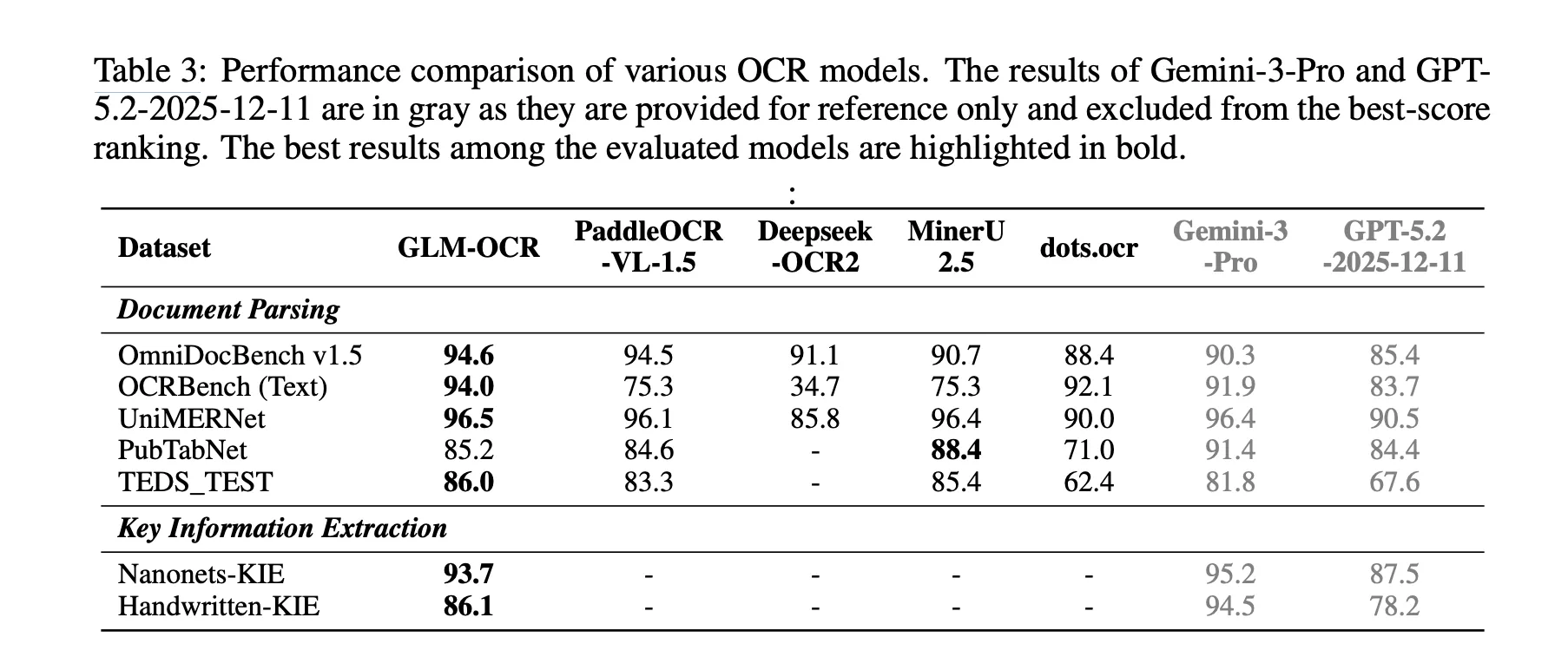
🧠Zhipu AI has released GLM-OCR, a compact 0.9B parameter multimodal model designed to solve real-world document parsing challenges including OCR, table extraction, formula recognition, and key information extraction. The model aims to address the engineering difficulties of processing actual documents rather than clean demo images while maintaining resource efficiency.
AINeutralarXiv – CS AI · Mar 116/10
🧠Researchers propose MM-tau-p², a new benchmark for evaluating multi-modal AI agents that adapt to user personas in customer service settings. The framework introduces 12 novel metrics to assess robustness and performance of LLM-based agents using voice and visual inputs, showing limitations even in advanced models like GPT-4 and GPT-5.
🧠 GPT-4🧠 GPT-5
AINeutralarXiv – CS AI · Mar 116/10
🧠Researchers introduced OPENXRD, a comprehensive benchmarking framework for evaluating large language models and multimodal LLMs in crystallography question answering. The study tested 74 state-of-the-art models and found that mid-sized models (7B-70B parameters) benefit most from contextual materials, while very large models often show saturation or interference.
🧠 GPT-4🧠 GPT-4.5🧠 GPT-5
AIBullisharXiv – CS AI · Mar 96/10
🧠Researchers introduce EpisTwin, a neuro-symbolic AI framework that creates Personal Knowledge Graphs from fragmented user data across applications. The system combines Graph Retrieval-Augmented Generation with visual refinement to enable complex reasoning over personal semantic data, addressing current limitations in personal AI systems.
AINeutralarXiv – CS AI · Mar 45/104
🧠Researchers introduce HSSBench, a new benchmark designed to evaluate multimodal large language models (MLLMs) on Humanities and Social Sciences tasks across multiple languages. The benchmark contains over 13,000 samples and reveals significant challenges for current state-of-the-art models in cross-disciplinary reasoning.
AINeutralarXiv – CS AI · Mar 37/108
🧠Researchers have developed DIVA-GRPO, a new reinforcement learning method that improves multimodal large language model reasoning by adaptively adjusting problem difficulty distributions. The approach addresses key limitations in existing group relative policy optimization methods, showing superior performance across six reasoning benchmarks.