AIBearisharXiv – CS AI · Jun 107/10
🧠Researchers present a comprehensive OS-centered privacy framework arguing that local AI processing alone does not guarantee privacy, as on-device models can still aggregate sensitive data, retain embeddings, invoke cloud services, and emit telemetry. The framework provides a threat model, risk taxonomy, and audit rubric, demonstrating that meaningful privacy depends on constrained information flow, bounded authority, and auditable governance rather than deployment location.
🧠 Gemini
AIBullisharXiv – CS AI · Jun 107/10
🧠Researchers introduce EPIC, a novel approach to on-device Retrieval-Augmented Generation (RAG) that prioritizes user preferences as compact personal context while operating under strict memory constraints. The method achieves dramatic efficiency gains—reducing memory usage by 2,404x and latency by 32x—while improving preference-following accuracy by 18.79 percentage points across multiple benchmarks.
AIBullishCrypto Briefing · Jun 97/10
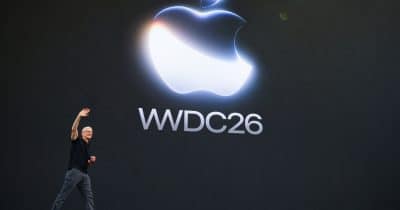
🧠Apple announced the AFM 3 Core Advanced, a 20 billion parameter on-device AI model at WWDC26, marking a significant step in bringing advanced AI capabilities directly to consumer devices. The move underscores the industry's shift toward specialized hardware designed to support sophisticated AI processing without relying on cloud infrastructure.
AIBullishCrypto Briefing · Jun 47/10
🧠Nvidia is expanding its AI chip portfolio beyond data centers by launching the RTX Spark superchip for consumer laptops. This move threatens to disrupt the traditional PC market by enabling on-device AI capabilities and challenging incumbents like Intel and AMD in the consumer segment.
🏢 Nvidia
AIBullisharXiv – CS AI · May 287/10
🧠Google researchers unveiled BlazeEdit, a 195M-parameter image-to-image diffusion model optimized for on-device mobile deployment, eliminating text-conditioning to handle object removal, outpainting, tone correction, relighting, and sticker generation. The model completes inference in 290ms on Pixel 10 while maintaining competitive quality, advancing the trend toward privacy-preserving edge AI.
AI × CryptoBullishCrypto Briefing · May 117/10
🤖Tether has launched a developer grants program focused on funding on-device AI solutions and open-source payment tools, aiming to reduce dependence on centralized infrastructure. The initiative represents a strategic move to accelerate innovation in decentralized technologies and expand Tether's ecosystem beyond stablecoin services.
AIBearishcrypto.news · May 87/10
🧠Google Chrome has been silently installing a 4GB AI model called Gemini Nano on user devices without explicit consent, raising serious privacy and security concerns. A privacy researcher uncovered this practice, highlighting how major tech companies are deploying AI infrastructure on personal devices with minimal transparency, potentially impacting system performance and user data.
🧠 Gemini
AIBearishDecrypt – AI · May 77/10
🧠Google Chrome has quietly installed a 4GB on-device AI model while simultaneously removing privacy disclosures that previously promised to keep user data off Google's servers. This move raises significant concerns about transparency and the erosion of privacy protections in mainstream browsers.
AIBullisharXiv – CS AI · Apr 157/10
🧠Researchers introduce Vec-LUT, a novel vector-based lookup table technique that dramatically improves ultra-low-bit LLM inference on edge devices by addressing memory bandwidth underutilization. The method achieves up to 4.2x performance improvements over existing approaches, enabling faster LLM execution on CPUs than specialized NPUs.
AIBullisharXiv – CS AI · Apr 157/10
🧠Researchers introduce RePAIR, a framework enabling users to instruct large language models to forget harmful knowledge, misinformation, and personal data through natural language prompts at inference time. The system uses a training-free method called STAMP that manipulates model activations to achieve selective unlearning with minimal computational overhead, outperforming existing approaches while preserving model utility.
AINeutralarXiv – CS AI · Mar 177/10
🧠Researchers propose shifting from large monolithic AI models to domain-specific superintelligence (DSS) societies due to unsustainable energy costs and physical constraints of current generative AI scaling approaches. The alternative involves smaller, specialized models working together through orchestration agents, potentially enabling on-device deployment while maintaining reasoning capabilities.
AIBullisharXiv – CS AI · Mar 56/10
🧠Researchers developed LiteVLA-Edge, a deployment-oriented Vision-Language-Action model pipeline that enables fully on-device inference on embedded robotics hardware like Jetson Orin. The system achieves 150.5ms latency (6.6Hz) through FP32 fine-tuning combined with 4-bit quantization and GPU-accelerated inference, operating entirely offline within a ROS 2 framework.
AIBullisharXiv – CS AI · Mar 37/104
🧠Researchers propose ROMA, a new hardware accelerator for running large language models on edge devices using QLoRA. The system uses ROM storage for quantized base models and SRAM for LoRA weights, achieving over 20,000 tokens/s generation speed without external memory.
AIBullishHugging Face Blog · Aug 87/108
🧠The article title suggests Apple has released Swift Transformers, a framework for running large language models locally on Apple devices. This would enable on-device AI inference without requiring cloud connectivity, potentially improving privacy and performance for iOS/macOS applications.
AIBullishGoogle Research Blog · Jun 266/10
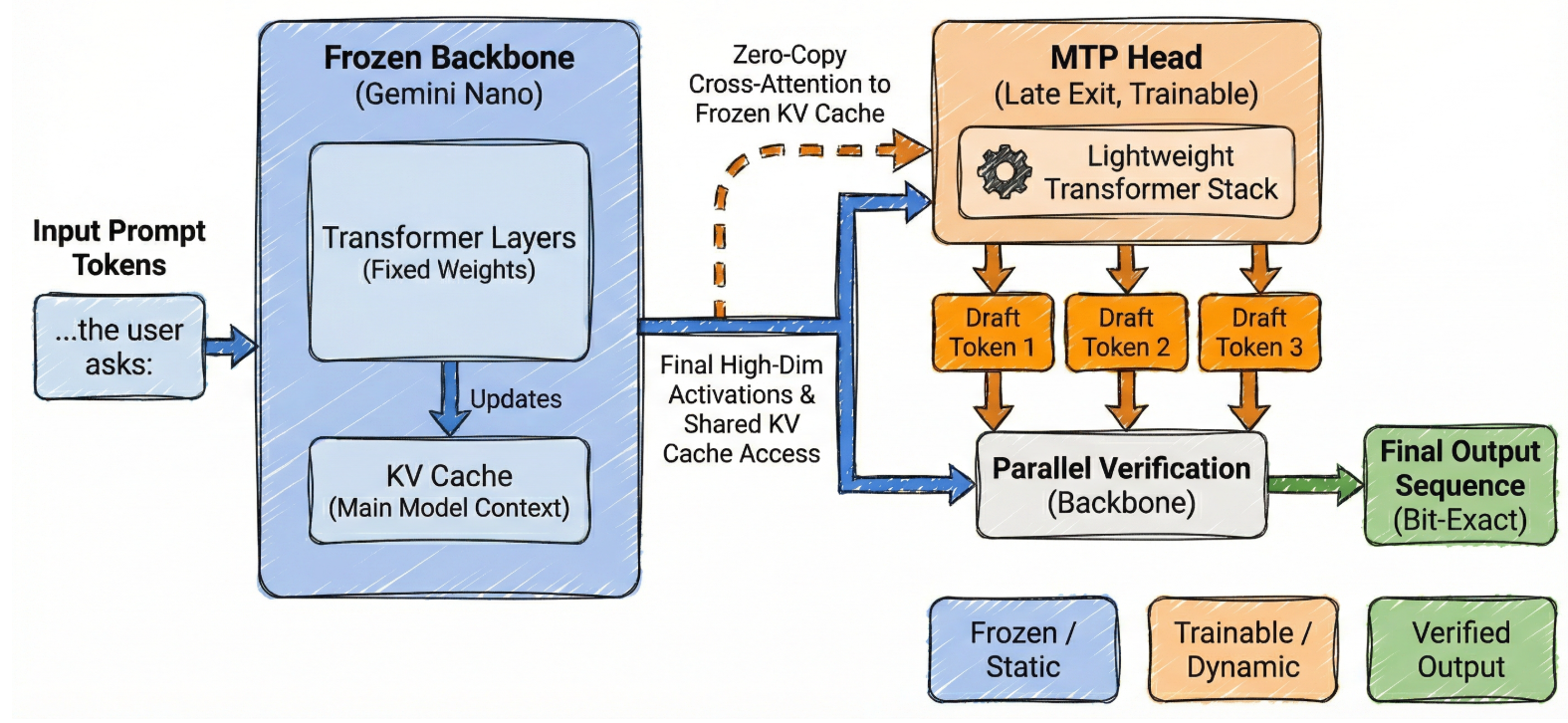
🧠Google has announced frozen Multi-Token Prediction (MTP) optimization for Gemini Nano models running on Pixel devices, improving inference speed and efficiency. This advancement enables faster on-device AI processing while maintaining model performance, representing progress in deploying capable language models directly on consumer hardware.
🧠 Gemini
AIBullisharXiv – CS AI · Jun 256/10
🧠WinDOM introduces a novel approach to training small 2B-parameter GUI-grounding models through Self-Family Distillation, achieving significant performance improvements without expensive human annotation by leveraging automated DOM-based data collection and rejection sampling techniques.
AIBullishTechCrunch – AI · Jun 216/10
🧠Apple is expanding AI capabilities across iOS 27 beyond Siri, integrating practical AI features throughout the operating system. The move reflects Apple's broader strategy to embed machine learning functionality into core user experiences rather than concentrating AI improvements in a single assistant.
AINeutralStratechery · Jun 116/10
🧠An interview with analyst Ben Bajarin explores Apple's AI strategy and broader developments in the compute industry, likely following WWDC announcements. The discussion addresses how Apple's approach to on-device AI and computational infrastructure positions the company within the competitive AI landscape.
AINeutralarXiv – CS AI · Jun 116/10
🧠Researchers propose a joint optimization framework for deploying large language model reasoning on resource-constrained edge devices, combining adaptive chain-of-thought prompting with distributed mixture-of-experts architecture. The framework dynamically balances reasoning quality and computational efficiency by treating reasoning depth as an optimizable network resource, achieving 90% accuracy and latency satisfaction with minimal inference overhead.
AINeutralarXiv – CS AI · Jun 95/10
🧠Researchers propose HASA, a subnet allocation algorithm for federated learning that assigns model sizes to edge devices based on data heterogeneity rather than just compute constraints. The method improves prediction accuracy across distributed clients while maintaining fixed computational budgets, with implications for efficient on-device AI deployment.
AIBullishTechCrunch – AI · Jun 96/10
🧠Apple is making strategic progress in artificial intelligence through a measured, integration-focused approach rather than chasing headline-grabbing AI models. The company's deliberate strategy appears vindicated as it positions itself competitively in the AI industry race, potentially defusing concerns about being left behind by more aggressive competitors.
AINeutralcrypto.news · Jun 86/10
🧠Apple unveiled new Siri AI capabilities and Apple Intelligence features at WWDC, alongside software updates across iOS 27, iPadOS 27, macOS 27, watchOS 27, and visionOS. The announcements include expanded parental controls, though Apple's stock declined following the presentation.
AIBullishCrypto Briefing · Jun 76/10
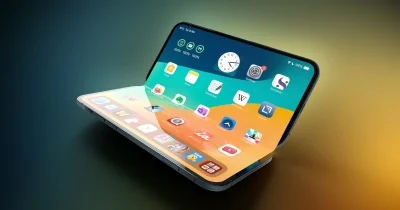
🧠Apple announced AI features and a foldable iPhone model at WWDC 2026, signaling a strategic shift in product innovation and artificial intelligence integration. The announcements, combined with leadership changes, reflect Apple's commitment to maintaining competitive advantage and investor confidence in emerging technologies.
AINeutralThe Verge – AI · Jun 56/10
🧠Major tech companies including Nvidia, Microsoft, and Google are pushing AI-integrated laptops as the next computing paradigm, with Nvidia's Jensen Huang unveiling new hardware designed specifically for on-device AI workloads. However, the article raises a critical question about market demand: whether consumers and enterprises actually want these AI-centric devices or if vendors are creating solutions in search of problems.
🏢 Nvidia🧠 Gemini
AINeutralarXiv – CS AI · May 286/10
🧠Apple has published research on foundation language models powering Apple Intelligence, including a 3 billion parameter on-device model and a larger server-based model for Private Cloud Compute. The announcement demonstrates Apple's commitment to developing efficient, responsible AI systems that balance performance with privacy.