#privacy News & Analysis
Recent coverage of #privacy has grown substantially, with 136 articles published in the last 30 days across the indexed collection of 441 total pieces. Discussion sentiment has shifted notably bullish, rising to 86.8% positive—an 18.8 percentage point increase compared to the previous quarter. The conversation centers heavily on artificial intelligence systems, with OpenAI, ChatGPT, and Gemini featuring prominently alongside broader concerns about #security and #machine-learning.
Academic research from arXiv dominates the source landscape, complemented by specialist coverage from crypto-focused outlets. The topic frequently intersects with blockchain discussions, particularly around Bitcoin and Ethereum. Scan the articles below to explore how privacy considerations are shaping current debates across technology and digital assets.
sentiment · last 30d (136 articles) · +18.8pp bullish vs prior 90dTop sources:arXiv – CS AI · 194Blockonomi · 20CoinDesk · 16crypto.news · 15U.Today · 14
Most-discussed entities:OpenAI · 8ChatGPT · 7Gemini · 6Claude · 6Anthropic · 6
AINeutralarXiv – CS AI · Jun 56/10
🧠Researchers introduce Synapse, a federated learning framework using typed artifacts that enables heterogeneous language models to collaborate without sharing weights or data. The system enables cross-architectural model transfer with minimal performance loss while maintaining formal privacy guarantees and schema-aware merging capabilities.
🧠 GPT-4
CryptoBearishBitcoinist · Jun 56/10
⛓️Bitcoin developer Peter Todd has raised concerns about integrating Zcash-style privacy features into Bitcoin's base layer, citing excessive cryptographic risk. The debate intensified following a disclosure by ZODL developers regarding a vulnerability in Zcash's Orchard shielded pool, reigniting questions about whether advanced privacy protocols are suitable for Bitcoin's consensus mechanism.
$BTC
GeneralNeutralCrypto Briefing · Jun 46/10
📰The European Parliament has switched from Google to Qwant, a European search engine, as part of a broader tech sovereignty initiative. This move reflects Europe's strategic effort to reduce dependence on American tech giants and build independent digital infrastructure.
AINeutralarXiv – CS AI · Jun 46/10
🧠Researchers present a framework for exact unlearning in reinforcement learning that enables efficient removal of user data upon request, with computational costs only a ρ√ln T fraction of full retraining. The work establishes both an algorithm achieving near-optimal regret bounds for tabular MDPs and matching lower bounds, advancing the theoretical foundation for privacy-preserving machine learning systems.
AIBullishCrypto Briefing · Jun 36/10
🧠Nvidia has unveiled RTX Spark, a technology designed to enhance local AI capabilities on Windows PCs. The innovation promises to strengthen security through on-device processing while creating new commercial opportunities for technology companies.
🏢 Nvidia
AINeutralDecrypt – AI · Jun 36/10
🧠Perplexity has introduced a hybrid inference system that distributes AI computational tasks between user devices and cloud servers automatically. The approach aims to reduce server costs, improve privacy, and lower latency by leveraging local processing power where feasible.
🏢 Perplexity
GeneralNeutralCoinDesk · Jun 35/10
GeneralNeutralarXiv – CS AI · Jun 35/10
GeneralNeutralarXiv – CS AI · Jun 35/10
GeneralNeutralarXiv – CS AI · Jun 35/10
GeneralNeutralarXiv – CS AI · Jun 35/10
AINeutralarXiv – CS AI · Jun 26/10
🧠Researchers propose Visual-Noise Guided In-Context Distillation (VGID), a novel framework for removing sensitive knowledge from multimodal large language models without full retraining. The method combines visual perturbation with textual in-context unlearning to achieve parameter-level knowledge removal while maintaining model performance, addressing critical privacy and safety concerns in MLLMs.
AI × CryptoBullishBlockonomi · Jun 16/10
🤖Tether has integrated Google's TurboQuant technology into production, enabling AI models to compress memory usage by up to 5x while maintaining quality. This advancement allows consumer devices like laptops and phones to run extended AI sessions locally without cloud reliance, advancing privacy-focused and efficient AI inference.
CryptoNeutralDecrypt · Jun 16/10
⛓️BChat is a decentralized messaging application built on the Beldex Network that addresses perceived limitations of traditional end-to-end encryption by implementing additional privacy layers. The platform represents an emerging class of privacy-focused communication tools leveraging blockchain infrastructure to enhance user anonymity beyond conventional E2EE standards.
AINeutralarXiv – CS AI · Jun 16/10
🧠A new study finds that language models can improve by learning from their own generated text, but only when the synthetic data is compatible with the student model's existing capabilities. The research reveals that synthetic data utility is relational rather than intrinsic, and surprisingly, this self-training approach can reduce verbatim memorization by 95% without explicit unlearning objectives.
AINeutralarXiv – CS AI · Jun 16/10
🧠Researchers introduce Speech Generation Speaker Poisoning (SGSP), a framework for removing specific speaker identities from zero-shot text-to-speech models while maintaining utility for other speakers. The study evaluates privacy-utility trade-offs and identifies scalability limitations when attempting to forget more than 15 speakers, highlighting emerging challenges in generative voice privacy.
AINeutralarXiv – CS AI · Jun 16/10
🧠Researchers propose Gap-K%, a novel method for detecting whether text was part of an LLM's pretraining data by analyzing the probability gap between a model's top prediction and the actual target token. The technique outperforms existing approaches on standard benchmarks and addresses critical privacy and copyright concerns surrounding the opaque datasets used to train large language models.
GeneralBearishFortune Crypto · May 296/10
📰California has sued 23andMe over inadequate data security that allowed hackers to access personal information from nearly 7 million users in a 2023 breach. The company agreed to a $50 million settlement in the resulting class-action lawsuit, highlighting growing regulatory scrutiny of genetic testing companies' cybersecurity practices.
CryptoBullishcrypto.news · May 296/10
⛓️Zcash has reached a milestone with 30% of its circulating supply now held in the shielded pool, a privacy-focused metric that signals growing adoption of on-chain privacy features rather than speculative price movement. This development demonstrates meaningful user engagement with Zcash's core privacy functionality and reflects increasing demand for confidential transactions.
AINeutralCrypto Briefing · May 286/10
🧠Apple is previewing a significant overhaul of Siri and new iOS 27 features ahead of its WWDC conference, emphasizing more integrated and customizable AI experiences. The update signals Apple's strategic pivot toward user-centric AI design that prioritizes personalization and control over generic AI assistants.
GeneralBullishGoogle Research Blog · May 276/10
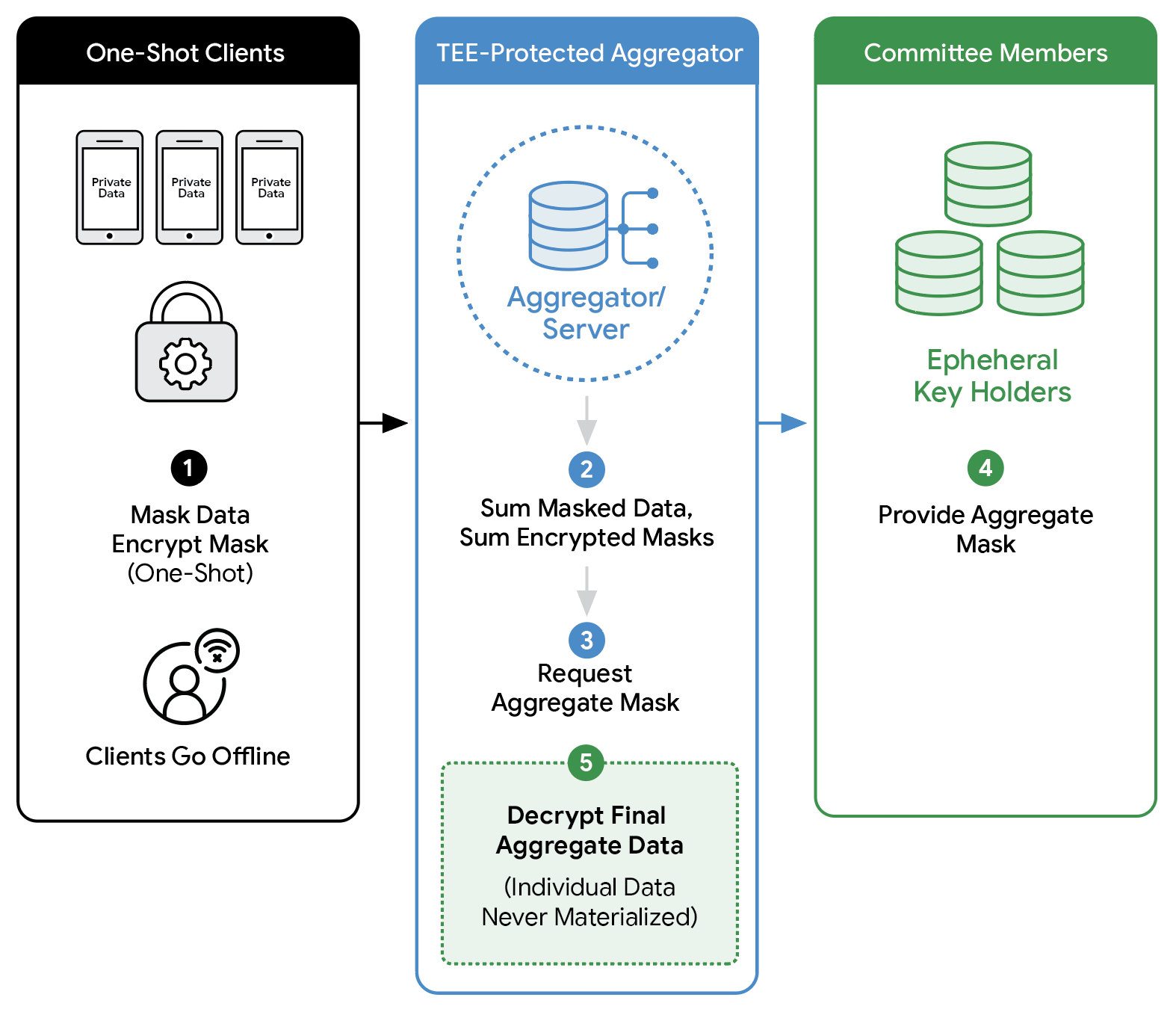
📰Zero-trust aggregation enables private analytics by aggregating sensitive data without exposing individual records, combining security protocols with privacy-preserving computation. This approach addresses the growing tension between data utility and user privacy, allowing organizations to extract insights while maintaining cryptographic guarantees against unauthorized access or data breaches.
CryptoBullishThe Block · May 276/10
⛓️Aztec Labs has acquired ZKPassport from the Obsidian team, with founders Michael Elliot and Theo Madzou joining Aztec to continue development. The company commits to maintaining ZKPassport's privacy protocol and iOS mobile app as open-source, signaling confidence in privacy-focused cryptographic solutions within the broader blockchain ecosystem.
CryptoBullishCrypto Briefing · May 276/10
⛓️QuickNode has integrated enterprise-grade RPC and validator infrastructure support for Aleo, a privacy-focused blockchain platform. This partnership aims to enhance adoption of privacy-preserving solutions while improving security and scalability for decentralized finance applications.
CryptoBearishU.Today · May 276/10
⛓️Shiba Inu (SHIB) faces potential displacement from the top-30 cryptocurrencies by market capitalization as NEAR Protocol surged 138% in May, driven by renewed investor interest in privacy-focused and utility-focused blockchain projects. This shift reflects broader market rotation away from meme coins toward projects with stronger technological fundamentals and use cases.
$NEAR
AINeutralarXiv – CS AI · May 276/10
🧠Researchers demonstrate that Gaussian mechanisms for hidden-state privacy face a fundamental trade-off, with no configurations achieving both moderate utility and moderate privacy against adaptive attackers. A diagonal inverse-Fisher mechanism emerges as minimax-optimal but sits at the privacy-utility boundary rather than within an achievable middle ground, suggesting future work must redesign architectures rather than optimize within existing Gaussian frameworks.