AIBullisharXiv – CS AI · Apr 156/10
🧠Researchers propose Heuristic Classification of Thoughts (HCoT), a novel prompting method that integrates expert system heuristics into large language models to improve structured reasoning on complex problems. The approach addresses LLMs' stochastic token generation and decoupled reasoning mechanisms by using heuristic classification to guide and optimize decision trajectories, demonstrating superior performance and token efficiency compared to existing methods like Chain-of-Thoughts and Tree-of-Thoughts prompting.
AINeutralarXiv – CS AI · Apr 156/10
🧠Researchers present a systematic study of seven tactics for reducing cloud LLM token consumption in coding-agent workloads, demonstrating that local routing combined with prompt compression can achieve 45-79% token savings on certain tasks. The open-source implementation reveals that optimal cost-reduction strategies vary significantly by workload type, offering practical guidance for developers deploying AI coding agents at scale.
🏢 OpenAI
AINeutralarXiv – CS AI · Apr 156/10
🧠Researchers propose a prompt evolution framework that uses classifier-guided evolutionary algorithms to improve generative AI outputs. Rather than enhancing prompts before generation, the method applies selection pressure during the generative process to produce images better aligned with user preferences while maintaining diversity.
AINeutralarXiv – CS AI · Apr 146/10
🧠Researchers introduce Agent Mentor, an open-source analytics pipeline that monitors and automatically improves AI agent behavior by analyzing execution logs and iteratively refining system prompts with corrective instructions. The framework addresses variability in large language model-based agent performance caused by ambiguous prompt formulations, demonstrating consistent accuracy improvements across multiple configurations.
AINeutralarXiv – CS AI · Apr 146/10
🧠A large-scale empirical study of 679 GitHub instruction files shows that AI coding agent performance improves by 7-14 percentage points when rules are applied, but surprisingly, random rules work as well as expert-curated ones. The research reveals that negative constraints outperform positive directives, suggesting developers should focus on guardrails rather than prescriptive guidance.
AINeutralarXiv – CS AI · Apr 146/10
🧠SRBench introduces a comprehensive evaluation framework for Sequential Recommendation models that combines Large Language Models with traditional neural network approaches. The benchmark addresses critical gaps in existing evaluation methodologies by incorporating fairness, stability, and efficiency metrics alongside accuracy, while establishing fair comparison mechanisms between LLM-based and neural network-based recommendation systems.
🏢 Meta
AIBullisharXiv – CS AI · Apr 136/10
🧠Researchers present PETITE, a tutor-student multi-agent framework that enhances LLM problem-solving by assigning complementary roles to agents from the same model. Evaluated on coding benchmarks, the approach achieves comparable or superior accuracy to existing methods while consuming significantly fewer tokens, demonstrating that structured role-differentiated interactions can improve LLM performance more efficiently than larger models or heterogeneous ensembles.
AINeutralarXiv – CS AI · Apr 106/10
🧠Researchers introduce TeamLLM, a multi-LLM collaboration framework that emulates human team structures with distinct roles to improve performance on complex, multi-step tasks. The team proposes a new CGPST benchmark for evaluating LLM performance on contextualized procedural tasks, demonstrating substantial improvements over single-perspective approaches.
AIBullisharXiv – CS AI · Apr 76/10
🧠Researchers introduce Context Engineering, a structured methodology for improving AI output quality through better context assembly rather than just prompting techniques. The study of 200 AI interactions showed that structured context reduced iteration cycles from 3.8 to 2.0 and improved first-pass acceptance rates from 32% to 55%.
🧠 ChatGPT🧠 Claude
AIBullisharXiv – CS AI · Apr 76/10
🧠Researchers developed I-CALM, a prompt-based framework that reduces AI hallucinations by encouraging language models to abstain from answering when uncertain, rather than providing confident but incorrect responses. The method uses verbal confidence assessment and reward schemes to improve reliability without model retraining.
🧠 GPT-5
AINeutralarXiv – CS AI · Apr 76/10
🧠Research study reveals that when Claude Opus 4.6 deobfuscates JavaScript code, poisoned identifier names from the original string table consistently survive in the reconstructed code, even when the AI demonstrates correct understanding of the code's semantics. Changing the task framing from 'deobfuscate' to 'write fresh implementation' significantly reduced this persistence while maintaining algorithmic accuracy.
🧠 Claude🧠 Haiku🧠 Opus
AIBullisharXiv – CS AI · Apr 66/10
🧠Research shows that smaller open-source AI models can match frontier models in mathematical proof verification when using specialized prompts, despite being up to 25% less consistent with general prompts. The study demonstrates that models like Qwen3.5-35B can achieve performance comparable to Gemini 3.1 Pro through LLM-guided prompt optimization, improving accuracy by up to 9.1%.
🧠 Gemini
AIBullishMarkTechPost · Apr 56/10
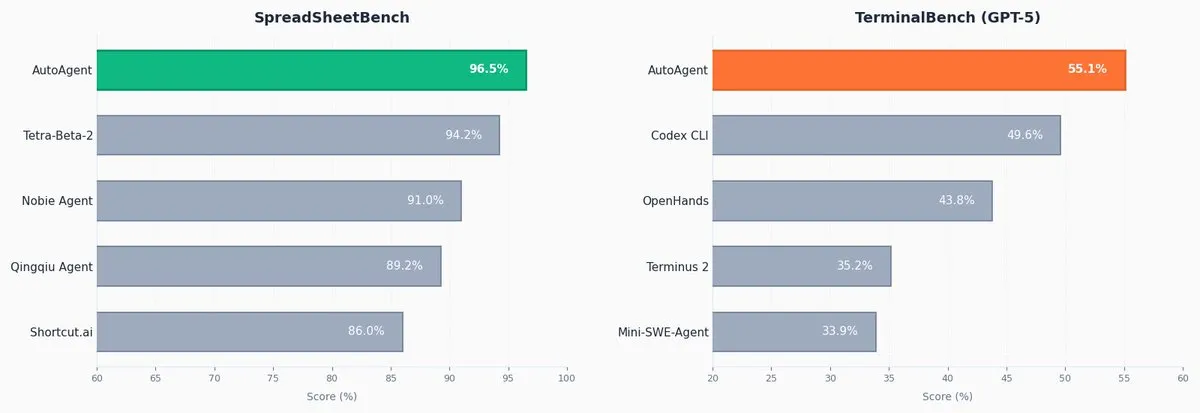
🧠AutoAgent is a new open-source library that automates the tedious process of prompt engineering and agent optimization for AI developers. The tool allows AI systems to engineer and optimize their own agent configurations overnight, potentially eliminating the manual prompt-tuning loop that typically requires dozens of iterations.
AIBullisharXiv – CS AI · Mar 276/10
🧠Researchers developed UF-FGTG, a framework that automatically converts novice user prompts into model-preferred prompts for text-to-image AI systems. The system uses a novel Coarse-Fine Granularity Prompts dataset and achieved 5% improvement across quality metrics compared to existing methods.
AINeutralarXiv – CS AI · Mar 176/10
🧠Researchers have introduced Prompt Readiness Levels (PRL), a nine-level maturity framework for evaluating and governing AI prompt assets in production environments. The system includes a multidimensional scoring method (PRS) designed to ensure prompt engineering meets operational, safety, and compliance standards across organizations.
AIBullisharXiv – CS AI · Mar 176/10
🧠Researchers propose a theoretical framework based on category theory to formalize meta-prompting in large language models. The study demonstrates that meta-prompting (using prompts to generate other prompts) is more effective than basic prompting for generating desirable outputs from LLMs.
AINeutralarXiv – CS AI · Mar 166/10
🧠Researchers discovered that large language models exhibit gender bias at the individual question level, creating different amounts of information for men versus women despite appearing unbiased at category levels. A new benchmark dataset called RealWorldQuestioning was developed, and a simple prompt-based debiasing approach was shown to improve response quality in 78% of cases.
🏢 Hugging Face🧠 ChatGPT
AIBullisharXiv – CS AI · Mar 166/10
🧠Researchers developed UniPrompt-CL, a new continual learning method specifically designed for medical AI that addresses the limitations of existing approaches when applied to medical data. The method uses a unified prompt pool design and regularization to achieve better performance while reducing computational costs, improving accuracy by 1-3 percentage points in domain-incremental learning settings.
AIBullisharXiv – CS AI · Mar 126/10
🧠Researchers developed and tested five prompt engineering strategies to reduce hallucinations in large language models for industrial applications. The Enhanced Data Registry method achieved 100% success rate in trials, while other methods showed varying degrees of improvement in producing consistent, factually grounded outputs.
AINeutralarXiv – CS AI · Mar 116/10
🧠A new academic paper introduces context engineering as a discipline for managing AI agent decision-making environments, proposing a maturity model that includes prompt, context, intent, and specification engineering. The research addresses enterprise challenges in scaling multi-agent AI systems, with 75% of enterprises planning deployment within two years despite current scaling difficulties.
🏢 Google🏢 Anthropic
AIBullisharXiv – CS AI · Mar 96/10
🧠Researchers developed a new training method to improve the robustness of AI foundation models like SAM3 for medical image segmentation by reducing sensitivity to prompt variations. The approach groups semantically similar prompts together and uses consistency constraints to ensure more reliable predictions across different prompt formulations.
AIBullisharXiv – CS AI · Mar 36/107
🧠Researchers introduce ROSA2, a framework that improves Large Language Model interactions by simultaneously optimizing both prompts and model parameters during test-time adaptation. The approach outperformed baselines by 30% on mathematical tasks while reducing interaction turns by 40%.
AIBullisharXiv – CS AI · Mar 36/103
🧠Researchers developed a meta-learning approach for Large Multimodal Models (LMMs) that uses distilled soft prompts to improve few-shot visual question answering performance. The method outperformed traditional in-context learning by 21.2% and parameter-efficient finetuning by 7.7% on VQA tasks.
AIBullisharXiv – CS AI · Mar 36/104
🧠Researchers introduce MetaTuner, a new framework that combines prompt optimization with fine-tuning for Large Language Models, using shared neural networks to discover optimal combinations of prompts and parameters. The approach addresses the discrete-continuous optimization challenge through supervised regularization and demonstrates consistent performance improvements across benchmarks.
AINeutralarXiv – CS AI · Mar 26/1016
🧠Research reveals that large language models don't significantly benefit from conditioning on their own previous responses in multi-turn conversations. The study found that omitting assistant history can reduce context lengths by up to 10x while maintaining response quality, and in some cases even improves performance by avoiding context pollution where models over-condition on previous responses.