AINeutralarXiv – CS AI · Jun 15/10
🧠Researchers introduce BEA-Dialogue+, an expanded Hungarian conversational speech recognition corpus that nearly triples training data from 85 to 200 hours while maintaining speaker separation across dataset splits. The expanded resource enables better evaluation of automatic speech recognition models and demonstrates that specialized fine-tuning techniques improve performance on dialogue transcription tasks.
AIBullisharXiv – CS AI · May 296/10
🧠Researchers introduce Agentic ASR, a multi-turn interactive speech recognition framework that enables iterative refinement of recognized speech through semantic correction and reasoning-based editing. The approach addresses limitations of single-pass ASR systems by aligning with human communication patterns, introducing a new semantic evaluation metric (S²ER) that better captures meaning-critical errors than traditional token-level metrics.
AINeutralarXiv – CS AI · May 276/10
🧠Researchers introduce MetaSICL, a post-training method that enhances auditory large language models' ability to learn from in-context demonstrations without fine-tuning. The approach uses high-resource speech data to improve performance on low-resource tasks, outperforming traditional fine-tuning methods when labeled data is scarce or domain-mismatched.
AINeutralarXiv – CS AI · May 126/10
🧠Researchers present a unified mathematical framework for Test-Time Adaptation (TTA) in autoregressive generative models, decomposing entropy minimization into token-level policy gradient and entropy losses. Validated on Whisper ASR across 20+ domains, the approach demonstrates consistent performance improvements and reconciles previously disparate adaptation methods under a single theoretical foundation.
AINeutralarXiv – CS AI · May 126/10
🧠Researchers have developed Bangla-WhisperDiar, a fine-tuned speech recognition and speaker diarization system that achieves a 24.41% word error rate for ASR and 23.92% diarization error rate. The work addresses critical gaps in Bangla language processing by combining OpenAI's Whisper model with PyAnnote's diarization framework, trained on custom datasets with extensive data augmentation techniques.
AIBullisharXiv – CS AI · Apr 136/10
🧠Researchers propose Interactive ASR, a new framework that combines semantic-aware evaluation using LLM-as-a-Judge with multi-turn interactive correction to improve automatic speech recognition beyond traditional word error rate metrics. The approach simulates human-like interaction, enabling iterative refinement of recognition outputs across English, Chinese, and code-switching datasets.
AIBearisharXiv – CS AI · Mar 276/10
🧠Researchers introduced WildASR, a multilingual diagnostic benchmark revealing that current ASR systems suffer severe performance degradation in real-world conditions despite achieving near-human accuracy on curated tests. The study found that ASR models often hallucinate plausible but unspoken content under degraded inputs, creating safety risks for voice agents.
AIBullishMarkTechPost · Mar 266/10
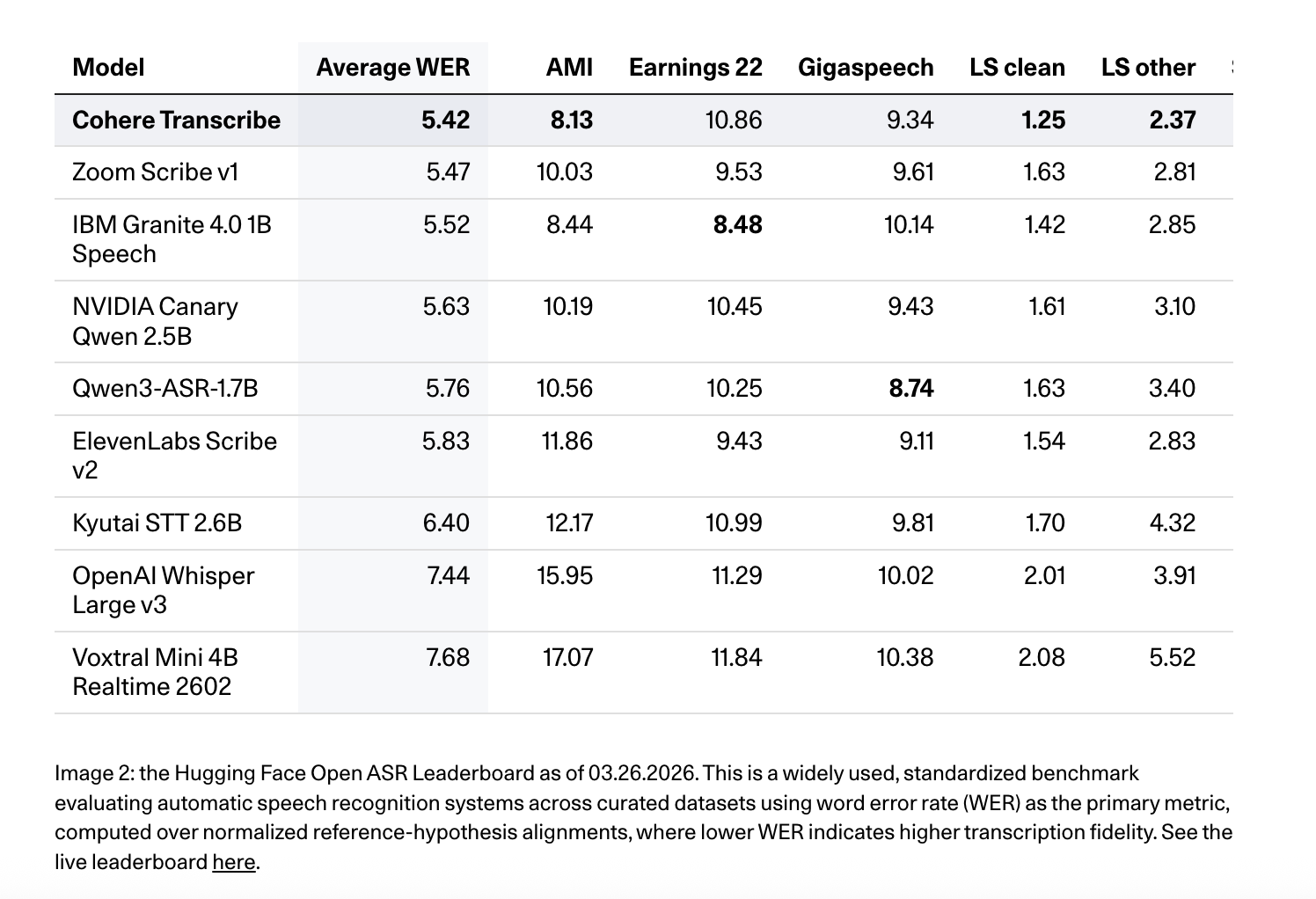
🧠Cohere AI has released Cohere Transcribe, a new state-of-the-art Automatic Speech Recognition (ASR) model designed for enterprise applications. This marks the company's expansion beyond text generation and embedding models into the speech recognition market, targeting enterprise speech intelligence solutions.
🏢 Cohere
AIBullishMarkTechPost · Mar 176/10
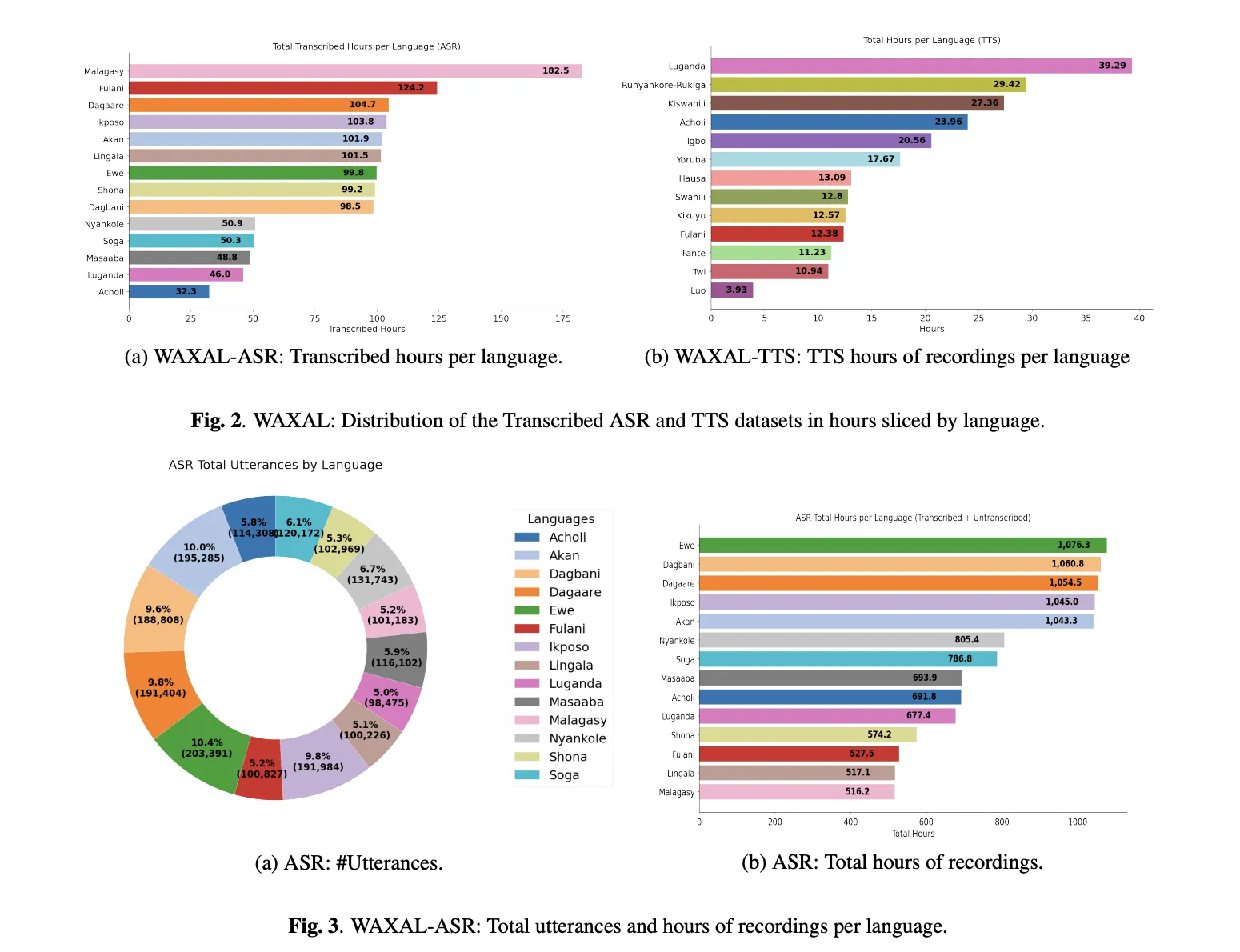
🧠Google AI has released WAXAL, an open multilingual speech dataset covering 24 African languages to improve Automatic Speech Recognition and Text-to-Speech systems. This addresses the significant data distribution problem where African languages remain poorly represented in speech technology training corpora.
🏢 Google
AIBullishMarkTechPost · Mar 166/10
🧠IBM has released Granite 4.0 1B Speech, a compact multilingual speech-language model optimized for automatic speech recognition and translation. The model is specifically designed for enterprise and edge deployments where memory efficiency, low latency, and compute optimization are critical alongside performance quality.
AIBullisharXiv – CS AI · Mar 126/10
🧠Researchers developed a protocol to evaluate speaker verification capabilities in speech-aware large language models, finding weak performance with error rates above 20%. They introduced ECAPA-LLM, a lightweight augmentation that achieves 1.03% error rate by integrating speaker embeddings while maintaining natural language interface.
AINeutralarXiv – CS AI · Mar 116/10
🧠Researchers introduce SCENEBench, a new benchmark for evaluating Large Audio Language Models (LALMs) beyond speech recognition, focusing on real-world audio understanding including background sounds, noise localization, and vocal characteristics. Testing of five state-of-the-art models revealed significant performance gaps, with some tasks performing below random chance while others achieved high accuracy.
AIBullisharXiv – CS AI · Mar 45/103
🧠Researchers developed GLoRIA, a parameter-efficient framework for automatic speech recognition that adapts to regional dialects using location metadata. The system achieves state-of-the-art performance while updating less than 10% of model parameters and demonstrates strong generalization to unseen dialects.
AIBullisharXiv – CS AI · Mar 37/107
🧠Researchers introduce Whisper-MLA, a modified version of OpenAI's Whisper speech recognition model that uses Multi-Head Latent Attention to reduce GPU memory consumption by up to 87.5% while maintaining accuracy. The innovation addresses a key scalability issue with transformer-based ASR models when processing long-form audio.
AIBullisharXiv – CS AI · Mar 26/1010
🧠Researchers developed SHINE, a Sequential Hierarchical Integration Network for analyzing brain signals (EEG/MEG) to detect speech from neural activity. The system achieved high F1-macro scores of 0.9155-0.9184 in the LibriBrain Competition 2025 by reconstructing speech-silence patterns from magnetoencephalography signals.
AIBullisharXiv – CS AI · Mar 27/1012
🧠Researchers have introduced Hello-Chat, an end-to-end audio language model designed to create more realistic and emotionally resonant AI conversations. The model addresses the robotic nature of existing Large Audio Language Models by using real-life conversation data and achieving breakthrough performance in prosodic naturalness and emotional alignment.
AIBullisharXiv – CS AI · Feb 276/107
🧠Researchers developed a new AI framework using RNN-T architecture to improve speech recognition for Taiwanese Hakka, an endangered low-resource language with high dialectal variability. The system achieved 57% and 40% relative error rate reductions for two different writing systems, marking the first systematic investigation into Hakka dialect variations in ASR.
AINeutralApple Machine Learning · Feb 256/103
🧠Research identifies a significant performance gap between speech-adapted Large Language Models and their text-based counterparts on language understanding tasks. Current approaches to bridge this gap rely on expensive large-scale speech synthesis methods, highlighting a key challenge in extending LLM capabilities to audio inputs.
AINeutralApple Machine Learning · Feb 246/102
🧠Researchers introduce AMUSE, a new benchmark for evaluating multimodal large language models in multi-speaker dialogue scenarios. The framework addresses current limitations of models like GPT-4o in tracking speakers, maintaining conversational roles, and reasoning across audio-visual streams in applications such as conversational video assistants.
AIBullishMicrosoft Research Blog · Feb 56/103
🧠Microsoft Research launched Paza, a human-centered speech recognition pipeline, and PazaBench, the first benchmark leaderboard specifically designed for low-resource languages. The initiative covers 39 African languages with 52 models and has been tested with real communities to improve AI accessibility for underrepresented languages.
AINeutralarXiv – CS AI · Mar 264/10
🧠Researchers developed a new training framework to address contextual exposure bias in Speech-LLMs, where models trained on perfect conversation history perform poorly with error-prone real-world context. Their approach combines teacher error knowledge, context dropout, and direct preference optimization to improve robustness, achieving WER reductions from 5.59% to 5.17% on TED-LIUM 3.
AIBullisharXiv – CS AI · Mar 175/10
🧠Researchers have developed a Video-Guided Post-ASR Correction (VPC) framework that uses Video-Large Multimodal Models to improve speech recognition accuracy in complex environments like TV series. The system addresses challenges with multiple speakers, overlapping speech, and domain-specific terminology by leveraging video context to refine ASR outputs.
AINeutralarXiv – CS AI · Mar 175/10
🧠Researchers developed a novel Bayesian Low-rank Adaptation method for personalizing automatic speech recognition systems to better understand impaired speech. The approach addresses challenges in ASR systems like Whisper that struggle with non-normative speech patterns from conditions like cerebral palsy, using data-efficient fine-tuning on English and German datasets.
AIBullisharXiv – CS AI · Mar 175/10
🧠Researchers developed a reproducible pipeline to transform public Zoom recordings into speaker-attributed transcripts for training LLMs to simulate realistic civic deliberations. The method achieved 67% reduction in perplexity and nearly doubled performance metrics, with human evaluations showing simulations often indistinguishable from real government meetings.
🏢 Perplexity
AINeutralarXiv – CS AI · Mar 54/10
🧠Researchers introduce ACES, a new method to analyze how automatic speech recognition systems perform differently across accents. The study finds that accent information is concentrated in early neural network layers and is deeply intertwined with speech recognition capabilities, making simple bias removal ineffective.