AIBullishCrypto Briefing · Jun 77/10
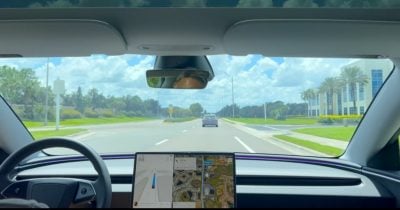
🧠Tesla demonstrated autonomous driving capabilities with a San Francisco to Palo Alto round trip, signaling progress toward commercial robotaxi services. The company's shift from vehicle sales to recurring subscription-based autonomous transportation could fundamentally reshape its revenue model and the transportation industry.
AINeutralCrypto Briefing · Jun 47/10
🧠Tesla has begun deploying unsupervised robotaxis in the Austin metropolitan area, marking a significant step in autonomous vehicle commercialization. The rollout reveals substantial engineering and operational challenges in scaling autonomous fleets, which could influence investor sentiment toward autonomous vehicle companies and reshape competitive dynamics in the mobility sector.
AIBullishCrypto Briefing · Jun 17/10
🧠Tesla's Full Self-Driving (FSD) Supervised system has successfully completed coast-to-coast autonomous drives without human intervention, marking a significant milestone in autonomous vehicle development. The achievement could reshape the competitive landscape, disrupt traditional automotive markets, and trigger intensified regulatory scrutiny around safety standards and liability frameworks.
AIBullishCrypto Briefing · May 307/10
🧠Tesla has begun production of its Cybercab with reported record-breaking efficiency metrics that could significantly reduce operational costs in ride-hailing. The development potentially disrupts the autonomous vehicle industry by demonstrating cost advantages that competitors will struggle to match.
AIBullishBlockonomi · Mar 177/10
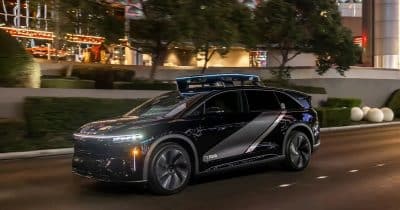
🧠Uber stock rose 3% following the announcement of a major partnership with Nvidia to deploy robotaxis across 28 cities by 2028. The rollout will begin with Los Angeles and San Francisco in early 2027, marking a significant expansion of autonomous vehicle technology.
🏢 Nvidia
AINeutralarXiv – CS AI · Mar 127/10
🧠Researchers propose Simulation-in-the-Reasoning (SiR), a framework that embeds domain-specific simulators into Large Language Model reasoning processes for autonomous transportation systems. The approach transforms LLM reasoning from hypothetical text generation into empirically-grounded, falsifiable hypothesis testing through executable simulation experiments.
GeneralBullishCrypto Briefing · Jun 256/10
📰The US Department of Transportation is moving toward performance-based standards that would eliminate the brake pedal requirement for driverless vehicles. This regulatory shift prioritizes functional safety outcomes over prescriptive hardware specifications, potentially accelerating autonomous vehicle innovation and commercialization.
AINeutralarXiv – CS AI · Jun 236/10
🧠Researchers propose a multi-agent deep reinforcement learning framework to optimize pricing and incentives across shared mobility services and public transport, balancing competing objectives between authorities, providers, and commuters. Simulations demonstrate the approach reduces congestion by 20%, lowers emissions by 10%, and doubles public transport profit while improving equity.
AIBullishCrypto Briefing · Jun 216/10
🧠Humble Robotics secured $24 million in funding to develop autonomous freight trucks, aiming to address logistics industry challenges including driver shortages and emissions. The investment signals growing commercial interest in autonomous vehicle technology for long-haul transportation.
AIBullishCrypto Briefing · Jun 196/10
🧠Go completed a ¥88.6 billion IPO in Japan, signaling strong investor appetite for autonomous vehicle technology and platform consolidation. The company plans to deploy robotaxis and pursue strategic acquisitions to reshape Japan's fragmented taxi industry.
GeneralBullishBlockonomi · Jun 196/10
📰FedEx reports Q4 earnings on June 23 with analyst expectations of $5.96 EPS and $24B revenue. The logistics giant's stock has surged 40% year-to-date, driven by its freight business spin-off and aggressive cost-cutting initiatives, positioning the company for potential continued momentum.
AINeutralMIT News – AI · Jun 115/10
🧠Jinhua Zhao has been appointed head of the Department of Urban Studies and Planning. Zhao is recognized for expertise in behavioral science, transportation, and the intersection of AI with public policy, positioning the department to address contemporary urban challenges through interdisciplinary approaches.
AINeutralarXiv – CS AI · Jun 96/10
🧠Researchers developed a method using vision language models to predict pedestrian crossing intentions from egocentric video footage, achieving state-of-the-art results through fine-tuning and incorporating contextual cues like eye gaze and ego motion. The approach frames pedestrian intent prediction as a visual question answering task and demonstrates 14.5% accuracy improvement over specialized baselines, with implications for autonomous vehicle safety systems.
GeneralNeutralarXiv – CS AI · Jun 95/10
📰Researchers propose a practical jam-absorption driving (JAD) strategy inspired by police-car swerving to suppress stop-and-go traffic waves on freeways. The SD-JAD approach uses two roadside detectors to measure key parameters and guide a vehicle through strategic slow-in/fast-out maneuvers, successfully preventing wave propagation without creating secondary congestion.
AINeutralarXiv – CS AI · Jun 85/10
🧠Researchers propose STDAE, a spatio-temporal deep learning framework that reconstructs missing ramp flow data at highway interchanges using mainline traffic information. The model matches the performance of systems with actual ramp data, addressing a critical infrastructure gap where real-time ramp detectors are unavailable.
AINeutralarXiv – CS AI · Jun 46/10
🧠Researchers introduce AgentMob, a training-free LLM-driven agent framework that improves mobility prediction by using adaptive evidence gathering rather than static prompts. The system achieves strong performance on multiple datasets by distinguishing routine cases from ambiguous ones, with significant accuracy improvements on difficult prediction scenarios.
🧠 GPT-5
AINeutralarXiv – CS AI · Jun 26/10
🧠A comprehensive survey examines how large language models and multimodal LLMs are being applied to transportation systems management and operations across three domains: operations, fleet services, and decision support. The research identifies LLMs as promising decision-support tools while highlighting key challenges in real-time inference, data integration, and explainability that must be addressed for operational deployment.
AINeutralarXiv – CS AI · May 295/10
🧠Researchers present a four-stage framework for modeling tourist mobility in urban areas using GPS data, spatial priors, demographic analysis, and LLM-based activity generation. The approach privacy-preservingly synthesizes individual tourist schedules that align with survey data and observed visitation patterns, demonstrated through case study analysis in Tokyo.
AINeutralarXiv – CS AI · May 296/10
🧠Researchers present a comprehensive review of network optimization challenges in Connected and Autonomous Vehicles (CAVs), addressing misconceptions while outlining future directions through multidisciplinary approaches like cooperative perception. The article draws on extensive CAVs experience to provide practical insights and experimental results relevant to the industry's development.
GeneralBearishFortune Crypto · May 116/10
📰President Trump proposes suspending the federal gas tax, a move intended to provide consumer relief but raising concerns about infrastructure funding and increased national debt. Research suggests consumers may not fully benefit from the tax holiday, while the policy could exacerbate funding shortfalls for road maintenance and repairs.
AIBullishCrypto Briefing · May 107/10
🧠Tesla achieved a coast-to-coast cannonball run using its Full Self-Driving (FSD) system without any human interventions, demonstrating significant progress in autonomous vehicle technology. While the milestone showcases rapid advancement in self-driving capabilities, broader commercial adoption will depend on proving consistent safety across diverse driving conditions and weather scenarios.
AIBullisharXiv – CS AI · May 96/10
🧠Researchers at the University of Minnesota developed an AI-powered CCTV analytics framework to measure the effectiveness of soft infrastructure interventions (temporary pedestrian refuges, curb extensions) on traffic safety. The study found speed reductions of 16-20% at both signalized and unsignalized intersections in Minneapolis, demonstrating that computer vision-based traffic analysis enables rapid, cost-effective evaluation of urban design policies.
AINeutralBlockonomi · Mar 267/10
🧠Uber's stock declined 1.3% despite launching Europe's first commercial autonomous taxi service in Zagreb, Croatia, in partnership with Pony.ai and Verne. The market reaction suggests investor skepticism about the immediate impact of this milestone on Uber's business.
AIBullisharXiv – CS AI · Mar 35/104
🧠Researchers developed a novel framework using large language models (LLMs) to analyze electric vehicle taxi driver charging behavior by integrating psychological traits and environmental factors. The study demonstrates that LLMs can reliably simulate real-world charging decisions across multiple urban environments, providing insights for optimizing charging infrastructure and energy policy.
GeneralNeutralFortune Crypto · Jun 276/10
📰Venture capitalist Joe Lonsdale, a Boring Company investor, pitched Austin's mayor a $2.6 billion citywide tunnel system comprising 45 stations to be built by Elon Musk's Boring Company. The proposal would begin with a smaller-scale tunnel connecting properties owned by Lonsdale's associates, demonstrating how private capital and infrastructure ambitions intersect with urban transportation planning.