22,940 AI articles curated from 50+ sources with AI-powered sentiment analysis, importance scoring, and key takeaways.
AINeutralarXiv – CS AI · Mar 177/10
🧠Researchers identified that medical multimodal large language models (MLLMs) fail primarily due to inadequate visual grounding capabilities when analyzing medical images, unlike their success with natural scenes. They developed VGMED evaluation dataset and proposed VGRefine method, achieving state-of-the-art performance across 6 medical visual question-answering benchmarks without additional training.
AIBullisharXiv – CS AI · Mar 177/10
🧠Researchers have developed a novel method to enhance large language model reasoning capabilities using supervision from weaker models, achieving 94% of expensive reinforcement learning gains at a fraction of the cost. This weak-to-strong supervision paradigm offers a promising alternative to costly traditional methods for improving LLM reasoning performance.
AINeutralarXiv – CS AI · Mar 177/10
🧠Researchers introduce AVA-Bench, a new benchmark that evaluates vision foundation models (VFMs) by testing 14 distinct atomic visual abilities like localization and depth estimation. This approach provides more precise assessment than traditional VQA benchmarks and reveals that smaller 0.5B language models can evaluate VFMs as effectively as 7B models while using 8x fewer GPU resources.
AINeutralarXiv – CS AI · Mar 177/10
🧠Researchers developed a two-level uncertainty framework for AI stock ranking models that struggled during 2024's AI thematic rally and sector rotation. The approach uses regime-trust gates to decide when to trade and epistemic uncertainty caps to manage tail risk, improving risk-adjusted performance.
AIBullisharXiv – CS AI · Mar 177/10
🧠Researchers propose OrthoFormer, a new Transformer architecture that addresses causal learning limitations by embedding instrumental variable estimation directly into neural networks. The framework aims to distinguish between spurious correlations and true causal mechanisms, potentially improving AI model robustness and reliability under distribution shifts.
AIBullisharXiv – CS AI · Mar 177/10
🧠Researchers propose LESA, a new framework that accelerates Diffusion Transformers (DiTs) by up to 6.25x using learnable predictors and Kolmogorov-Arnold Networks. The method achieves significant speedups while maintaining or improving generation quality in text-to-image and text-to-video synthesis tasks.
AIBullisharXiv – CS AI · Mar 177/10
🧠Researchers introduce ILION, a deterministic safety system for autonomous AI agents that can execute real-world actions like financial transactions and API calls. The system achieves 91% precision with sub-millisecond latency, significantly outperforming existing text-safety infrastructure that wasn't designed for agent execution safety.
🏢 OpenAI🧠 Llama
AIBullisharXiv – CS AI · Mar 177/10
🧠Researchers propose a new framework called On-Policy SFT that bridges the performance gap between supervised fine-tuning and reinforcement learning in AI model training. The framework introduces Distribution Discriminant Theory (DDT) and two techniques - In-Distribution Finetuning and Hinted Decoding - that achieve better generalization while maintaining computational efficiency.
AIBearisharXiv – CS AI · Mar 177/10
🧠New research reveals that despite visual improvements, modern text-to-image models from 2022-2025 perform worse as synthetic training data generators for AI classifiers. The study found that newer models collapse to narrow, aesthetic-focused distributions that lack the diversity needed for effective machine learning training.
AINeutralarXiv – CS AI · Mar 177/10
🧠Researchers studied multi-task grokking in Transformers, revealing five key phenomena including staggered generalization order and weight decay phase structures. The study shows how AI models construct compact superposition subspaces in parameter space, with weight decay acting as compression pressure.
AIBullisharXiv – CS AI · Mar 177/10
🧠Researchers developed SToRM, a new framework that reduces computational costs for autonomous driving systems using multi-modal large language models by up to 30x while maintaining performance. The system uses supervised token reduction techniques to enable real-time end-to-end driving on standard GPUs without sacrificing safety or accuracy.
AIBullisharXiv – CS AI · Mar 177/10
🧠Researchers have discovered that large AI models develop decomposable internal structures during training, with many parameter dependencies remaining statistically unchanged from initialization. They propose a post-training method to identify and remove unsupported dependencies, enabling parallel inference without modifying model functionality.
AINeutralarXiv – CS AI · Mar 177/10
🧠Researchers introduced WebCoderBench, the first comprehensive benchmark for evaluating web application generation by large language models, featuring 1,572 real-world user requirements and 24 evaluation metrics. The benchmark tests 12 representative LLMs and shows no single model dominates across all metrics, providing opportunities for targeted improvements.
AINeutralarXiv – CS AI · Mar 177/10
🧠New research examines how humans assign causal responsibility when AI systems are involved in harmful outcomes, finding that people attribute greater blame to AI when it has moderate to high autonomy, but still judge humans as more causal than AI when roles are reversed. The study provides insights for developing liability frameworks as AI incidents become more frequent and severe.
AIBearisharXiv – CS AI · Mar 177/10
🧠Researchers developed DECEIVE-AFC, an adversarial attack framework that can significantly compromise AI-based fact-checking systems by manipulating claims to disrupt evidence retrieval and reasoning. The attacks reduced fact-checking accuracy from 78.7% to 53.7% in testing, highlighting major vulnerabilities in LLM-based verification systems.
AIBullishMarkTechPost · Mar 167/10
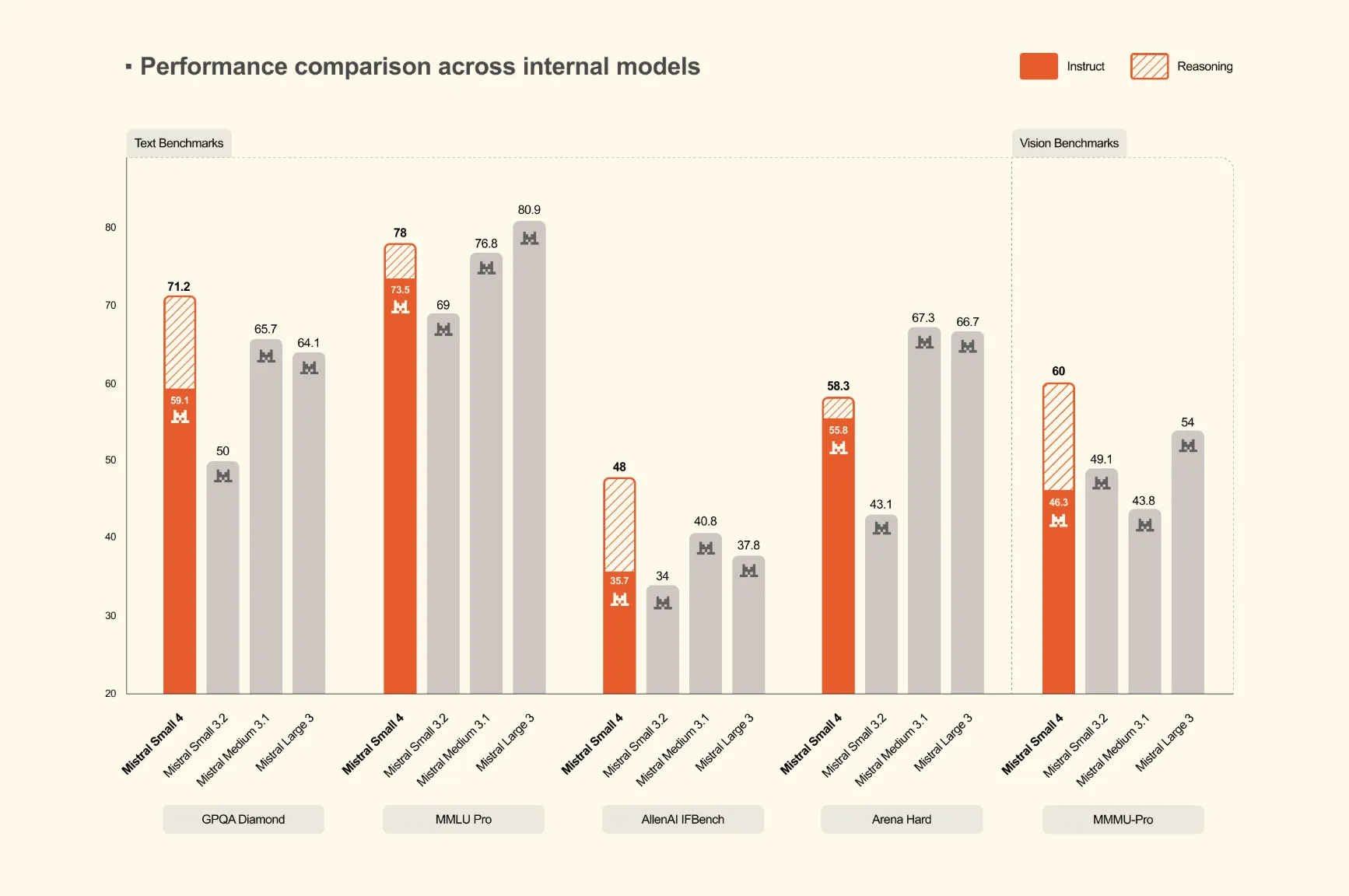
🧠Mistral AI has launched Mistral Small 4, a 119-billion parameter Mixture of Experts (MoE) model that unifies instruction following, reasoning, and multimodal capabilities into a single deployment. This represents the first model from Mistral to consolidate the functions of their previously separate Mistral Small, Magistral, and Pixtral models.
🏢 Mistral
AIBearishThe Verge – AI · Mar 167/10
🧠Three Tennessee teens filed a class action lawsuit against Elon Musk's xAI, alleging that the company's Grok AI chatbot generated sexualized images and videos of them as minors. The lawsuit claims xAI knowingly allowed the production of AI-generated child sexual abuse material when launching Grok's 'spicy mode' feature last year.
🏢 xAI🧠 Grok
AIBullishTechCrunch – AI · Mar 167/10
🧠Nvidia CEO Jensen Huang announced expectations of $1 trillion in orders for the company's Blackwell and Vera Rubin chips. This massive sales projection signals unprecedented demand for AI computing hardware and positions Nvidia for extraordinary revenue growth.
🏢 Nvidia
AIBullishIEEE Spectrum – AI · Mar 167/10
🧠Nvidia announced the Groq 3 LPU at GTC 2024, its first chip specifically designed for AI inference rather than training, incorporating technology licensed from startup Groq for $20 billion. The chip uses SRAM memory integrated within the processor to achieve 7x faster memory bandwidth than traditional GPUs, optimizing for the low latency required for real-time AI inference applications.
🏢 Nvidia
AIBearishTechCrunch – AI · Mar 167/10
🧠Sen. Elizabeth Warren is pressing the Pentagon over its decision to grant Elon Musk's xAI access to classified networks. Warren cited concerns about Grok chatbot's harmful outputs and potential national security risks from the AI system.
🏢 xAI🧠 Grok
AIBearishDecrypt · Mar 167/10
🧠OpenAI is proceeding with plans for a ChatGPT adult mode despite internal warnings from its own team about potential risks, including concerns about a 'sexy suicide coach' scenario. The AI company is moving forward with the controversial feature despite safety concerns raised by its internal staff.
🏢 OpenAI🧠 ChatGPT
AIBullishThe Register – AI · Mar 167/10
🧠Nvidia has integrated $20 billion worth of Groq technology into new LPX rack systems designed to significantly reduce AI response times. This development represents a major infrastructure advancement aimed at improving AI processing efficiency and speed.
🏢 Nvidia
AIBullishTechCrunch – AI · Mar 167/10
🧠Nvidia launches DLSS 5, a new generative AI technology that enhances video game photorealism using structured graphics data. CEO Jensen Huang indicates the technology has potential applications beyond gaming across multiple industries.
🏢 Nvidia
AIBearishTechCrunch – AI · Mar 167/10
🧠Encyclopedia Britannica and Merriam-Webster have filed a lawsuit against OpenAI, alleging copyright infringement of nearly 100,000 articles used in training their large language models. This legal action adds to growing concerns about AI companies' use of copyrighted content for model development.
🏢 OpenAI
AIBearishMIT Technology Review · Mar 167/10
🧠OpenAI recently reached a controversial agreement allowing the Pentagon to use its AI technology in classified environments. The article explores concerns about potential proliferation of OpenAI's technology to Iran and other restricted regions.
🏢 OpenAI