21,049 AI articles curated from 50+ sources with AI-powered sentiment analysis, importance scoring, and key takeaways.
AIBullishAI News · Mar 176/10
🧠Trustpilot is pursuing partnerships with large eCommerce companies as AI-driven shopping grows, with CEO Adrian Blair noting that AI agents need comprehensive business information to make effective consumer decisions. The move comes as traditional search methods decline and AI systems require more structured data sources.
AIBullishBlockonomi · Mar 176/10
🧠BBVA increased its Shopify stake by 59.9% while analysts set a $163.38 price target. President Finkelstein announced new AI agent shopping strategy as part of Shopify's innovation push.
AINeutralBlockonomi · Mar 176/10
🧠Google is partnering with Chinese suppliers like Envicool to secure liquid cooling equipment for its AI data centers amid global supply chain constraints. Analysts maintain a Strong Buy rating on GOOGL stock as the company addresses infrastructure challenges for AI operations.
AINeutralFortune Crypto · Mar 177/10
🧠AI is fundamentally changing how professional value is measured by making traditional productivity metrics obsolete. Leaders must now focus on uniquely human capabilities that machines cannot replicate as the definition of workplace worth shifts away from pure output.
AIBullishMarkTechPost · Mar 176/10
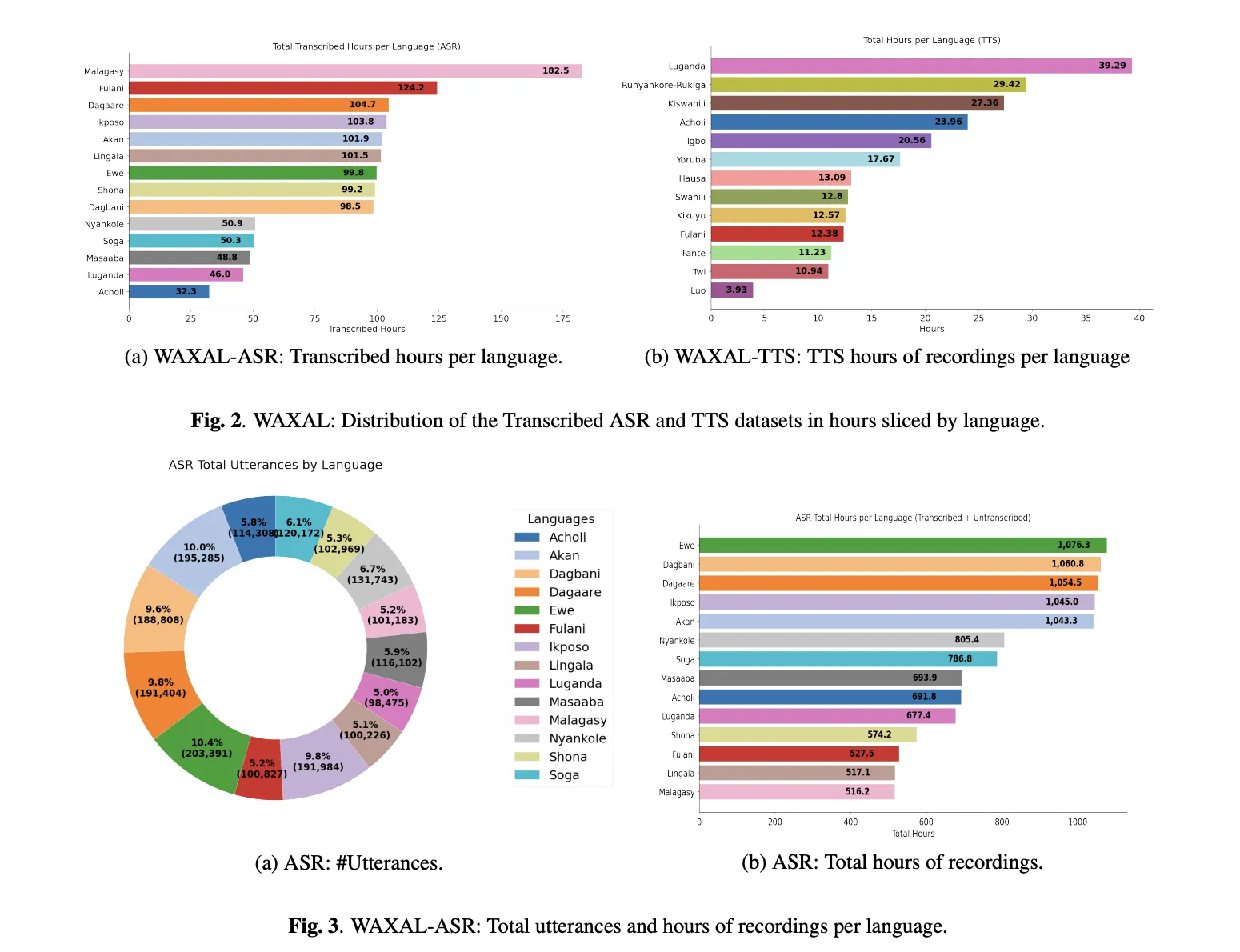
🧠Google AI has released WAXAL, an open multilingual speech dataset covering 24 African languages to improve Automatic Speech Recognition and Text-to-Speech systems. This addresses the significant data distribution problem where African languages remain poorly represented in speech technology training corpora.
🏢 Google
AIBullisharXiv – CS AI · Mar 176/10
🧠Researchers propose a dual-path AI framework combining Variational Autoencoders and Wasserstein GANs for real-time fraud detection in banking systems. The system achieves sub-50ms detection latency while maintaining GDPR compliance through selective explainability mechanisms for high-uncertainty transactions.
AIBullisharXiv – CS AI · Mar 176/10
🧠Researchers developed plan conditioning, a training-free method that significantly improves diffusion language model reasoning by prepending short natural-language plans from autoregressive models. The technique improved performance by 11.6 percentage points on math problems and 12.8 points on coding tasks, bringing diffusion models to competitive levels with autoregressive models.
🧠 Llama
AIBullisharXiv – CS AI · Mar 176/10
🧠Researchers developed a Hierarchical Takagi-Sugeno-Kang Fuzzy Classifier System that converts opaque deep reinforcement learning agents into human-readable IF-THEN rules, achieving 81.48% fidelity in tests. The framework addresses the critical explainability problem in AI systems used for safety-critical applications by providing interpretable rules that humans can verify and understand.
AIBullisharXiv – CS AI · Mar 176/10
🧠Researchers propose EMBRAG, a new framework that combines large language models with knowledge graphs to improve reasoning accuracy and reduce hallucinations. The system generates multiple logical rules from queries and applies them in embedding space, achieving state-of-the-art performance on knowledge graph question-answering benchmarks.
AIBullisharXiv – CS AI · Mar 176/10
🧠Researchers introduce DOVA (Deep Orchestrated Versatile Agent), a multi-agent AI platform that improves research automation through deliberation-first orchestration and hybrid collaborative reasoning. The system reduces inference costs by 40-60% on simple tasks while maintaining deep reasoning capabilities for complex research requiring multi-source synthesis.
AIBullisharXiv – CS AI · Mar 176/10
🧠Researchers developed a method to control AI safety refusal behavior using categorical refusal tokens in Llama 3 8B, enabling fine-grained control over when models refuse harmful versus benign requests. The technique uses steering vectors that can be applied during inference without additional training, improving both safety and reducing over-refusal of harmless prompts.
🧠 Llama
AINeutralarXiv – CS AI · Mar 176/10
🧠A new research paper identifies the 'AI-Fiction Paradox' - AI models desperately need fiction for training data but struggle to generate quality fiction themselves. The paper outlines three core challenges: narrative causation requiring temporal paradoxes, informational revaluation that conflicts with current attention mechanisms, and multi-scale emotional architecture that current AI cannot orchestrate effectively.
AIBearisharXiv – CS AI · Mar 176/10
🧠Researchers introduce HEARTS, a comprehensive benchmark for evaluating large language models' ability to reason over health time series data across 16 datasets and 12 health domains. The study reveals that current LLMs significantly underperform compared to specialized models and struggle with multi-step temporal reasoning in healthcare applications.
AINeutralarXiv – CS AI · Mar 176/10
🧠Researchers propose MESD (Multi-category Explanation Stability Disparity), a new metric to detect procedural bias in AI models across intersectional groups. They also introduce UEF framework that balances utility, explanation quality, and fairness in machine learning systems.
AIBearisharXiv – CS AI · Mar 176/10
🧠A new research study reveals that AI judges used to evaluate the safety of large language models perform poorly when assessing adversarial attacks, often degrading to near-random accuracy. The research analyzed 6,642 human-verified labels and found that many attacks artificially inflate their success rates by exploiting judge weaknesses rather than generating genuinely harmful content.
AIBearisharXiv – CS AI · Mar 176/10
🧠Researchers introduced MDial, the first large-scale framework for generating multi-dialectal conversational data across nine English dialects, revealing that over 80% of English speakers don't use Standard American English. Evaluation of 17 LLMs showed even frontier models achieve under 70% accuracy in dialect identification, with particularly poor performance on non-American dialects.
AIBullisharXiv – CS AI · Mar 176/10
🧠Researchers introduce Imagine-then-Plan (ITP), a new AI framework that enables agents to learn through adaptive lookahead imagination using world models. The system allows AI agents to simulate multi-step future scenarios and adjust planning horizons dynamically, significantly outperforming existing methods in benchmark tests.
AINeutralarXiv – CS AI · Mar 176/10
🧠EgoGrasp introduces the first method to reconstruct world-space hand-object interactions from egocentric videos using open-vocabulary objects. The multi-stage framework combines vision foundation models with body-guided diffusion models to achieve state-of-the-art performance in 3D scene reconstruction and hand pose estimation.
AINeutralarXiv – CS AI · Mar 176/10
🧠Researchers have developed a new white-box watermarking framework that uses chaotic sequences to embed ownership information into deep neural network parameters for intellectual property protection. The method uses logistic maps and genetic algorithms to verify model ownership without degrading performance, showing effectiveness on MNIST and CIFAR-10 datasets.
AIBullisharXiv – CS AI · Mar 176/10
🧠Researchers introduce Agentic Retoucher, a new AI framework that fixes common distortions in text-to-image generation through a three-agent system for perception, reasoning, and correction. The system outperformed existing methods on a new 27K-image dataset, potentially improving the quality and reliability of AI-generated images.
AIBullisharXiv – CS AI · Mar 176/10
🧠Researchers developed LabelFusion, a hybrid AI architecture combining Large Language Models with transformer encoders for financial news classification. The system achieves 96% F1 score on full datasets but LLMs alone perform better in low-data scenarios, suggesting different strategies based on available training data.
AIBullisharXiv – CS AI · Mar 176/10
🧠Researchers developed VLAD-Grasp, a training-free robotic grasping system that uses vision-language models to detect graspable objects without requiring curated datasets. The system achieves competitive performance with state-of-the-art methods on benchmark datasets and demonstrates zero-shot generalization to real-world robotic manipulation tasks.
AINeutralarXiv – CS AI · Mar 176/10
🧠Research reveals that while increasing the number of LLM agents improves mathematical problem-solving accuracy, these multi-agent systems remain vulnerable to adversarial attacks. The study found that human-like typos pose the greatest threat to robustness, and the adversarial vulnerability gap persists regardless of agent count.
🧠 Llama
AIBullisharXiv – CS AI · Mar 176/10
🧠GlobalRAG is a new reinforcement learning framework that significantly improves multi-hop question answering by decomposing questions into subgoals and coordinating retrieval with reasoning. The system achieves 14.2% average improvements in performance metrics while using only 42% of the training data required by baseline models.
AIBullisharXiv – CS AI · Mar 176/10
🧠Researchers introduce Slow-Fast Policy Optimization (SFPO), a new reinforcement learning framework that improves training stability and efficiency for large language model reasoning. SFPO outperforms existing methods like GRPO by up to 2.80 points on math benchmarks while requiring up to 4.93x fewer rollouts and 4.19x less training time.