#ai-agents News & Analysis
Coverage of #ai-agents has generated 98 articles over the past month, with 61.2% maintaining a bullish sentiment. Discussion remains stable compared to the previous quarter, reflecting consistent interest rather than sudden shifts in outlook. The conversation centers on major AI models including GPT-5 and Claude, with substantial research contributions tracked through arXiv's computer science and AI channels alongside cryptocurrency-focused outlets.
The topic frequently intersects with machine learning, large language models, and automation research, while also appearing alongside discussions of blockchain assets like Ethereum and Bitcoin. Scan the articles below to explore how #ai-agents are being developed, deployed, and analyzed across technical and financial perspectives.
sentiment · last 30d (98 articles)Top sources:arXiv – CS AI · 243Crypto Briefing · 19CoinDesk · 18Fortune Crypto · 12TechCrunch – AI · 12
Most-discussed entities:GPT-5 · 13Claude · 13Anthropic · 10OpenAI · 9Opus · 6
AIBullishAI News · Jun 47/10
🧠Meta has launched Business Agent, an AI system that automates customer service and transactions directly within Instagram, Messenger, and WhatsApp. The technology enables retail brands to handle support tickets and execute transactions autonomously, embedding agentic AI into social commerce workflows at scale.
AIBullishOpenAI News · Jun 47/10
🧠Endava is leveraging AI agents, ChatGPT Enterprise, and Codex to transform its software delivery processes, automating workflows and accelerating development cycles. The initiative represents a broader enterprise shift toward AI-native operations that prioritizes efficiency and developer productivity.
🧠 ChatGPT
AI × CryptoBullishcrypto.news · Jun 47/10
🤖AI agents are transitioning from experimental tools to active market participants in decentralized finance, with industry experts like Neyro's Andrew Isaacs suggesting DeFi could become a key sector demonstrating AI's tangible value. The development raises important questions about maintaining user control and autonomy while leveraging AI capabilities for trading optimization.
AIBullisharXiv – CS AI · Jun 47/10
🧠MapAgent is an AI framework that automates lane-level map generation for autonomous driving at city scale, combining vision-language models with constraint verification to produce specification-compliant maps. Already deployed by Baidu Maps across 360+ Chinese cities, the system achieves over 95% production automation while reducing manual editing overhead in complex scenarios.
AIBullisharXiv – CS AI · Jun 47/10
🧠Strabo demonstrates how declarative interaction protocols from academic multiagent systems research can be applied to Google's Universal Commerce Protocol (UCP) for AI agent e-commerce interactions. By implementing UCP checkout specifications using formal protocol definitions and achieving interoperability with Google's reference implementation, the work validates a pathway for integrating academic EMAS (Engineering Multiagent Systems) methodologies into industry AI agent infrastructure.
AIBullisharXiv – CS AI · Jun 47/10
🧠Researchers introduce RUBAS, a reinforcement learning framework that improves AI agent safety by using multi-dimensional rubrics to evaluate tool use, argument validity, response quality, and helpfulness. The approach addresses the growing challenge of aligning language model agents for real-world execution tasks while maintaining utility.
AIBearisharXiv – CS AI · Jun 47/10
🧠Researchers have identified widespread Description-Code Inconsistency (DCI) in Model Context Protocol servers, where tool descriptions don't match actual implementations. A study of 2,214 MCP servers found that 9.93% of description-code pairs exhibit inconsistencies, creating security vulnerabilities that enable operational failures and malicious behavior in LLM-powered applications.
AIBullisharXiv – CS AI · Jun 47/10
🧠Researchers introduce Curation-Bench, a benchmark demonstrating that AI agents can automate data curation—a critical bottleneck in AI development—by iteratively proposing and refining data-selection policies. While agents reach strong baselines quickly, they struggle to explore novel approaches without structured scaffolding that guides them toward methodological adaptation rather than local optimization.
AIBullisharXiv – CS AI · Jun 47/10
🧠Researchers propose an ontology-grounded framework for pre-deployment verification of enterprise AI agents, combining formalized operational envelopes with automated regulatory scenario generation and trust certification. A controlled pilot across fintech, banking, insurance, and healthcare found ontology-based testing achieved 48.3% regulatory coverage versus 33.1% for persona-based baselines, establishing a new standard for AI safety assurance in regulated industries.
🧠 Claude🧠 Sonnet
AIBullisharXiv – CS AI · Jun 47/10
🧠Researchers propose Self-Evolving Prompt Optimization (SePO), a novel system that automatically optimizes AI agent prompts by treating the prompt agent's own instructions as an optimization target. The method demonstrates consistent performance gains across five diverse benchmarks, outperforming existing approaches and showing generalization to unseen tasks.
AIBullisharXiv – CS AI · Jun 47/10
🧠Researchers introduce CyberGym-E2E, a large-scale benchmark with 920 real-world vulnerabilities that evaluates AI agents across the complete vulnerability lifecycle—discovery, proof-of-concept generation, and patch creation. This addresses a critical gap in cybersecurity AI evaluation by testing end-to-end remediation capabilities rather than isolated tasks, establishing a new standard for measuring autonomous vulnerability management systems.
AIBearisharXiv – CS AI · Jun 47/10
🧠Researchers have identified systematic vulnerabilities in LLM-based AI agents that enable memory poisoning attacks, where adversaries inject malicious data into persistent memory to manipulate long-term agent behavior. The study reveals four memory write channels and nine structural vulnerabilities across system design, with existing security defenses proving ineffective against this threat vector.
AI × CryptoNeutralarXiv – CS AI · Jun 47/10
🤖Researchers propose Sello, a cryptographic protocol that addresses a critical vulnerability in AI agent observability by having external services sign tamper-evident receipts of agent actions rather than agents logging their own activity. The system uses receiver-side signing, encryption, and public transparency logs to create an independent audit trail that prevents compromised agents from falsifying records.
AI × CryptoBullishCrypto Briefing · Jun 37/10
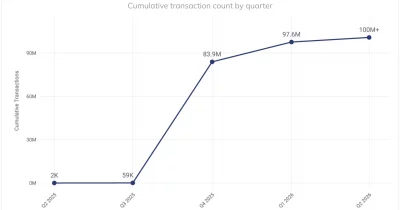
🤖Coinbase's x402 protocol has reached 100 million agentic transactions on its Base blockchain, demonstrating significant adoption of machine-to-machine payment infrastructure. This milestone reflects growing market interest in autonomous agent economies and highlights the potential for AI-driven systems to conduct independent financial transactions at scale.
AI × CryptoBullishDecrypt – AI · Jun 37/10
🤖Mysten Labs has introduced Walrus Memory, a portable memory layer that enables AI agents to retain context across different applications, sessions, and providers while keeping users in control of their data. This development addresses a fundamental limitation in current AI systems where agents lose contextual information when switching between platforms or interactions.
AIBullishTechCrunch – AI · Jun 37/10
🧠Meta has launched its AI agent for WhatsApp Business globally, introducing a token-based pricing model for business customers. This move monetizes AI capabilities within WhatsApp's messaging platform while expanding Meta's AI infrastructure offerings to businesses worldwide.
AIBullishTechCrunch – AI · Jun 37/10
🧠Coralogix, an AI monitoring platform, raised $200M in Series F funding at a $1.6B valuation, betting on growing demand for observability tools that track AI agent behavior. The round reflects investor confidence in infrastructure plays addressing the operational complexity of autonomous AI systems.
AI × CryptoBullishDecrypt – AI · Jun 37/10
🤖MoonPay has launched MoonAgents, a desktop application that integrates AI assistants like Claude and Codex with cryptocurrency wallets and blockchain services through a graphical interface. This development bridges AI capabilities with on-chain functionality, enabling AI systems to execute crypto transactions and interact with blockchain services directly.
🧠 Claude
AI × CryptoNeutralCrypto Briefing · Jun 27/10
🤖George Fraser argues that AI agents require centralized data access to operate effectively, while AI-native companies are disrupting traditional software markets. Simultaneously, new strategies are emerging to restrict and control data access, creating tension between AI performance needs and data governance.
AIBullishArs Technica – AI · Jun 27/10
🧠Microsoft has unveiled Project Solara, an Android-based operating system designed to run AI agents rather than traditional applications. This strategic pivot reflects Microsoft's recognition that it missed the mobile app era and is now positioning itself for an AI-agent-centric computing paradigm.
AIBullishDecrypt · Jun 27/10
🧠Microsoft is productizing OpenClaw as an enterprise AI agent called Scout, leveraging its massive Windows user base of 1.4 billion to drive adoption. This move positions Microsoft to dominate enterprise AI agent deployment at scale, though the technology itself is not new to the market.
AIBullishThe Verge – AI · Jun 27/10
🧠Microsoft has launched Scout, an always-on AI personal assistant built on OpenClaw technology that integrates across Microsoft 365 applications like Outlook, OneDrive, and Teams. Unlike existing Copilot features, Scout functions as a dedicated personal assistant capable of handling calendar management, expense reporting, email drafting, and other productivity tasks for enterprise users.
🏢 Microsoft
AIBullishWired – AI · Jun 27/10
🧠Microsoft has introduced Scout, an AI agent that operates within Teams as a virtual coworker to automate routine office tasks. Built on OpenAI's agent architecture, Scout represents a significant step toward autonomous workplace automation, enabling organizations to delegate time-consuming administrative work to AI systems that operate continuously without human intervention.
AIBullishThe Verge – AI · Jun 27/10
🧠Microsoft announced Project Solara at Build 2026, a new operating system built on Android designed specifically for AI agent-powered devices. The company demonstrated two concept devices—a desk-based unit similar to Amazon Echo Show and a wearable badge—both featuring AI agent integration with biometric security controls.
AI × CryptoBullishCrypto Briefing · Jun 27/10
🤖Crossmint has launched a Visa-powered API enabling AI agents to execute card payments using tokenized credentials, bridging traditional payment infrastructure with autonomous AI systems. This integration allows developers to build AI agents capable of conducting financial transactions, potentially expanding use cases for autonomous systems in commerce and financial services.