AI × CryptoNeutralCrypto Briefing · Jun 257/10
🤖Render Network is experiencing negative GPU supply for the first time since 2018, indicating that demand for computational resources exceeds available capacity. This shortage reflects surging demand for AI infrastructure and decentralized computing, potentially forcing customers to seek alternative providers and highlighting the competitive pressure within the emerging distributed compute market.
$RNDR
AIBullishFortune Crypto · Jun 227/10
🧠Upscale AI, an AI networking startup, has raised $190 million in a new funding round, bringing its total capital to $500 million in under 18 months. Investors are betting the company will become a major infrastructure player in connecting AI chips globally, positioning it as a potential successor to Cisco in the AI era.
AI × CryptoBullishCrypto Briefing · Jun 97/10
🤖SpaceX is developing AI-powered satellites leveraging its existing Starlink infrastructure ahead of a planned IPO, which could transform space-based computing capabilities and reshape the enterprise AI market. This strategic move positions the company to capture emerging opportunities in distributed computing and satellite-based AI services while preparing for a significant capital raise.
AIBullisharXiv – CS AI · Jun 97/10
🧠FlashCP is a new framework that improves context parallelism for training large language models by addressing workload imbalance and inefficient communication. The approach introduces load-balanced sharding strategies and eliminates redundant key-value tensor communication, delivering up to 1.63x speedup over existing methods.
AIBullisharXiv – CS AI · Jun 27/10
🧠Researchers introduce Science Earth, a planet-scale operating system that enables diverse AI capabilities—from simulation clusters to wet-lab robots to proof engines—to autonomously discover, coordinate, and collaborate on scientific problems without pre-designed workflows. Two validation runs demonstrate the system successfully identifying theoretical gaps in mathematical models and generating novel insights from cancer cell data through distributed, self-correcting reasoning.
AI × CryptoBullishBankless · May 287/10
🤖Eigen Labs launched Darkbloom, a system that converts idle Apple Silicon Macs into a distributed private inference network for AI processing. This development addresses computational bottlenecks in AI inference while enabling hardware owners to monetize underutilized devices.
AIBullishCrypto Briefing · May 287/10
🧠AtlasEdge has secured €1.2 billion in funding to deploy AI infrastructure across European secondary markets, positioning itself as a sustainable alternative amid the continent's stringent regulatory environment. The investment reflects growing capital flows toward decentralized AI infrastructure while navigating Europe's evolving compliance framework.
AIBullisharXiv – CS AI · May 127/10
🧠SPECTRE is a new LLM serving framework that improves inference efficiency by repurposing underutilized smaller models as remote drafters for heavily-loaded large models through parallel speculative decoding. The system achieves up to 2.28× speedup on large models like Qwen3-235B while maintaining minimal interference to smaller models' native workloads.
AI × CryptoBullishCrypto Briefing · May 97/10
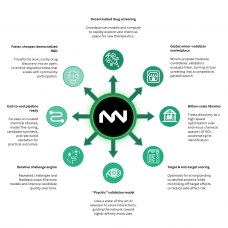
🤖Bittensor's SN68 subnet is being leveraged by Metanova Labs to accelerate pharmaceutical research and development through decentralized AI infrastructure. While this application demonstrates potential to democratize drug discovery and reduce costs, significant validation challenges remain before decentralized approaches can meaningfully compete with traditional pharma workflows.
$TAO
AIBullisharXiv – CS AI · May 17/10
🧠Researchers introduce RoundPipe, a novel pipeline scheduling algorithm that enables efficient fine-tuning of large language models on consumer-grade GPUs by eliminating the weight binding constraint that causes computational bottlenecks. The system achieves 1.48-2.16x speedups over existing approaches and enables fine-tuning of models with up to 235 billion parameters on standard hardware.
AIBullisharXiv – CS AI · Apr 137/10
🧠TensorHub introduces Reference-Oriented Storage (ROS), a novel weight transfer system that enables efficient reinforcement learning training across distributed GPU clusters without physically copying model weights. The production-deployed system achieves significant performance improvements, reducing GPU stall time by up to 6.7x for rollout operations and improving cross-datacenter transfers by 19x.
AI × CryptoBullisharXiv – CS AI · Mar 56/10
🤖Researchers developed a multi-dimensional quality scoring framework for decentralized LLM inference networks that evaluates output quality across multiple dimensions including semantic quality and query-output alignment. The framework integrates with Proof of Quality (PoQ) mechanisms to provide better incentive alignment and defense against adversarial attacks in distributed AI compute networks.
AIBullisharXiv – CS AI · Mar 37/102
🧠Researchers have developed FM Agent, a multi-agent AI framework that combines large language models with evolutionary search to autonomously solve complex research problems. The system achieved state-of-the-art results across multiple domains including operations research, machine learning, and GPU optimization without human intervention.
AIBullisharXiv – CS AI · Feb 277/107
🧠Researchers developed a system that trains large language models using renewable energy during curtailment periods when excess clean electricity would otherwise be wasted. The distributed training approach across multiple GPU clusters reduced operational emissions to 5-12% of traditional single-site training while maintaining model quality.
AI × CryptoBearishCoinTelegraph – AI · Jan 87/10
🤖Nvidia's new Vera Rubin technology significantly reduces AI computing costs, potentially threatening decentralized GPU networks like Render that rely on expensive and underutilized computing resources. This development could disrupt the business model of crypto-based distributed computing platforms.
🏢 Nvidia
AIBullishCrypto Briefing · Jun 236/10
🧠Super Micro Computer has expanded its edge AI system lineup with Intel-powered processors, enhancing real-time processing capabilities for sectors requiring immediate, localized AI inference. This development reflects growing demand for edge computing solutions that process data locally rather than relying on cloud infrastructure.
AI × CryptoBullishThe Block · Jun 226/10
🤖HIVE stock increased 25% following news that Ivy League researchers published neural network training research utilizing GPU infrastructure in Paraguay. The work was submitted to NeurIPS, a premier AI conference, suggesting potential breakthroughs in distributed AI computing or cost-efficient GPU utilization.
AIBullisharXiv – CS AI · Jun 106/10
🧠Researchers introduce GASLoC, a decentralized pre-training algorithm that reduces communication overhead in distributed LLM training by enabling local optimizer steps and sparse peer communication instead of synchronous operations. The method demonstrates competitive or superior performance compared to existing approaches, particularly in heterogeneous bandwidth environments where worker speeds vary significantly.
AI × CryptoNeutralCrypto Briefing · Jun 106/10
🤖SpaceX has delayed orbital AI computing tests to late 2027 and filed for regulatory approval to deploy a 1 million satellite constellation. The expanded network aims to enable distributed AI processing in space but faces substantial technical, regulatory, and logistical hurdles before operationalization.
AINeutralarXiv – CS AI · Jun 86/10
🧠Researchers demonstrate that graph neural networks can learn to execute classical graph algorithms exactly through a two-step training process combining MLPs with NTK theory. The work establishes rigorous theoretical learnability results for distributed computing models and practical algorithms like breadth-first search and Bellman-Ford, advancing understanding of what GNNs can provably learn.
AINeutralarXiv – CS AI · Jun 26/10
🧠Researchers introduce a new class of asynchronous adaptive first-order optimization methods that improve upon existing algorithms through momentum and inexact normalization variants. The methods achieve O(1/√t) convergence rates in stochastic non-convex settings and demonstrate practical relevance for large-scale heterogeneous machine learning systems.
AIBullisharXiv – CS AI · Jun 16/10
🧠Researchers introduce Gaussian-Head OFL, a one-shot federated learning method that reduces communication overhead to a single round by transmitting only statistical summaries instead of full models. The approach combines closed-form Gaussian classifiers with synthetic data generation, achieving competitive accuracy while maintaining privacy and eliminating dependency on public datasets.
AINeutralCrypto Briefing · May 296/10
🧠Nvidia is partnering with homebuilders to deploy small AI data centers in residential backyards, leveraging unused residential power capacity to decentralize AI infrastructure. While the XFRA initiative could reduce strain on centralized data centers and create new revenue streams for homeowners, it faces significant obstacles including scalability concerns, technical integration challenges, and uncertain homeowner adoption rates.
🏢 Nvidia
AIBullisharXiv – CS AI · May 286/10
🧠ASTRA is a new framework that enables efficient multi-device Transformer inference by combining sequence parallelism with mixed-precision attention, allowing non-local token embeddings to be transmitted as compressed codes while maintaining full precision for local attention. The system achieves significant speedups (up to 2.64x) over single-device inference while operating at extremely low bandwidth requirements (as low as 10 Mbps), making it practical for bandwidth-constrained environments.
🧠 Llama
AIBullisharXiv – CS AI · May 116/10
🧠Fluxion, a new hybrid CPU-GPU system, optimizes long-context inference by efficiently managing key-value caches split between host and GPU memory. The approach delivers 1.5x-3.7x speedup over existing baselines while maintaining near-baseline accuracy, addressing a critical bottleneck in modern large language model deployment.