AIBullishCrypto Briefing · Jun 257/10
🧠Stanford researchers have developed AI scientist agents that dramatically accelerate drug discovery, reducing timelines from months to days. This breakthrough could significantly speed up treatment development during health emergencies and reshape pharmaceutical R&D processes.
AIBullisharXiv – CS AI · Jun 257/10
🧠OmegAMP is a deep learning framework that uses diffusion-based generation with biologically informed encoding to design antimicrobial peptides (AMPs) with unprecedented controllability and precision. In wet lab validation, 24 of 25 candidate peptides (96%) demonstrated antimicrobial activity, including against multi-drug resistant strains, potentially accelerating drug discovery for antibiotic-resistant infections.
AIBullishCrypto Briefing · Jun 237/10
🧠Immunologist Derya Unutmaz leveraged GPT-5 Pro to resolve a T cell research question that eluded his laboratory for two years, demonstrating AI's potential to accelerate biomedical discovery. This breakthrough illustrates how advanced language models can dramatically compress research timelines and reshape therapeutic development economics in the biotechnology sector.
🧠 GPT-5
AINeutralarXiv – CS AI · Jun 237/10
🧠Researchers demonstrate that closed-loop automated machine learning systems can discover generalizable improvements in molecular property prediction by having language-model agents modify features, models, and acquire external evidence. Testing across 36 molecular endpoints reveals that while some improvements validate strongly, they don't consistently transfer to held-out test sets, highlighting critical challenges in ensuring reproducibility of AI-driven research discoveries.
AIBullisharXiv – CS AI · Jun 237/10
🧠Researchers introduce BioMatrix, a multimodal foundation model that integrates molecular sequences, structures, protein data, and natural language within a single decoder-only architecture. The model achieves state-of-the-art performance on 77 of 80 downstream tasks, demonstrating that a unified generalist AI can match or exceed specialized biological tools across diverse applications.
AIBearisharXiv – CS AI · Jun 237/10
🧠Researchers reveal that molecular graph neural networks face previously underestimated backdoor attack risks when subjected to chemistry-aware validation checks. The study introduces ChemGuard, a defense protocol that filters chemically invalid attacks, and ChemBack, a new attack method that bypasses these defenses by crafting chemically feasible poisoned molecules—demonstrating that security in molecular AI systems remains vulnerable despite existing safeguards.
AIBullisharXiv – CS AI · Jun 237/10
🧠Researchers introduced UltraNMR, a foundation model trained on 158 million simulated nuclear magnetic resonance spectra that successfully bridges the gap between simulation and real-world molecular analysis. The model demonstrates state-of-the-art performance on experimental NMR tasks and has been applied to identify previously unknown natural products from Chinese herbal medicines, suggesting large-scale simulation pre-training can enable robust generalization in spectroscopy.
AIBullishTechCrunch – AI · Jun 127/10
🧠Prometheus, a physical AI startup backed by Jeff Bezos, raised $12 billion in funding at a $41 billion valuation to develop an artificial general engineer capable of automating complex engineering and drug design tasks. The massive funding round reflects surging investor confidence in AI systems designed for real-world physical automation beyond software applications.
AIBullisharXiv – CS AI · Jun 97/10
🧠Researchers introduce SurfDesign, a novel protein design framework that conditions on molecular surface geometry rather than just backbone structure, integrating surface-based equivariant message passing with pretrained protein language models. The method significantly outperforms existing approaches on de novo binder and enzyme design benchmarks, demonstrating that manifold-aware surface representations provide a more effective foundation for functional protein design.
AIBullishCrypto Briefing · Jun 77/10
🧠The University of Cambridge is conducting the first clinical trial of an AI-designed vaccine targeting coronaviruses, representing a breakthrough in computational drug development. This advancement could accelerate pandemic preparedness by enabling rapid vaccine design against future coronavirus variants and zoonotic spillover events.
AIBullisharXiv – CS AI · Jun 57/10
🧠Researchers propose biomedical world models as an AI paradigm that learns dynamic representations of biological systems to simulate future states and predict responses to interventions. These models could accelerate drug discovery, personalized medicine, and surgical planning by enabling simulation-based experimentation before real-world testing.
AIBullishFortune Crypto · Jun 37/10
🧠Amgen CEO Bob Bradway made early bets on AI in biotech, positioning the company to leverage artificial intelligence for drug discovery and development. The strategy is now generating measurable returns while forcing the organization to navigate tensions between AI-driven automation and the need for specialized scientific expertise.
AIBullisharXiv – CS AI · Jun 27/10
🧠Researchers introduce Symbolic Neural Generators (SNGs), a hybrid neurosymbolic model combining inductive logic programming with large language models to generate molecules meeting formal correctness criteria. The system demonstrates performance comparable to state-of-the-art drug discovery methods on benchmark problems and generates promising inhibitor candidates for poorly understood drug targets.
AIBullisharXiv – CS AI · Jun 27/10
🧠Researchers introduce FTDiff, a reinforcement learning framework that fine-tunes diffusion models for molecular generation in drug design by combining group relative policy optimization with fast sampling techniques. The approach eliminates costly post-hoc processing and complex data curation while balancing multiple drug design objectives more effectively than existing methods.
AINeutralarXiv – CS AI · May 297/10
🧠BioArc introduces a neural architecture search framework that systematically discovers optimal model architectures for biological foundation models, moving beyond generic adaptation of NLP and computer vision models. The research identifies design principles and proposes methods to predict architectures for new biological tasks, providing foundational methodology for next-generation biology-focused AI systems.
AIBullisharXiv – CS AI · May 287/10
🧠Researchers introduce MolLingo, a multi-agent AI system that automates molecular design by coordinating specialized agents through shared memory and domain-specific tools. The system uses BRICS-based Fragment Enumeration to represent molecules in chemically meaningful ways that LLMs can reason about effectively, achieving superior performance on drug design benchmarks compared to frontier models like GPT-5.
🧠 GPT-5
AIBullishMIT Technology Review · May 227/10
🧠During Google I/O, DeepMind CEO Demis Hassabis stated we are approaching the "singularity," signaling that AI-driven scientific advancement is accelerating rapidly. The keynote highlighted Google's positioning of AI as a transformative force for research and development across industries.
🏢 Google
AIBullisharXiv – CS AI · May 127/10
🧠Researchers introduce MolWorld, a novel AI framework that optimizes molecular structures for drug discovery by modeling actionable pathways between molecules. Unlike existing methods, MolWorld ensures discovered candidates are chemically reachable from known compounds through valid intermediate steps, making them practically viable for lead optimization.
AIBullisharXiv – CS AI · May 127/10
🧠Researchers introduce Yeti, a compact protein structure tokenizer that converts protein structures into discrete tokens for multimodal AI models. The approach achieves superior codebook utilization and token diversity while maintaining competitive reconstruction accuracy with 10x fewer parameters than existing solutions, enabling efficient joint generation of protein sequences and structures.
AIBullisharXiv – CS AI · May 117/10
🧠Researchers developed an LLM-based agent system for identifying competing drugs in clinical indications, achieving 83% recall compared to 65% and 60% for competitor systems. The agent validates results using an LLM-as-a-judge approach to minimize hallucinations, reducing biotech due diligence analysis time from 2.5 days to 3 hours in production deployment.
🏢 OpenAI🏢 Perplexity
AIBullisharXiv – CS AI · May 117/10
🧠Researchers have developed an automated framework to generate a large-scale dataset of 163,000 molecule-description pairs by combining rule-based chemical nomenclature parsing with LLM guidance, achieving 98.6% precision in aligning molecular structures with natural language descriptions. This addresses a critical bottleneck in training language models for chemistry applications where manual annotation is prohibitively expensive.
🏢 Hugging Face
AIBullisharXiv – CS AI · May 117/10
🧠Researchers introduce DualLGD, a novel dual-stream diffusion architecture for generating molecular structures from mass spectra data. The method achieves 3x improvement over previous state-of-the-art by separating atom-level and bond-level reasoning into dedicated computation streams, addressing a fundamental circular dependency problem in molecular generation.
AIBullisharXiv – CS AI · May 117/10
🧠FlashMol represents a major breakthrough in computational drug discovery by generating high-quality 3D molecular conformations in just 4 steps, compared to hundreds required by traditional diffusion models. The technique achieves 250x acceleration in sampling speed while matching or exceeding the quality of slower teacher models, potentially transforming the economics of large-scale in silico screening.
AI × CryptoBullishBlockonomi · May 107/10
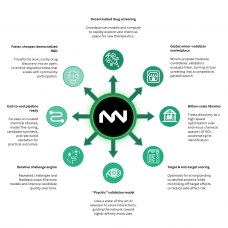
🤖Bittensor Subnet 68 has screened over 11 million molecules across nine disease targets using decentralized computing, demonstrating a practical application of blockchain technology in pharmaceutical research. The subnet operates three live competitions rewarding computational contributions through its Yuma Consensus mechanism, enabling companies like Metanova Labs to conduct drug discovery at reduced operational costs.
$TAO
AI × CryptoBullishCrypto Briefing · May 97/10
🤖Bittensor's SN68 subnet is being leveraged by Metanova Labs to accelerate pharmaceutical research and development through decentralized AI infrastructure. While this application demonstrates potential to democratize drug discovery and reduce costs, significant validation challenges remain before decentralized approaches can meaningfully compete with traditional pharma workflows.
$TAO