#generative-ai News & Analysis
Recent coverage of #generative-ai spans 89 articles in the past month, with sentiment evenly split between bullish and neutral perspectives at 40.4% each, while bearish views account for 19.1%. The overall tone has softened compared to the previous quarter, with bullish sentiment declining 14.1 percentage points. Academic research dominates the discourse through arXiv submissions, while discussions frequently center on specific systems like Stable Diffusion, ChatGPT, and companies such as Anthropic.
The tag currently indexes 264 articles total, with coverage frequently intersecting with #machine-learning, #diffusion-models, and #ai-research. Scan the article list below to explore recent developments and perspectives on the topic.
sentiment · last 30d (89 articles) · -14.1pp bullish vs prior 90dTop sources:arXiv – CS AI · 150TechCrunch – AI · 10Blockonomi · 7Crypto Briefing · 5Fortune Crypto · 5
Most-discussed entities:Stable Diffusion · 6ChatGPT · 6Anthropic · 6Nvidia · 5Gemini · 5
AIBearishCrypto Briefing · May 307/10
🧠Corporate America is reassessing AI spending as infrastructure costs escalate, with research indicating 82% of token spending fails to deliver productive results. The wave of generative AI hype is obscuring practical development challenges and encouraging wasteful capital allocation across enterprises.
AIBullishCrypto Briefing · May 297/10
🧠Bessemer Venture Partners has highlighted Anthropic's exceptional 80x growth rate in Q1, underscoring massive investor confidence in the AI sector. The company's near-trillion-dollar valuation reflects the transformative potential of advanced AI technologies and the substantial capital flowing into the space.
🏢 Anthropic
AINeutralarXiv – CS AI · May 297/10
🧠Researchers demonstrate that Fréchet Inception Distance (FID), a standard metric for evaluating image generators, produces inconsistent results depending on the reference dataset's geometric properties. The study shows that dataset density and effective rank significantly influence FID trends, meaning lower FID scores don't reliably indicate better sample quality across different benchmarks.
AIBullisharXiv – CS AI · May 297/10
🧠Researchers introduce Logit-aware Final-block Quantization (LFQ), a technique that improves low-bit quantization of large language models by optimizing the final transformer block to preserve token probability distributions. This advancement addresses quality degradation in generative tasks while maintaining efficiency gains critical for deploying scaled LLMs.
AIBullisharXiv – CS AI · May 297/10
🧠Researchers introduce Conf-Gen, a framework that extends conformal prediction—a formal uncertainty quantification method—to generative AI models like LLMs and image generators. The work bridges a gap between established machine learning safety techniques and modern unsupervised AI systems, enabling confidence guarantees on generative outputs across multiple domains.
AIBearisharXiv – CS AI · May 297/10
🧠Researchers have established the first comprehensive evaluation framework for dataset watermarking in fine-tuned diffusion models, revealing significant vulnerabilities in existing protection methods. While current watermarking techniques show promise in universality and transmissibility, the study demonstrates practical watermark removal methods that can eliminate these protections without degrading model performance, exposing critical gaps in copyright and security safeguards.
AIBullisharXiv – CS AI · May 297/10
🧠Researchers introduce Mirage Atom Diffusion (MiAD), a novel diffusion model that enables dynamic alteration of atom counts during crystal generation by treating atoms as existing or non-existing states. The technique achieves an 8.2% success rate on the MP-20 dataset for generating stable, unique, and novel crystalline materials, representing a significant improvement over existing methods.
AIBullisharXiv – CS AI · May 297/10
🧠MENTOR is a novel autoregressive framework for multimodal-conditioned image generation that achieves strong visual control and prompt-following performance through efficient two-stage training without relying on auxiliary adapters or cross-attention modules. The method demonstrates superior performance on the DreamBench++ benchmark compared to diffusion-based approaches while requiring fewer training resources.
AIBearisharXiv – CS AI · May 297/10
🧠Researchers challenge the assumption that memorization in text-to-image diffusion models can be localized to specific weights, demonstrating that pruning efforts can be bypassed through minor text embedding perturbations. The study reveals memorization is distributed throughout embedding space, suggesting current mitigation strategies are fundamentally fragile and requiring new approaches to protect training data privacy.
AIBullisharXiv – CS AI · May 297/10
🧠Researchers introduce CityGen, a diffusion-based framework that enables autonomous driving systems to generalize across different cities without labeled training data. The approach uses HD-map guidance and visual prompts to synthesize city-specific driving scenarios, addressing a critical scalability challenge in deploying autonomous vehicles to new geographic regions.
AIBullisharXiv – CS AI · May 297/10
🧠Researchers have introduced Archon, a unified multimodal AI model capable of generating holistic digital humans by integrating seven modalities including text, audio, motion, and video. The model employs novel techniques like semantic video reparameterization to reduce computational overhead while maintaining fidelity, potentially advancing avatar and metaverse applications.
AIBullishSimon Willison Blog · May 297/10
🧠Anthropic, an AI safety company, has reached a $47 billion run-rate revenue milestone, signaling explosive growth in enterprise demand for advanced AI services. This valuation reflects the intense competition in the generative AI market and underscores investor confidence in AI-first business models.
🏢 Anthropic
AIBullishCrypto Briefing · May 287/10
🧠Anthropic has secured a $65 billion funding round that values the AI company near $1 trillion, positioning it ahead of OpenAI in valuation. This funding surge reflects intensifying competition in the generative AI market and signals investor confidence in Anthropic's technology and business trajectory.
🏢 OpenAI🏢 Anthropic
AIBullishDecrypt · May 287/10
🧠Anthropic, maker of Claude AI, has secured a $65 billion funding round that values the company near $1 trillion, surpassing OpenAI's valuation. The company reports annualized revenue exceeding $47 billion, driven by expanding cloud and compute partnerships.
$MKR🏢 OpenAI🏢 Anthropic🧠 Claude
AIBullishCrypto Briefing · May 287/10
🧠Fountain 0 premiered an AI-generated film titled Dreams of Violets at the Tribeca Festival, produced for just $2,000, demonstrating how artificial intelligence is democratizing filmmaking by enabling creators to produce high-quality narratives with minimal financial resources.
AINeutralThe Verge – AI · May 287/10
🧠An AI-generated feature film titled Dreams of Violets will premiere at the Tribeca Festival next month, marking the first full-length live-action film created entirely by AI to be accepted by a major film festival. The 75-minute film cost just $2,000 to produce and dramatizes Iran's January mass killing of protestors using entirely AI-generated imagery and characters.
AIBearishCrypto Briefing · May 287/10
🧠CNN has filed a copyright infringement lawsuit against Perplexity, an AI company, over the use of its content in AI-generated responses. The case highlights growing legal tensions between content creators and AI firms, with potential industry-wide implications for how AI systems are trained and deployed.
🏢 Perplexity
AIBearishThe Verge – AI · May 287/10
🧠CNN has sued Perplexity, alleging the AI startup's search engine generates verbatim copies of its news content and provides access to paywalled articles without permission. The lawsuit claims Perplexity ignored CNN's crawler-blocking efforts while profiting from human-created journalism without compensation.
🏢 Perplexity
AINeutralarXiv – CS AI · May 287/10
🧠Researchers propose a steganographic method to trace the lineage of AI-generated content by embedding hidden traits in synthetic information, addressing the challenge of attribution in an era where AI models produce outputs with little apparent connection to their sources. The approach treats synthetic information inheritance analogously to biological evolution, enabling verification of parentage and maintaining accountability in AI-generated data.
AIBearisharXiv – CS AI · May 287/10
🧠Researchers introduce Deepfake-Eval-2024, a new benchmark dataset of real-world deepfakes collected from social media in 2024, revealing that state-of-the-art detection models experience dramatic performance drops of 45-50% compared to academic benchmarks. The findings underscore a critical gap between laboratory-validated deepfake detectors and their effectiveness against actual manipulated content in circulation.
AINeutralarXiv – CS AI · May 287/10
🧠A comprehensive academic resource presenting the unified mathematical foundations of diffusion models, explaining how three complementary perspectives—variational, score-based, and flow-based—emerge from shared principles. The work bridges theoretical understanding with practical applications including controllable generation and efficient sampling methods.
AIBullisharXiv – CS AI · May 287/10
🧠Researchers propose LIFT and PLACE, a knowledge distillation framework that enables stable training of extremely lightweight diffusion models by decomposing the teacher's complex denoising process into coarse and fine stages with spatially adaptive guidance. The method achieves stable convergence even at extreme compression ratios (1.6% of teacher size) where conventional distillation fails, with potential applications across image generation, latent diffusion, and flow-based models.
AIBullishSimon Willison Blog · May 277/10
🧠An analyst argues that Anthropic and OpenAI have achieved product-market fit, indicating their AI assistants have reached sufficient user adoption and value delivery to sustain long-term growth. This assessment reflects the maturation of consumer-facing AI products and suggests the market has moved beyond experimental adoption to mainstream utility.
🏢 OpenAI🏢 Anthropic
AINeutralLast Week in AI · May 277/10
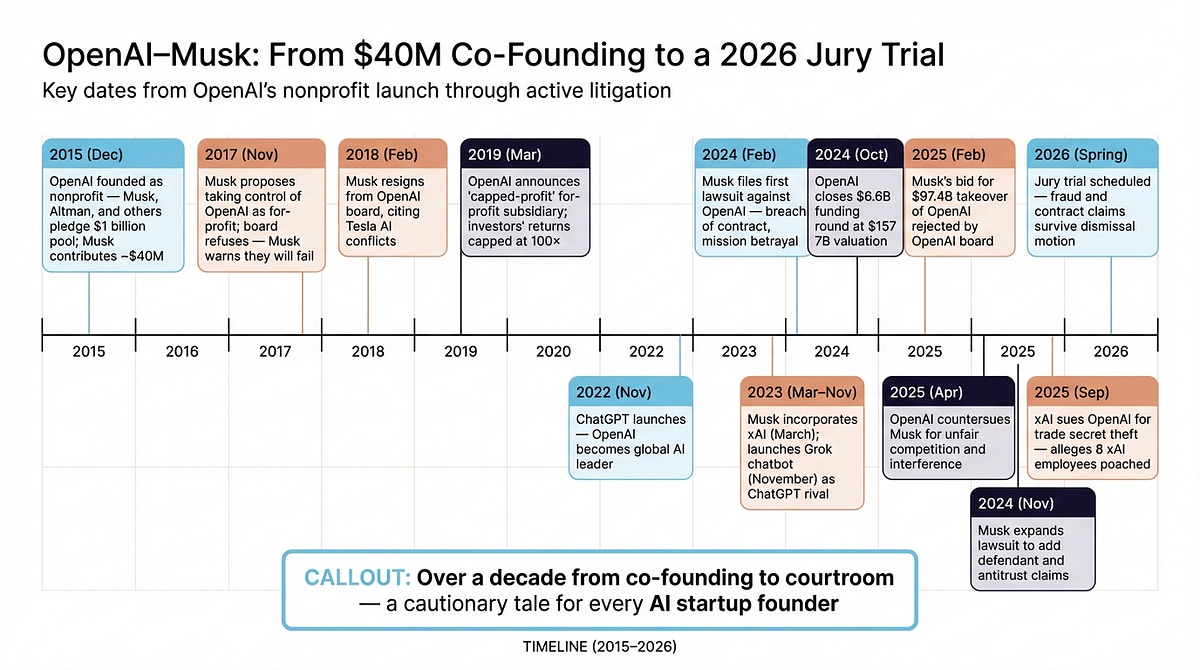
🧠Elon Musk's $150 billion lawsuit against OpenAI and Sam Altman was dismissed, marking a significant legal defeat for the Tesla CEO. Simultaneously, Google unveiled substantial updates to its Gemini app at IO 2026 designed to compete directly with ChatGPT and Claude, while OpenAI achieved a notable breakthrough in solving the Erdős problem.
🏢 OpenAI🧠 ChatGPT🧠 Claude
AIBullisharXiv – CS AI · May 277/10
🧠Researchers introduce DIDR (Diff-Instruct with Diffused Reward), a reinforcement learning framework that improves one-step text-to-image generation by aligning reward optimization with diffusion dynamics. The method addresses a fundamental mismatch in existing approaches where optimizing for image-space rewards often degrades overall image fidelity, demonstrating superior results compared to current SDXL baselines.