AIBullisharXiv – CS AI · Jun 197/10
🧠Researchers identify a fundamental flaw in current FP4 training approaches for large language models: E2M1 formats suffer from systematic "Shrinkage Bias" that degrades training stability. They propose UFP4, a uniform 4-bit recipe using E1M2/INT4 grids that outperforms existing E2M1 baselines across multiple model scales, suggesting future AI accelerators should prioritize uniform grid formats for training.
🏢 Nvidia
AIBullisharXiv – CS AI · Jun 197/10
🧠Researchers present SDQN-RMFS, a framework that converts reinforcement learning policies into energy-efficient spiking neural networks for robotic warehouse systems. The approach achieves 11,281× energy savings and 2× latency reduction compared to GPU-based solutions while maintaining decision quality, demonstrating practical neuromorphic computing for real-world logistics applications.
AIBullisharXiv – CS AI · Jun 127/10
🧠Arbor introduces a multi-agent framework using tree search as a cognition layer for autonomous agents operating in complex action spaces. The system achieves 193% inference throughput-latency improvements over vendor baselines through coordinated Orchestrator and Critic agents, demonstrating reproducible, hardware-agnostic optimization across multiple hardware generations.
AIBullisharXiv – CS AI · Jun 107/10
🧠EstRTL is an LLM-powered framework that improves the functional correctness of automatically generated register transfer level (RTL) code through a three-stage process involving generation, static functional estimation, and correction. The system demonstrates 3.2%-9.0% improvement in code correctness over baseline LLM approaches, addressing a critical gap in hardware design automation where code compilation success doesn't guarantee proper hardware implementation.
AIBullisharXiv – CS AI · Jun 47/10
🧠Researchers introduce Large Lookup Layers (L³), a novel sparse architecture that generalizes embedding tables to decoder layers, enabling more efficient scaling than traditional Mixture-of-Experts models. The approach uses static token-based routing to aggregate learned embeddings contextually, achieving superior performance on language modeling tasks with up to 2.6B active parameters while maintaining hardware efficiency.
AIBullisharXiv – CS AI · Jun 17/10
🧠TRINE is a new FPGA accelerator and compiler that enables efficient end-to-end inference for multimodal AI models (combining vision transformers, CNNs, and language models) without requiring reconfiguration. The system achieves up to 22.57x latency reduction compared to RTX 4090 GPUs while consuming only 20-21W, demonstrating significant energy efficiency gains for embedded AI deployment.
AIBullishCrypto Briefing · Jun 17/10
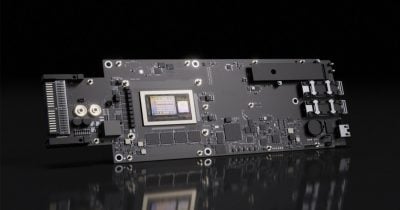
🧠Nvidia has unveiled the BlueField-4 STX, a specialized processor designed to handle AI storage operations autonomously with integrated security features. The technology aims to improve data center efficiency, scalability, and energy consumption for AI workloads by processing data at the storage layer rather than routing everything through central processors.
🏢 Nvidia
AIBullisharXiv – CS AI · May 127/10
🧠Researchers identify weight gradient (Wgrad) quantization as the primary cause of instability in FP4 training of large language models, while forward and activation gradient quantization prove relatively benign. Using deterministic Hadamard rotations on AMD MI355X GPUs, they demonstrate that structured micro-scaling errors—not insufficient randomness—drive training divergence, offering insights for efficient LLM pretraining.
🧠 Llama
AINeutralStratechery · May 117/10
🧠The article argues that agentic inference—AI systems operating autonomously without human involvement—will fundamentally differ from current inference workloads, eliminating the speed-critical requirements that dominate today's compute infrastructure design. This shift will reshape hardware and infrastructure priorities as latency becomes less critical than efficiency and throughput for agent-based systems.
AIBullisharXiv – CS AI · May 117/10
🧠XiYOLO is a new energy-efficient object detection framework that uses neural architecture search and scaling techniques to optimize AI models for edge devices with strict power constraints. The system achieves 20-53% energy reductions compared to YOLOv12 baselines across GPU and NPU deployments while maintaining competitive accuracy metrics.
AIBullisharXiv – CS AI · May 117/10
🧠Researchers introduce Cached State Representation (CSR), a framework that reduces latency in deploying large language models for robotics by 26-fold through optimized token caching and asynchronous state management. The approach enables real-time robot control with massive language models while maintaining full contextual understanding over infinite operational horizons.
AIBullisharXiv – CS AI · May 117/10
🧠EULER-ADAS is a specialized neural compute engine that uses bounded-Posit arithmetic to accelerate Advanced Driver-Assistance Systems (ADAS) inference on edge devices. The architecture achieves up to 71.9% power reduction and 10x better energy efficiency compared to conventional Posit implementations while maintaining near-FP32 accuracy, demonstrating practical viability for real-time autonomous driving applications.
AINeutralImport AI (Jack Clark) · Apr 207/10
🧠Import AI 454 covers three major developments: automation of AI alignment research to accelerate safety improvements, a safety evaluation of a Chinese AI model revealing potential concerns, and Huawei's HiFloat4 training format outperforming Western MXFP4 on their Ascend chips. These developments reflect broader trends in AI safety standardization, international model auditing, and competition in AI hardware optimization amid geopolitical tensions.
AIBullisharXiv – CS AI · Mar 57/10
🧠Researchers developed a joint hardware-workload co-optimization framework for in-memory computing accelerators that can efficiently support multiple neural network workloads rather than just single specialized models. The framework achieved significant energy-delay-area product reductions of up to 76.2% and 95.5% compared to baseline methods when optimizing across multiple workloads.
AIBullisharXiv – CS AI · Mar 56/10
🧠Chimera introduces a framework that enables neural network inference directly on programmable network switches by combining attention mechanisms with symbolic constraints. The system achieves line-rate, low-latency traffic analysis while maintaining predictable behavior within hardware limitations of commodity programmable switches.
AINeutralarXiv – CS AI · Mar 57/10
🧠Researchers propose an Adaptive Quantized Planetary Crater Detection System (AQ-PCDSys) that uses quantized neural networks and multi-sensor fusion to enable real-time AI-powered crater detection on resource-constrained space exploration hardware. The system addresses the critical bottleneck of deploying sophisticated deep learning models on power-limited, radiation-hardened space computers.
AIBullisharXiv – CS AI · Mar 46/103
🧠Researchers propose a heterogeneous computing framework for Mixture-of-Experts AI models that combines analog in-memory computing with digital processing to improve energy efficiency. The approach identifies noise-sensitive experts for digital computation while running the majority on analog hardware, eliminating the need for costly retraining of large models.
AINeutralarXiv – CS AI · Mar 47/102
🧠Research identifies a critical bottleneck in Vision-Language-Action (VLA) models for edge AI, where up to 75% of latency comes from memory-bound action generation phases. The study analyzes performance on Nvidia edge hardware and projects requirements for scaling to 100B parameter models in robotics applications.
AIBullisharXiv – CS AI · Mar 37/104
🧠Researchers developed NANOMIND, a software-hardware framework that optimizes Large Multimodal Models for battery-powered devices by breaking them into modular components and mapping each to optimal accelerators. The system achieves 42.3% energy reduction and enables 20.8 hours of operation running LLaVA-OneVision on a compact device without network connectivity.
AIBullishSynced Review · May 157/109
🧠DeepSeek has released a 14-page technical paper on their V3 model, focusing on scaling challenges and hardware-aware co-design for low-cost large model training. The paper, co-authored by DeepSeek CEO Wenfeng Liang, reveals insights into cost-effective AI architecture development.
AIBullisharXiv – CS AI · Jun 236/10
🧠Researchers propose VQ4SNN, a hardware-efficient architecture that uses vector quantization to reduce memory requirements for spiking neural networks on FPGAs by 52-61% without sacrificing inference accuracy. This innovation addresses a critical bottleneck in deploying dense SNNs on edge hardware, combining weight-sharing techniques with FPGA-aware memory optimization.
AINeutralarXiv – CS AI · Jun 106/10
🧠QSplitFL introduces a Deep Q-Network framework that optimizes split point selection in federated learning by considering device heterogeneity, using lightweight hardware metrics instead of model weights. The approach demonstrates improved convergence and accuracy across multiple datasets and neural network architectures while adapting to varying client capabilities.
AIBullisharXiv – CS AI · Jun 96/10
🧠Researchers demonstrate a Coherent Ising Machine (CIM) trained to optimize energy-based neural networks using Equilibrium Propagation, achieving performance comparable to traditional software implementations. By integrating the Adam optimizer, the approach significantly improves convergence speed and accuracy while scaling across deeper architectures, positioning quantum-inspired analog hardware as a viable platform for energy-efficient AI.
AINeutralarXiv – CS AI · Jun 96/10
🧠Q-Delta presents a novel approach to linear attention mechanisms in sequence modeling by integrating query-conditioned state evolution, moving beyond traditional key-value associative paradigms. The method combines efficient linear-time inference with improved performance on language modeling and long-context retrieval tasks through a hardware-optimized implementation.
AIBullisharXiv – CS AI · Jun 16/10
🧠Researchers introduce EGGROLL, a low-rank factorization technique that enables gradient-free training of Spiking Neural Networks (SNNs) using Evolution Strategies, reducing computational overhead by 2.23x while maintaining 79.21% accuracy on N-MNIST. This breakthrough addresses the long-standing challenge of training SNNs on neuromorphic hardware without requiring backpropagation infrastructure.