AINeutralarXiv – CS AI · Jun 16/10
🧠Researchers introduce LVCG, a self-supervised learning framework that represents cardiac electrical activity in vectorcardiogram (VCG) space rather than traditional ECG signal space. By learning unified latent representations instead of lead-specific artifacts, the method reduces redundancy, minimizes spurious correlations, and demonstrates improved generalization across cardiac assessment tasks.
AINeutralarXiv – CS AI · May 296/10
🧠Researchers propose FHRFormer, a masked transformer-based autoencoder that reconstructs missing fetal heart rate data from wearable monitors using self-supervised learning. The method addresses signal dropout caused by sensor displacement and positional changes, preserving spectral characteristics better than traditional interpolation while enabling both data inpainting and forecasting for improved fetal risk assessment.
AINeutralarXiv – CS AI · May 296/10
🧠Researchers demonstrate that training self-supervised learning models with semantic positive pairs (different images of the same class) outperforms traditional augmented-pair methods across multiple benchmarks. The controlled study isolates semantic pairing's effectiveness and shows contrastive methods like SimCLR benefit most strongly, providing guidance for designing more generalizable representation learning frameworks.
AINeutralCrypto Briefing · May 296/10
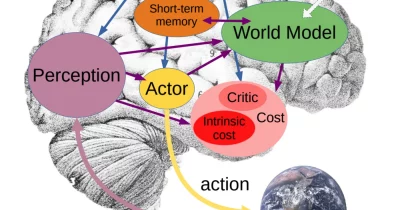
🧠Yann LeCun's research paper outlines the specific conditions necessary for LeJEPA (Joint-Embedding Predictive Architecture) to effectively learn world models, potentially advancing AI's ability to understand complex systems. However, practical implementation faces significant hurdles due to environmental variability and real-world complexity.
AIBullisharXiv – CS AI · May 286/10
🧠Researchers propose BayesNCL, a new machine learning approach that improves the interpretability of self-supervised learning models by using probabilistic gating to filter out task-irrelevant features. The method achieves a 142.1% improvement in semantic consistency on ImageNet-100 while maintaining downstream task performance, addressing a fundamental limitation in how contrastive learning models process information.
AINeutralarXiv – CS AI · May 286/10
🧠Researchers demonstrate that graph autoencoders (GAEs), traditionally viewed as distinct from graph contrastive learning approaches, actually function as implicit contrastive learners. By unifying these paradigms and introducing asymmetric contrastive views as a design principle, the work provides a clearer framework for understanding and building more effective graph neural networks for self-supervised learning tasks.
AINeutralarXiv – CS AI · May 286/10
🧠Researchers propose SelfJudge, a new method for accelerating large language model inference through self-supervised judge verification that eliminates the need for human annotations. The approach trains verifiers to assess whether token substitutions preserve semantic meaning, enabling faster inference without sacrificing accuracy across diverse NLP tasks.
AINeutralarXiv – CS AI · May 276/10
🧠Researchers propose Dynamic-Consistency Contrastive Learning (DyCo-CL), a machine learning framework that improves automatic modulation recognition in wireless signal processing by combining virtual adversarial augmentation with semantic consistency loss. The method achieves a 6.27% accuracy improvement in few-shot learning scenarios on standard benchmarks, addressing key challenges in self-supervised learning for signal classification.
AINeutralarXiv – CS AI · May 276/10
🧠FoundObj introduces a self-supervised framework for 3D object segmentation in point clouds without manual scene-level annotations, using reinforcement learning guided by semantic and geometric reward modules from foundation models. The approach demonstrates strong performance across benchmarks and shows particular promise in zero-shot and long-tail scenarios, advancing label-free computer vision capabilities.
AIBullisharXiv – CS AI · May 276/10
🧠Researchers introduce Olaf-World, a new approach to training action-controllable video world models that solves the problem of action latents failing to transfer across different contexts. By anchoring latent actions to observable semantic effects rather than relying on scarce labeled data, the method achieves stronger zero-shot transfer and more efficient adaptation to new control interfaces.
AINeutralarXiv – CS AI · May 126/10
🧠Researchers propose Grounded Correspondence, a new framework for video object tracking that replaces learned prediction models with deterministic bipartite matching. By leveraging existing vision backbone features, the approach achieves competitive results without learnable temporal parameters, challenging the conventional approach of using dynamics modules for temporal consistency.
AIBullisharXiv – CS AI · May 126/10
🧠Researchers introduce CA-DSSL, a new self-supervised learning technique that enables efficient AI model training on microcontrollers with under 500K parameters. The method surpasses existing approaches by 18 percentage points on standard benchmarks while requiring significantly fewer parameters, achieving 94% of supervised learning performance with models deployable in just 378 KB of memory.
AINeutralarXiv – CS AI · May 125/10
🧠Researchers propose a multi-level graph attention network framework that uses contrastive learning to improve knowledge-graph-based recommendation systems. The approach addresses limitations in existing methods by leveraging multi-view learning and self-supervised techniques to better model user preferences and item representations.
AINeutralarXiv – CS AI · May 126/10
🧠Researchers introduce WavesFM, a foundation model using hierarchical self-supervised learning to extract health insights from continuous wearable sensor data. Trained on 6.8M hours of physiological recordings from 324k individuals, the model captures both local waveform patterns and long-term behavioral dynamics, demonstrating strong performance across 58 health-related prediction tasks.
AIBullisharXiv – CS AI · May 116/10
🧠Researchers demonstrate that ProteinJEPA, a latent-space prediction technique, can complement traditional masked language modeling (MLM) in protein language models, achieving better downstream task performance when combined strategically. The optimal approach—masked-position MLM+JEPA—wins 10 out of 16 evaluation tasks against MLM-only baselines while maintaining computational efficiency.
AIBullisharXiv – CS AI · May 116/10
🧠Researchers introduce Miner, a novel reinforcement learning method that leverages a model's intrinsic uncertainty as a self-supervised reward signal to improve training efficiency for large reasoning models. The approach achieves state-of-the-art results on reasoning benchmarks, with performance gains up to 4.58 points in Pass@1 metrics compared to existing methods, addressing a critical inefficiency in current critic-free RL training.
AINeutralarXiv – CS AI · May 16/10
🧠Researchers develop a theoretical framework connecting Information Bottleneck principles to encoder-decoder learning through rate-distortion analysis, showing optimal representations form soft clusters on probability manifolds. The work introduces Sketched Isotropic Gaussian Regularization (SIGReg) as a principled regularizer for self-supervised, semi-supervised, and supervised learning without requiring variational bounds.
AIBullisharXiv – CS AI · Apr 206/10
🧠SSMamba introduces a self-supervised hybrid state space model designed to improve pathological image classification by addressing domain shift, local-global relationship modeling, and fine-grained feature detection. The framework outperforms 11 state-of-the-art pathological foundation models on multiple public datasets without requiring large external training datasets.
AINeutralarXiv – CS AI · Apr 146/10
🧠Researchers present a minimal mathematical model demonstrating how representation collapse occurs in self-supervised learning when frustrated (misclassified) samples exist, and show that stop-gradient techniques prevent this failure mode. The work provides closed-form analysis of gradient-flow dynamics and fixed points, offering theoretical insights into why modern embedding-based learning systems sometimes lose discriminative power.
AINeutralarXiv – CS AI · Apr 106/10
🧠Facebook Research releases EB-JEPA, an open-source library for learning representations through Joint-Embedding Predictive Architectures that predict in representation space rather than pixel space. The framework demonstrates strong performance across image classification (91% on CIFAR-10), video prediction, and action-conditioned world models, making self-supervised learning more accessible for research and practical applications.
AIBullisharXiv – CS AI · Mar 276/10
🧠Researchers developed SAVe, a self-supervised AI framework that detects audio-visual deepfakes by learning from authentic videos rather than synthetic ones. The system identifies visual artifacts and audio-visual misalignment patterns to detect manipulated content, showing strong cross-dataset generalization capabilities.
AIBullisharXiv – CS AI · Mar 176/10
🧠Researchers propose CroBo, a new visual state representation learning framework that helps robotic agents better understand dynamic environments by encoding both semantic identities and spatial locations of scene elements. The framework uses a global-to-local reconstruction method that compresses observations into compact tokens, achieving state-of-the-art performance on robot policy learning benchmarks.
AIBullisharXiv – CS AI · Mar 37/107
🧠Meta researchers introduced MetaMind, a cognitive world model for multi-agent systems that enables agents to understand and predict other agents' behaviors without centralized supervision or communication. The system uses a meta-theory of mind framework allowing agents to reason about goals and beliefs of others through self-reflective learning and analogical reasoning.
AIBullisharXiv – CS AI · Mar 36/106
🧠Researchers developed a foundational crop-weed detection model combining DINOv3 vision transformer with YOLO26 architecture, achieving significant improvements in precision agriculture applications. The model showed up to 14% better performance on cross-domain datasets while maintaining real-time processing at 28.5 fps despite increased computational requirements.
AINeutralarXiv – CS AI · Mar 36/105
🧠Researchers introduced Spoof-SUPERB, a new benchmark for evaluating self-supervised learning models' ability to detect audio deepfakes. The study tested 20 SSL models and found that large-scale discriminative models like XLS-R and WavLM Large consistently outperformed others, especially under acoustic degradations.