Models, papers, tools. 109,897 articles with AI-powered sentiment analysis and key takeaways.
AIBearisharXiv – CS AI · May 117/10
🧠Researchers introduce the Adversarial Empathy Benchmark (AEB) to test whether RL-trained empathetic language models remain robust against adversarial user tactics like gaslighting and emotional manipulation. While RLVER-trained models significantly outperform baselines in empathetic responsiveness, a new metric (ECS) reveals they excel at behavioral responsiveness without demonstrating genuine emotional state tracking, raising questions about the depth of empathetic AI capabilities.
AIBullisharXiv – CS AI · May 117/10
🧠XiYOLO is a new energy-efficient object detection framework that uses neural architecture search and scaling techniques to optimize AI models for edge devices with strict power constraints. The system achieves 20-53% energy reductions compared to YOLOv12 baselines across GPU and NPU deployments while maintaining competitive accuracy metrics.
AIBullisharXiv – CS AI · May 117/10
🧠Researchers introduce the Context Gathering Decision Process (CGDP), a POMDP framework that formalizes how LLM agents should search and gather information from environments exceeding their context windows. The approach yields measurable improvements in multi-hop reasoning (up to 11.4%) and token efficiency (up to 39% savings) through explicit belief state management and programmatic exhaustion detection.
AIBearisharXiv – CS AI · May 117/10
🧠A research paper examines how agentic AI systems are fundamentally lowering the cost and complexity of cyber attacks by automating reconnaissance, phishing, credential abuse, and exploit adaptation. The analysis forecasts significant security risks for enterprises and mid-market organizations through 2028, recommending immediate defensive priorities including identity management, patch velocity, and agent governance.
AIBullisharXiv – CS AI · May 117/10
🧠Researchers introduce Implicit Compression Regularization (ICR), a novel training method that reduces unnecessary verbosity in AI reasoning models without sacrificing accuracy. By leveraging the shortest correct responses within training batches as natural compression targets, ICR maintains performance while producing more concise outputs—addressing a key limitation of existing length-penalty approaches.
AINeutralarXiv – CS AI · May 117/10
🧠Researchers introduce Agentick, a unified benchmark for evaluating diverse AI agents—from reinforcement learning to large language models—across 37 procedurally generated tasks. Testing 27 configurations reveals no single approach dominates, with GPT-4 mini leading overall while specialized methods excel in specific domains, suggesting significant optimization potential across all agent paradigms.
🏢 Meta🧠 GPT-5
AIBearisharXiv – CS AI · May 117/10
🧠A new empirical study evaluates how Large Language Models perform on the Equivalence Class Problem, a simple yet computationally demanding long-chain reasoning task. The research reveals that non-reasoning LLMs fail entirely at the task, while reasoning-capable models perform significantly better but still struggle with complete accuracy, with performance patterns differing based on problem complexity metrics.
AIBullisharXiv – CS AI · May 117/10
🧠Researchers introduce a mechanistic-interpretability toolkit using Sparse Autoencoders and linear probes to diagnose AI agent failures before they occur, addressing a critical gap in enterprise AI deployment where tool-use errors in long-horizon workflows create cascading safety and financial risks.
🏢 Nvidia
AINeutralarXiv – CS AI · May 117/10
🧠Researchers developed a method to extract and analyze search trees from LLM reasoning traces, revealing that large language models use shallower, more myopic planning strategies compared to humans. While LLMs generate extended chain-of-thought reasoning, their actual decision-making is driven primarily by shallow search rather than deep lookahead, contrasting sharply with human expert planning.
AIBullisharXiv – CS AI · May 117/10
🧠Researchers introduce Weblica, a framework for creating reproducible and scalable web environments to train visual web agents at scale. The system uses HTTP-level caching and LLM-based synthesis to generate thousands of diverse training environments, with the resulting Weblica-8B model achieving competitive performance against larger API-based models on web navigation benchmarks.
AINeutralarXiv – CS AI · May 117/10
🧠Researchers have developed a psychometric framework to evaluate generative AI models' cognitive abilities across generations, revealing profound imbalances in their intelligence architecture. While leading multimodal models excel at verbal comprehension and working memory (>98th percentile), they severely lag in perceptual reasoning (<1st percentile), indicating that scaling alone cannot achieve human-like general intelligence.
AINeutralarXiv – CS AI · May 117/10
🧠Researchers propose Agent-BOM, a unified graph-based representation system for auditing the security of LLM-based autonomous agents. The framework addresses critical gaps in existing audit mechanisms by tracking both static capabilities and dynamic runtime states, enabling detection of complex attack chains across multi-agent systems.
AINeutralarXiv – CS AI · May 117/10
🧠Researchers introduce Self-Programmed Execution (SPE), a novel agent architecture where language models act as their own orchestrators rather than following fixed turn-by-turn policies. The approach uses Spell, a Lisp-based language enabling self-editing programs, and demonstrates that frontier models can perform complex agentic tasks without specialized training.
AIBullisharXiv – CS AI · May 117/10
🧠Researchers introduce HCL-GP, a machine learning approach that enables large language model agents to learn and reuse hierarchical task decompositions for improved performance on complex applications. The method achieves 98.2% accuracy on standard tasks and demonstrates significant improvements over static synthesis approaches, particularly benefiting open-source models through dynamic component reuse.
AIBullisharXiv – CS AI · May 117/10
🧠Researchers propose a unified evolutionary framework for LLM agent memory systems, categorizing development into three stages: Storage, Reflection, and Experience. The framework addresses fragmented research by synthesizing engineering and cognitive science perspectives, offering design principles for building more capable autonomous AI agents.
AIBullisharXiv – CS AI · May 117/10
🧠Researchers introduce GazeVLM, a vision-language model that implements active attention control mechanisms mimicking human visual reasoning. The 4B-parameter model autonomously generates gaze tokens to dynamically focus on task-relevant visual details, achieving 4-5% performance improvements over comparable VLMs without increasing context window size.
AIBullisharXiv – CS AI · May 117/10
🧠Researchers introduce Behavior Cue Reasoning, a technique that trains large language models to emit special token sequences before specific behaviors, making their reasoning processes more monitorable and controllable. The method enables external oversight systems to prune inefficient reasoning tokens and recover safe actions from otherwise unsafe reasoning traces, achieving up to 96% success rates in constrained environments without sacrificing performance.
AIBullisharXiv – CS AI · May 117/10
🧠FlashMol represents a major breakthrough in computational drug discovery by generating high-quality 3D molecular conformations in just 4 steps, compared to hundreds required by traditional diffusion models. The technique achieves 250x acceleration in sampling speed while matching or exceeding the quality of slower teacher models, potentially transforming the economics of large-scale in silico screening.
AIBullisharXiv – CS AI · May 117/10
🧠VISTA is a novel decentralized machine learning algorithm designed to operate securely when adversaries control the majority of worker nodes. By implementing an incentive-based framework that rewards mutually consistent reports, the system converts adversarial nodes from pure saboteurs into rational agents, enabling convergence comparable to standard SGD without requiring an honest majority.
GeneralBearishCrypto Briefing · May 117/10
📰The S&P 500 has gained 142% when including AI stocks but only 16% without them, revealing extreme market concentration in the AI sector. This disparity raises critical concerns about portfolio vulnerability and systemic risk if AI valuations correct or investor sentiment shifts.
AIBullishCrypto Briefing · May 117/10
🧠SoftBank is entering large-scale battery cell manufacturing to support AI infrastructure, addressing critical energy constraints that limit data center scalability. This vertical integration strategy aims to reduce dependence on traditional power grids and could reshape how AI providers handle power requirements.
GeneralBearishCrypto Briefing · May 117/10
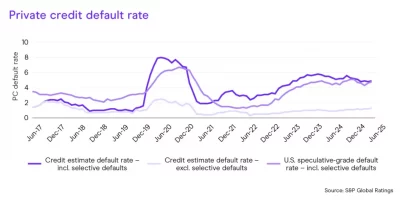
📰Private-credit firms face declining returns as Federal Reserve rate cuts compress yields, while simultaneously confronting risks of elevated default rates. This margin squeeze threatens profitability across the sector and has broader implications for credit availability and risk management in non-traditional lending markets.
GeneralBearishCrypto Briefing · May 11🔥 8/10
📰Disruptions in the Strait of Hormuz triggered by Iran tensions are forcing insurance companies to withdraw coverage from shipping routes, creating significant vulnerabilities in global energy supply chains. This geopolitical crisis threatens to reshape international trade patterns and could have ripple effects across commodity markets and cryptocurrency volatility.
GeneralBearishCrypto Briefing · May 117/10
📰China's April inflation data shows PPI rising 2.8% and CPI increasing 1.2% year-on-year, marking the end of a three-year deflation period. This development constrains Beijing's monetary easing options and may cause its economic policy to diverge from the US Federal Reserve's approach, with potential implications for global markets and cryptocurrency volatility.
GeneralBearishCrypto Briefing · May 11🔥 8/10
📰Israeli Prime Minister Netanyahu has reiterated that the conflict with Iran remains active and demanded the removal of enriched uranium, signaling a hardline stance that could escalate military tensions. Analysts warn his position may undermine diplomatic efforts and increase geopolitical instability with broader implications for global security and markets.