AIBearishCrypto Briefing · Jun 257/10
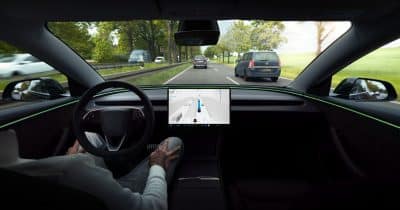
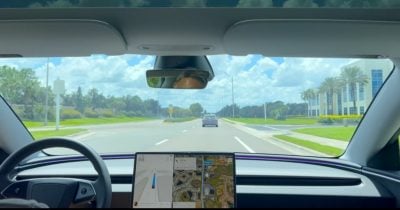
🧠Tesla faces a lawsuit following a fatal crash involving its Full Self-Driving feature in Texas, raising questions about autonomous vehicle safety and liability. The legal challenge could intensify regulatory scrutiny of autonomous driving systems and create investor uncertainty about Tesla's FSD program, with potential spillover effects on tech and crypto markets due to broader confidence concerns.
AIBearishCrypto Briefing · Jun 237/10
🧠Tesla defended its Full Self-Driving system following a fatal crash in Texas, attributing the incident to driver override rather than system failure. The incident underscores the regulatory and liability challenges facing autonomous vehicle developers as safety concerns clash with technological advancement.
GeneralBearishBlockonomi · Jun 237/10
📰The National Highway Traffic Safety Administration (NHTSA) has opened a special crash investigation into Tesla following a fatal accident involving a vehicle operating under Full Self-Driving (FSD) mode that killed a 76-year-old woman in Texas. The probe could potentially lead to vehicle recalls and represents a significant regulatory scrutiny of Tesla's autonomous driving technology.
AIBearishFortune Crypto · Jun 237/10
🧠A Tesla Model 3 operating on autopilot struck and killed a woman inside her home near Houston, raising critical safety questions about autonomous vehicle systems. The incident occurs as Elon Musk positions Tesla's autopilot technology as foundational to the company's planned national robotaxi rollout.
AIBullisharXiv – CS AI · Jun 237/10
🧠FleetAgent is a cloud-based AI system that uses compact vectorized vehicle-to-network messages to assist remote operators in managing autonomous vehicle fleets. The system reduces data transmission costs by up to 625x compared to raw images while improving teleoperation monitoring accuracy and decision-making efficiency.
AIBearisharXiv – CS AI · Jun 237/10
🧠Researchers demonstrate that transformer-based trajectory prediction models used in autonomous vehicles experience severe accuracy degradation when exposed to noisy real-world sensor data, with prediction accuracy declining by up to 3.9x under realistic noise conditions. The findings highlight a critical gap between idealized training environments and actual deployment scenarios, signaling the need for robust noise mitigation strategies in autonomous vehicle systems.
AIBullisharXiv – CS AI · Jun 237/10
🧠Researchers developed a framework combining deep reinforcement learning (DRL) with large language models (LLMs) to make autonomous vehicles safer and more trustworthy by explaining driving decisions to passengers. The system was trained to handle three driving modes—fast, comfort, and stop—while generating safety-focused explanations for its actions, demonstrating effective mode switching and rule compliance.
AIBullisharXiv – CS AI · Jun 237/10
🧠OmniV2X is a generative foundation model that enables vehicle-to-everything (V2X) cooperative driving by processing multi-modal, multi-agent data without requiring dense 3D perception or shared representations. The model achieves state-of-the-art performance on the DAIR-V2X-Seq dataset while using 90% less fine-tuning data and consuming less than 1% of typical communication bandwidth.
AIBullisharXiv – CS AI · Jun 197/10
🧠Researchers propose PiDR, a physics-informed neural network framework for autonomous navigation using only inertial sensors, achieving 29% positioning improvement over conventional approaches. The system addresses critical limitations of traditional deep learning by embedding physical principles directly into the model, enabling accurate dead reckoning in GPS-denied environments without requiring extensive training data.
AIBullishCrypto Briefing · Jun 107/10
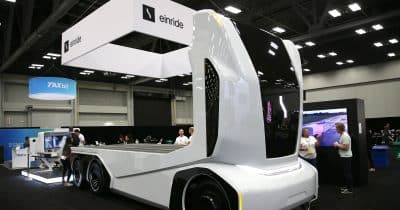
🧠Einride completed its Nasdaq debut through a SPAC merger with a 70%+ stock surge on day one. The strong market reception signals growing investor appetite for autonomous trucking technology and suggests accelerating commercialization timelines for the sector.
AIBullishCrypto Briefing · Jun 107/10
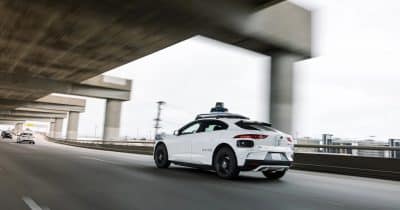
🧠Waymo has developed a benchmark model to standardize crash comparisons for robotaxis, potentially reshaping autonomous vehicle safety standards and regulatory frameworks. This initiative could accelerate public acceptance of self-driving technology by establishing objective safety metrics for the industry.
AIBullisharXiv – CS AI · Jun 107/10
🧠Researchers propose Generalized-CVO, a fast point cloud registration method using second-order Riemannian optimization that achieves 10x speedup over previous approaches. The technique demonstrates significant improvements in LiDAR tracking with >55% drift reduction in sparse environments and enhanced robustness on object registration benchmarks.
AIBullisharXiv – CS AI · Jun 107/10
🧠NOVA, a symbolic regression framework, discovers interpretable models of human driving behavior from 4.7 million real-world observations, achieving superior performance on car-following and lane-change prediction tasks. The research demonstrates that complex driving dynamics can be captured through compact algebraic structures that generalize across different freeway locations and driver populations.
$RMSE
AIBullishCrypto Briefing · Jun 97/10
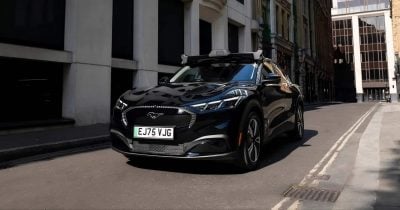
🧠Uber is intensifying competition with Wayve, an AI-driven autonomous vehicle company, in the London robotaxi market. This rivalry signals accelerating commercialization of self-driving technology in major cities and could reshape urban transportation globally.
AIBullishCrypto Briefing · Jun 97/10
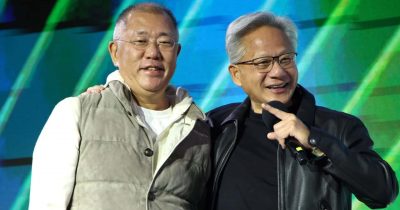
🧠Nvidia and Hyundai have deepened their strategic alliance to accelerate AI integration in robotics and autonomous mobility solutions. This expanded partnership could significantly reshape industrial automation and transportation sectors by combining Nvidia's AI computing expertise with Hyundai's automotive and robotics capabilities.
🏢 Nvidia
AIBullisharXiv – CS AI · Jun 97/10
🧠Researchers introduce ATN3D, a LiDAR-Radar fusion framework designed to improve 3D object detection for autonomous vehicles in sparse, long-range sensing conditions. The method achieves significant performance gains on the VoD benchmark, with +3.55% mAP improvement in clear weather and +8.41% under heavy fog, particularly benefiting detection of distant objects beyond 30 meters.
AIBearishCrypto Briefing · Jun 47/10
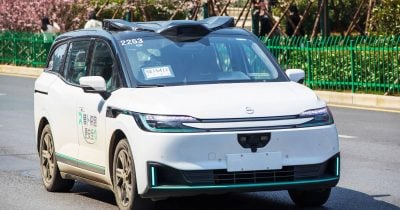
🧠China has suspended robotaxi licenses following a Baidu autonomous vehicle malfunction that left passengers stranded in Wuhan, signaling heightened regulatory scrutiny of self-driving technology. The pause underscores growing concerns about safety protocols and may influence autonomous vehicle standards globally.
AIBullishBlockonomi · Jun 47/10
🧠Uber has committed nearly $500 million in milestone-based funding to Nuro for a massive autonomous vehicle expansion, targeting deployment of 35,000 robotaxis equipped with Lucid Gravity SUVs. This investment represents a significant corporate bet on autonomous delivery and ridesharing technology, with funding tied to specific autonomous deployment achievements.
AINeutralCrypto Briefing · Jun 47/10
🧠Tesla has begun deploying unsupervised robotaxis in the Austin metropolitan area, marking a significant step in autonomous vehicle commercialization. The rollout reveals substantial engineering and operational challenges in scaling autonomous fleets, which could influence investor sentiment toward autonomous vehicle companies and reshape competitive dynamics in the mobility sector.
AIBullisharXiv – CS AI · Jun 27/10
🧠Researchers propose a Risk Horizon Profiling (RHP) module that improves vehicle trajectory prediction for autonomous driving by dynamically modeling future risk distributions rather than relying solely on historical risk data. The method achieves 25-29% error reduction on highway and urban datasets, suggesting significant safety improvements for autonomous vehicles and driver-assistance systems.
AIBullishCrypto Briefing · Jun 17/10
🧠Tesla's Full Self-Driving (FSD) Supervised system has successfully completed coast-to-coast autonomous drives without human intervention, marking a significant milestone in autonomous vehicle development. The achievement could reshape the competitive landscape, disrupt traditional automotive markets, and trigger intensified regulatory scrutiny around safety standards and liability frameworks.
AIBullishBlockonomi · Jun 17/10
🧠Uber, Nvidia, and Autobrains have announced a partnership to deploy autonomous taxi services in Munich using agentic AI technology, though the service still awaits regulatory approval. This collaboration combines Uber's mobility platform, Nvidia's AI infrastructure, and Autobrains' autonomous driving capabilities to advance the robotaxi market in Europe.
🏢 Nvidia
AIBullishCrypto Briefing · May 307/10
🧠Tesla has begun production of its Cybercab with reported record-breaking efficiency metrics that could significantly reduce operational costs in ride-hailing. The development potentially disrupts the autonomous vehicle industry by demonstrating cost advantages that competitors will struggle to match.
GeneralBullishCrypto Briefing · May 297/10
📰Estonia has approved Tesla's Full Self-Driving (FSD) system for public road use, marking a significant regulatory milestone in Europe. This approval could accelerate FSD adoption across the EU and strengthen Tesla's competitive position in the electric vehicle market.
AIBearishBlockonomi · May 297/10
🧠Texas Department of Motor Vehicles filings reveal that Tesla operates only 42 robotaxis in the state, significantly trailing Waymo's 577 deployed vehicles. The data underscores a substantial gap between Tesla CEO Elon Musk's public predictions about autonomous vehicle dominance and the company's current operational reality in the competitive autonomous taxi market.