#deep-learning News & Analysis
Recent coverage of #deep-learning spans 272 indexed articles, with 41 pieces published in the last month. Academic research dominates the conversation, particularly through arXiv submissions in computer science and AI, though coverage also appears across machine learning-focused publications. Over the past 30 days, sentiment has remained largely stable at 51.2% bullish and 43.9% neutral, with minimal bearish commentary at 4.9%.
Perplexity, Gemini, and Nvidia have emerged as the most frequently discussed entities alongside #deep-learning, while related discussions often intersect with #machine-learning, #neural-networks, and #computer-vision. Scan the articles below for the latest developments in this area.
sentiment · last 30d (41 articles)Top sources:arXiv – CS AI · 227Apple Machine Learning · 3MarkTechPost · 2Crypto Briefing · 2
Most-discussed entities:Perplexity · 4Gemini · 2Nvidia · 2Llama · 1
AINeutralarXiv – CS AI · Mar 176/10
🧠Researchers have developed a new white-box watermarking framework that uses chaotic sequences to embed ownership information into deep neural network parameters for intellectual property protection. The method uses logistic maps and genetic algorithms to verify model ownership without degrading performance, showing effectiveness on MNIST and CIFAR-10 datasets.
AIBullishMarkTechPost · Mar 167/10
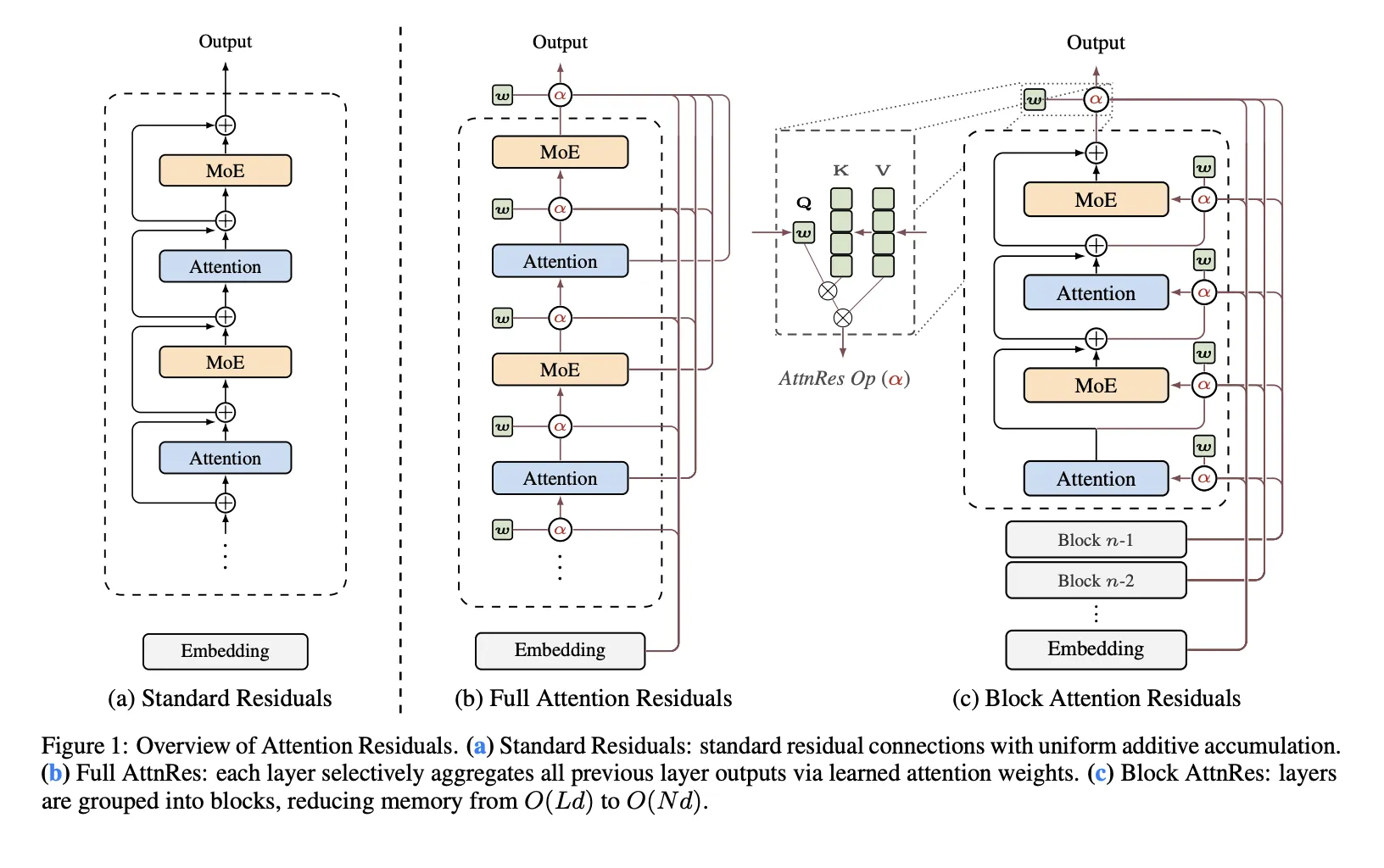
🧠Moonshot AI has released Attention Residuals, a new approach that replaces traditional fixed residual connections in Transformer architectures with depth-wise attention mechanisms. The innovation addresses structural problems in PreNorm architectures where all prior layer outputs are mixed equally, potentially improving model scaling capabilities.
AIBullisharXiv – CS AI · Mar 166/10
🧠Researchers introduce DART, a new framework for early-exit deep neural networks that achieves up to 3.3x speedup and 5.1x lower energy consumption while maintaining accuracy. The system uses input difficulty estimation and adaptive thresholds to optimize AI inference for resource-constrained edge devices.
AIBullisharXiv – CS AI · Mar 126/10
🧠Researchers developed DxEvolve, a self-evolving AI diagnostic system that mimics clinical reasoning through interactive workflows and continuous learning. The system achieved 90.4% diagnostic accuracy on benchmarks, comparable to human clinicians at 88.8%, and showed significant improvements over traditional AI models.
AIBullisharXiv – CS AI · Mar 126/10
🧠Researchers introduce CUPID, a plug-in framework that estimates both aleatoric and epistemic uncertainty in deep learning models without requiring model retraining. The modular approach can be inserted into any layer of pretrained networks and provides interpretable uncertainty analysis for high-stakes AI applications.
AIBullisharXiv – CS AI · Mar 116/10
🧠This comprehensive review examines FPGA-based AI accelerators as a promising solution for deep learning workloads, addressing the limitations of ASIC and GPU accelerators. The paper analyzes hardware optimizations including loop pipelining, parallelism, and quantization techniques that make FPGAs attractive for AI applications requiring high performance and energy efficiency.
AINeutralarXiv – CS AI · Mar 116/10
🧠Researchers propose a unified framework for latent world models in automated driving, organizing recent advances in generative AI and vision-language-action systems. The framework addresses scalable simulation, long-horizon forecasting, and decision-making through latent representations that compress multi-sensor data.
AIBullisharXiv – CS AI · Mar 96/10
🧠Researchers propose Hybrid Hierarchical RL (H²RL), a new framework that combines symbolic logic with deep reinforcement learning to address misalignment issues in AI agents. The method uses logical option-based pretraining to improve long-horizon decision-making and prevent agents from over-exploiting short-term rewards.
AIBullisharXiv – CS AI · Mar 96/10
🧠Researchers developed DEX-AR, a new explainability method for autoregressive Vision-Language Models that generates 2D heatmaps to understand how these AI systems make decisions. The method addresses challenges in interpreting modern VLMs by analyzing token-by-token generation and visual-textual interactions, showing improved performance across multiple benchmarks.
🏢 Perplexity
AIBullisharXiv – CS AI · Mar 55/10
🧠Researchers developed DCENWCNet, a deep learning ensemble model that combines three CNN architectures to classify white blood cells with superior accuracy. The model outperforms existing state-of-the-art networks on the Rabbin-WBC dataset and incorporates LIME-based explainability for interpretable medical diagnosis.
AIBullisharXiv – CS AI · Mar 55/10
🧠Researchers propose JPmHC (Jacobian-spectrum Preserving manifold-constrained Hyper-Connections), a new deep learning framework that improves upon existing Hyper-Connections by replacing identity skips with trainable linear mixers while controlling gradient conditioning. The framework addresses training instability and memory overhead issues in current deep learning architectures through constrained optimization on specific mathematical manifolds.
AINeutralarXiv – CS AI · Mar 45/103
🧠Researchers propose ShipTraj-R1, a novel LLM-based framework using group relative policy optimization (GRPO) for ship trajectory prediction. The system reformulates trajectory prediction as a text-to-text generation problem and demonstrates superior performance compared to existing deep learning baselines on real-world maritime datasets.
AIBullisharXiv – CS AI · Mar 45/102
🧠Researchers have developed Domain-aware Fourier Features (DaFFs) to enhance Physics-Informed Neural Networks (PINNs), achieving orders-of-magnitude lower errors and faster convergence. The approach incorporates domain-specific characteristics like geometry and boundary conditions while eliminating the need for explicit boundary condition loss terms, making PINNs more accurate, efficient, and interpretable.
AINeutralarXiv – CS AI · Mar 35/103
🧠Researchers introduce Protap, a comprehensive benchmark comparing protein modeling approaches across realistic applications. The study finds that large-scale pretrained models often underperform supervised encoders on small datasets, while structural information and domain-specific biological knowledge can enhance specialized protein tasks.
AIBullisharXiv – CS AI · Mar 36/105
🧠Researchers propose Dataset Color Quantization (DCQ), a new framework that compresses visual datasets by reducing color-space redundancy while preserving information crucial for AI model training. The method achieves significant storage reduction across major datasets including CIFAR-10, CIFAR-100, Tiny-ImageNet, and ImageNet-1K while maintaining training performance.
AIBullisharXiv – CS AI · Mar 36/103
🧠Researchers developed WS-KAN, the first weight-space architecture designed specifically for Kolmogorov-Arnold Networks (KANs), which learns directly from neural network parameters. The study shows KANs share permutation symmetries with MLPs and introduces a graph representation to better understand their computation structure.
AIBullisharXiv – CS AI · Mar 36/104
🧠Researchers have developed SwitchMT, a novel methodology using Spiking Neural Networks with adaptive task-switching for multi-task learning in autonomous agents. The approach addresses task interference issues and demonstrates competitive performance in multiple Atari games while maintaining low power consumption and network complexity.
AIBullisharXiv – CS AI · Mar 36/103
🧠Researchers have developed ST-Prune, a dynamic sample pruning technique that accelerates training of deep learning models for spatio-temporal forecasting by intelligently selecting the most informative data samples. The method significantly improves training efficiency while maintaining or enhancing model performance on real-world datasets from transportation, climate science, and urban planning domains.
AINeutralarXiv – CS AI · Mar 35/103
🧠Researchers propose FIRE, a new reinitialization method for deep neural networks that balances stability and plasticity when learning from nonstationary data. The method uses mathematical optimization to maintain prior knowledge while adapting to new tasks, showing superior performance across visual learning, language modeling, and reinforcement learning domains.
AINeutralarXiv – CS AI · Mar 36/104
🧠Researchers introduce Vision-DeepResearch Benchmark (VDR-Bench) with 2,000 VQA instances to better evaluate multimodal AI systems' visual and textual search capabilities. The benchmark addresses limitations in existing evaluations where answers could be inferred without proper visual search, and proposes a multi-round cropped-search workflow to improve model performance.
$NEAR
AINeutralarXiv – CS AI · Mar 35/104
🧠Researchers propose SCER (Spurious Correlation-Aware Embedding Regularization), a new deep learning approach that improves AI model robustness by regularizing feature representations to suppress spurious correlations. The method demonstrates superior performance in worst-group accuracy across vision and language tasks compared to existing state-of-the-art approaches.
AIBullisharXiv – CS AI · Mar 36/104
🧠Researchers developed AIRMap, a deep-learning framework that generates radio maps for wireless network simulation over 100x faster than traditional ray tracing methods. The AI model achieves under 4 dB RMSE accuracy in 4 ms per inference and significantly outperforms traditional simulators when calibrated with field measurements.
$NEAR
AIBullisharXiv – CS AI · Mar 36/103
🧠Researchers have introduced Next Visual Granularity (NVG), a new AI image generation framework that creates images by progressively refining visual details from global layout to fine granularity. The approach outperforms existing VAR models on ImageNet, achieving better FID scores and offering fine-grained control over the generation process.
AIBullisharXiv – CS AI · Mar 36/108
🧠Researchers introduce GRAD-Former, a novel AI framework for detecting changes in satellite imagery that outperforms existing methods while using fewer computational resources. The system uses gated attention mechanisms and differential transformers to more efficiently identify semantic differences in very high-resolution satellite images.
AINeutralarXiv – CS AI · Mar 36/104
🧠Researchers developed a lightweight AI model using unsupervised deep learning to detect conflict-related fires in Sudan within 24-30 hours using commercially available satellite imagery. The Variational Auto-Encoder (VAE) approach outperformed traditional methods in identifying burn signatures from 4-band Planet Labs satellite data at 3-meter resolution.
$CRV$NEAR