GeneralBearishCrypto Briefing · Jun 277/10
📰The US has expanded its ban on Chinese technology imports to include Huawei, ZTE, and surveillance equipment manufacturers, intensifying tech tensions between Washington and Beijing. The move risks disrupting global supply chains and escalating geopolitical competition in critical technology sectors.
GeneralNeutralCrypto Briefing · May 297/10
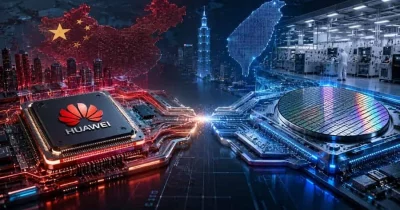
📰Huawei is developing a novel chip architecture strategy to reduce its semiconductor performance gap with TSMC amid US export restrictions. This approach could challenge existing global supply chain dynamics and reshape competitive positioning in the semiconductor industry.
GeneralNeutralWired – AI · May 277/10
📰Huawei is advancing chip design strategies to overcome Moore's Law limitations, potentially challenging US semiconductor dominance. The Chinese tech giant's adaptation to slower transistor scaling could reshape global chip competition and have implications for technology supply chains.
AIBearishDecrypt – AI · May 277/10
🧠Huawei has introduced Claw-Anything, a benchmark that tests AI agents' ability to handle complex digital tasks over extended simulated timeframes. GPT-5.5, currently the best-performing model, achieved only 34.5% on the benchmark, highlighting significant limitations in current AI agents' capacity to maintain performance during long-horizon tasks.
🧠 GPT-5
AINeutralCrypto Briefing · May 27/10
🧠Huawei's AI chip sales are experiencing significant growth as the company capitalizes on China's strategic push toward technological self-sufficiency, particularly in response to U.S. export restrictions that have limited Nvidia's access to the Chinese market. This shift reflects broader geopolitical tensions and China's determination to develop domestic alternatives to American semiconductor technology.
🏢 Nvidia
AIBearishCrypto Briefing · May 17/10
🧠Huawei's AI chip sales are accelerating in China as the company gains market share from Nvidia, reflecting a strategic shift in semiconductor dominance amid escalating US-China trade tensions. This development signals potential fragmentation of the global AI chip market along geopolitical lines, with Chinese companies increasingly developing domestic alternatives to American technology.
🏢 Nvidia
AINeutralImport AI (Jack Clark) · Apr 207/10
🧠Import AI 454 covers three major developments: automation of AI alignment research to accelerate safety improvements, a safety evaluation of a Chinese AI model revealing potential concerns, and Huawei's HiFloat4 training format outperforming Western MXFP4 on their Ascend chips. These developments reflect broader trends in AI safety standardization, international model auditing, and competition in AI hardware optimization amid geopolitical tensions.
AINeutralLast Week in AI · Jan 237/10
🧠OpenAI plans to test advertising in ChatGPT amid high operational costs, while Sequoia prepares to invest in competitor Anthropic. Chinese AI company Zhipu AI partners with Huawei to reduce dependence on US semiconductors, highlighting ongoing tech tensions.
🏢 OpenAI🏢 Anthropic🧠 ChatGPT
GeneralBearishCrypto Briefing · Jun 256/10
📰Apple's iPhone sales in China have declined 19% according to UBS estimates, driven by intensified competition from Huawei and other local manufacturers. This significant market share loss highlights Apple's vulnerability in one of its most critical markets and raises questions about the company's ability to maintain growth momentum in a region where Chinese competitors are gaining technological parity.
AINeutralarXiv – CS AI · Jun 236/10
🧠Researchers conducted a systematic empirical study evaluating quantization methods for OpenPangu language models on Huawei Ascend NPUs, finding that 8-bit weight-only quantization is lossless while 4-bit quantization remains practical for larger models but degrades performance on reasoning tasks in smaller models. The study reveals that extreme low-bit compression (2-bit and binary) remains fundamentally challenging, with most configurations collapsing to near-random behavior.
🏢 Perplexity
GeneralNeutralarXiv – CS AI · May 286/10
📰OpenURMA is the first open-source implementation of Huawei's Unified Bus (UB) protocol, a 2025 specification designed to overcome RDMA bottlenecks at the network interface. The implementation demonstrates 4.37x lower latency and 2.80x higher throughput compared to RoCEv2, while consuming only 14% of FPGA resources, offering a potential architectural shift for datacenter networking.
AIBullisharXiv – CS AI · Mar 266/10
🧠Researchers introduce AscendOptimizer, an AI agent that optimizes operators for Huawei's Ascend NPUs through evolutionary search and experience-based learning. The system achieved 1.19x geometric-mean speedup over baselines on 127 real operators, with nearly 50% outperforming reference implementations.
AINeutralThe Register – AI · Mar 36/10
🧠Huawei is expanding its modular AI datacenter solutions globally, featuring domestically-produced Chinese chips as the company seeks to compete internationally despite ongoing US sanctions. The flatpack datacenter approach allows for rapid deployment and scalability of AI infrastructure using Huawei's own semiconductor technology.
AIBullisharXiv – CS AI · Mar 26/1015
🧠Researchers developed LACE-RL, a deep reinforcement learning framework that optimizes serverless computing by balancing cold-start latency and carbon emissions. The system dynamically adjusts keep-alive durations based on real-time carbon intensity and workload patterns, achieving 51.69% fewer cold starts and 77.08% lower idle carbon emissions compared to static policies.
AINeutralImport AI (Jack Clark) · Feb 96/104
🧠Import AI 444 covers recent AI research including Google's findings on LLMs simulating multiple personalities, Huawei's use of AI for kernel development, and the introduction of ChipBench. The newsletter focuses on advancing AI research and development across various applications and hardware optimization.