#robotics News & Analysis
The #robotics tag covers 249 indexed articles, with 35 published in the last month. Recent coverage leans bullish at 57.1%, though sentiment has softened by 15.8 percentage points compared to the prior quarter, with 40% neutral and 2.9% bearish articles. ArXiv's computer science and AI sections dominate the source list, alongside coverage from AI News and TechCrunch's AI beat. Nvidia and OpenAI appear most frequently in related discussions.
#robotics content intersects regularly with #machine-learning, #reinforcement-learning, #computer-vision, and #ai-research. Scan the articles below for the latest developments and perspectives in the field.
sentiment · last 30d (35 articles) · -15.8pp bullish vs prior 90dTop sources:arXiv – CS AI · 167AI News · 7TechCrunch – AI · 6Crypto Briefing · 4Blockonomi · 3
Most-discussed entities:Nvidia · 5OpenAI · 4Haiku · 1Gemini · 1Hugging Face · 1
AINeutralarXiv – CS AI · Jun 85/10
🧠Researchers introduce a Gaussian Mixture Model (GMM) framework that represents plane curves as probabilistic geometric primitives, encoding both tangential and normal uncertainty. This mathematical approach enables uncertainty-aware geometric modeling applicable to CAD, robotics, and digital twin applications.
AINeutralarXiv – CS AI · Jun 86/10
🧠SCOUT is an online semantic exploration framework that enables robots to actively understand indoor environments by coupling real-time scene graph construction with uncertainty-guided traversal planning. The system builds 3D scene graphs with probabilistic object labels and structural relations, then uses uncertainty metrics to decide where robots should explore next, treating semantic scene completion as an operational objective rather than a passive mapping byproduct.
AINeutralarXiv – CS AI · Jun 86/10
🧠Researchers introduce AxisGuide, a lightweight method that improves robot manipulation by explicitly visualizing action coordinates in camera views. The technique augments visual observations with cues showing robot base-frame axes, enabling better generalization when objects are placed in unseen locations despite identical scene layouts.
AINeutralarXiv – CS AI · Jun 86/10
🧠Researchers introduce FLIGHT, a benchmark for training UAV agents to follow natural language instructions with precise, continuous flight control over long-horizon tasks. The accompanying FLIGHT VLA architecture decouples high-level reasoning from low-frequency control, advancing autonomous drone navigation beyond existing discrete-action systems.
AINeutralarXiv – CS AI · Jun 85/10
🧠EgoPressDiff presents a conditional video diffusion framework that estimates hand-surface contact pressure from egocentric viewpoints by generating UV-pressure maps from visual input. The method combines pose and mesh vertex features with a novel Distribution-Calibrated Spatial Layer to achieve 34% improvement in accuracy metrics, addressing limitations in AR/VR, robotics, and ergonomic applications.
AINeutralarXiv – CS AI · Jun 86/10
🧠Researchers present a neuro-symbolic learning framework that addresses a critical inefficiency in robotic task planning by combining neural networks with symbolic planning under complex logical constraints. The method uses bilevel optimization to learn object-importance scores while solving planning problems in pruned search spaces, reducing planning failures by 80% and planning time by 57% across multiple benchmarks and real-world robotic applications.
AINeutralarXiv – CS AI · Jun 86/10
🧠Researchers present an abstract architecture for building autonomous robotic systems that can explain their decision-making processes to human operators and regulators. The framework addresses the critical need for explainability in autonomous systems deployed in hazardous environments, with a practical application example in nuclear industry operations where trust and regulatory compliance are essential.
AINeutralarXiv – CS AI · Jun 86/10
🧠Researchers propose a novel Vision-Language Navigation approach that grounds waypoints in executable trajectories rather than predicting isolated navigation points. By using a TSDF-guided diffusion policy, the method ensures predicted waypoints are reachable and maintains consistency between high-level planning and low-level control, demonstrating superior performance on VLN-CE benchmarks.
AINeutralarXiv – CS AI · Jun 86/10
🧠Researchers propose CHDP (Cooperative Hybrid Diffusion Policies), a novel reinforcement learning framework that addresses the challenge of optimizing hybrid action spaces combining discrete and continuous parameters. The method employs two cooperative agents with separate diffusion policies and achieves up to 19.3% performance improvement over existing approaches in robot control and game AI applications.
AIBullisharXiv – CS AI · Jun 86/10
🧠Researchers introduce MatterDoor, a method enabling autonomous robots to infer hidden room structure and semantics from doorway-occluded views using pretrained generative vision models without task-specific training. The approach combines VLM-guided outpainting, depth estimation, and semantic segmentation to generate 3D hypotheses of unobserved spaces, evaluated on a new Matterport3D-derived benchmark for robot navigation and object-reaching tasks.
AIBullishCrypto Briefing · Jun 66/10
🧠J.P. Morgan upgraded Tesla to neutral rating, recognizing robotics and autonomous driving as significant long-term value drivers despite near-term execution risks. The move reflects institutional acknowledgment of Tesla's potential beyond traditional automotive, though regulatory and development hurdles remain.
AIBearishFortune Crypto · Jun 66/10
🧠Chinese humanoid robot manufacturers are shipping thousands of units annually, establishing market dominance, but most robots remain demonstration-focused rather than truly functional for real-world applications. The industry faces a critical chicken-and-egg problem: companies cannot justify mass production investments without proven market demand, while customers hesitate to adopt immature technology.
AIBullishCrypto Briefing · Jun 66/10
🧠Nvidia is establishing an R&D center in South Korea and plans to recruit local talent to strengthen its artificial intelligence and robotics capabilities. The move leverages South Korea's technical expertise and strategic partnerships in the semiconductor and AI sectors.
🏢 Nvidia
AIBullishBlockonomi · Jun 56/10
🧠Nvidia's stock rose 1.82% following CEO Jensen Huang's visit to South Korea, where he is pursuing robotics partnerships with major manufacturers including Samsung and Hyundai. The trip signals Nvidia's strategic focus on expanding its AI and robotics presence in a key Asian market.
🏢 Nvidia
AIBullisharXiv – CS AI · Jun 56/10
🧠Researchers introduce Brick-Composer, a learning framework that enhances multimodal large language models (MLLMs) with physical assembly capabilities through targeted training on brick construction tasks. The study reveals current MLLMs lack reliable spatial reasoning and fine-grained object recognition needed for real-world assembly, but demonstrates that structured learning approaches can improve performance significantly.
AINeutralarXiv – CS AI · Jun 56/10
🧠Researchers introduce LongSpace-Bench, a video benchmark for evaluating multimodal AI models' ability to remember and retrieve spatial information across long videos, and propose LongSpace, a memory framework that improves long-horizon spatial reasoning by incorporating 3D structural cues and layer-aware memory retrieval.
AIBullisharXiv – CS AI · Jun 56/10
🧠Researchers propose iCEM+TL, a framework combining the Cross-Entropy Method with transfer learning to improve robotic manipulation planning efficiency. The approach achieves up to 23% success rate improvements in complex tasks like stacking and shelf placement, with validation demonstrated on a real Franka Emika robot.
AINeutralarXiv – CS AI · Jun 56/10
🧠Researchers introduce MPCoT, a multi-path latent reasoning framework for Vision-Language-Action policies that improves decision-making in complex, long-horizon control tasks without adding inference latency. The system evaluates multiple hypothetical action paths using reward signals and aggregates them before final action selection, demonstrating performance gains on robotics benchmarks.
AINeutralarXiv – CS AI · Jun 56/10
🧠TempoVLA introduces a controllable speed mechanism for Vision-Language-Action robot models, enabling flexible execution from fast transit to slow precision work. The approach uses trajectory augmentation during training and conditioning mechanisms during inference, allowing a single model to dynamically adjust operational speed based on task risk levels.
AINeutralarXiv – CS AI · Jun 56/10
🧠Researchers introduce R4 (Ranked Return Regression for RL), a new reinforcement learning method that learns reward functions from human ratings rather than binary preferences. The approach uses a novel ranking mean squared error loss and provides formal mathematical guarantees about solution completeness and minimality, demonstrating competitive or superior performance against existing methods on robotic benchmarks.
🏢 OpenAI🏢 Google
AIBullisharXiv – CS AI · Jun 56/10
🧠Researchers introduce Reflex, a reinforcement learning framework that exploits reflection symmetry in state-based continuous control tasks to improve sample efficiency. The method integrates with both on-policy (PPO) and off-policy (SAC) algorithms and demonstrates superior performance on standard benchmarks compared to baseline approaches.
🏢 OpenAI🏢 Google
AIBearishArs Technica – AI · Jun 46/10
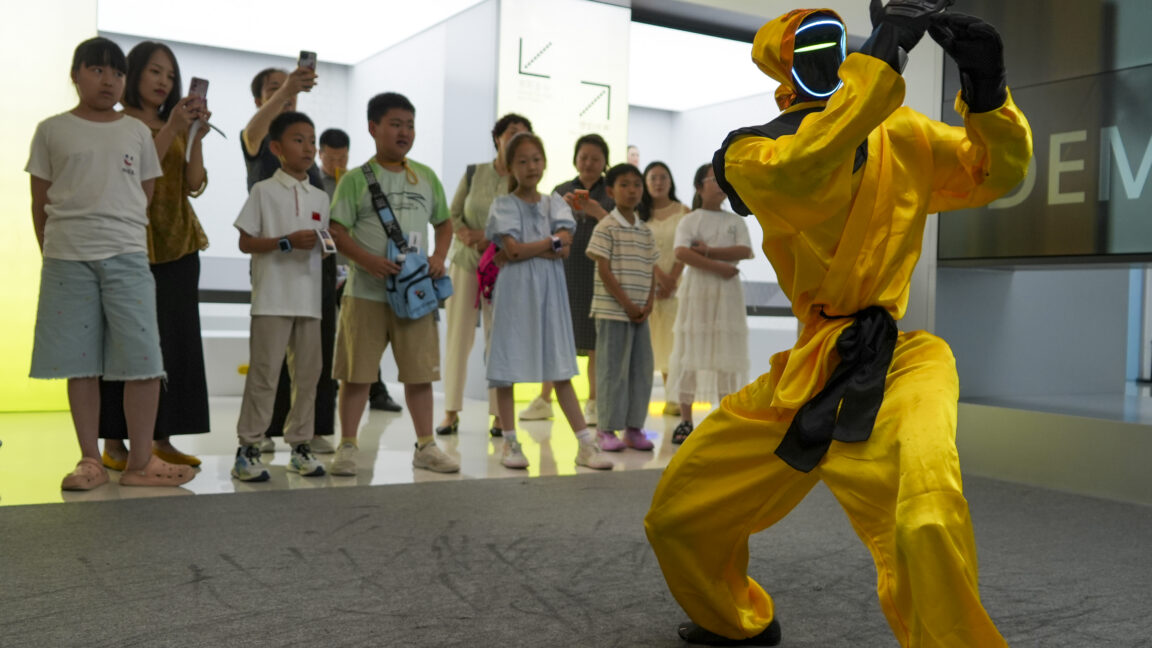
🧠Viral humanoid robot demonstrations often misrepresent actual capabilities through selective editing and controlled environments, creating inflated public expectations. The disconnect between viral content and genuine technological progress risks undermining credibility in the robotics field and misleading investors about near-term commercialization timelines.
AIBullishCrypto Briefing · Jun 46/10
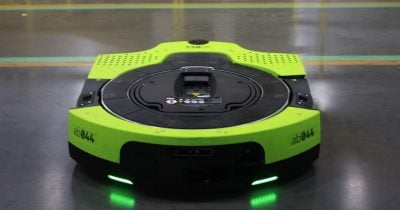
🧠Amazon has unveiled an upgraded version of its Proteus robot that can now accept natural language commands in plain English, representing a significant advancement in human-machine interaction within warehouse automation. This development demonstrates the growing integration of AI capabilities into physical robotics, potentially reshaping operational workflows across logistics and manufacturing sectors.
AIBullishCrypto Briefing · Jun 46/10
🧠TSMC's CEO has highlighted strong growth prospects in autonomous driving and robotics sectors, signaling a strategic pivot that could reshape semiconductor demand patterns. This expansion into AI-driven applications suggests the chip industry is poised for sustained growth beyond traditional computing markets.
AINeutralarXiv – CS AI · Jun 46/10
🧠Researchers propose Dual Advantage Fields (DAF), a reinforcement learning method that extracts local policy signals from dual value representations to improve offline goal-conditioned learning. The approach combines global reachability estimates with local action preferences, showing strong performance on locomotion, manipulation, and puzzle tasks where direct movement toward goals isn't optimal.