#robotics News & Analysis
The #robotics tag covers 249 indexed articles, with 35 published in the last month. Recent coverage leans bullish at 57.1%, though sentiment has softened by 15.8 percentage points compared to the prior quarter, with 40% neutral and 2.9% bearish articles. ArXiv's computer science and AI sections dominate the source list, alongside coverage from AI News and TechCrunch's AI beat. Nvidia and OpenAI appear most frequently in related discussions.
#robotics content intersects regularly with #machine-learning, #reinforcement-learning, #computer-vision, and #ai-research. Scan the articles below for the latest developments and perspectives in the field.
sentiment · last 30d (35 articles) · -15.8pp bullish vs prior 90dTop sources:arXiv – CS AI · 167AI News · 7TechCrunch – AI · 6Crypto Briefing · 4Blockonomi · 3
Most-discussed entities:Nvidia · 5OpenAI · 4Haiku · 1Gemini · 1Hugging Face · 1
AIBullishFortune Crypto · May 286/10
🧠Duke University scientists have developed a multi-legged robot with distributed sensory systems that can navigate complex terrain and withstand heavy collisions. The breakthrough represents a significant advancement in biomimetic robotics, with potential applications in exploration, disaster response, and industrial automation.
AINeutralarXiv – CS AI · May 286/10
🧠Researchers introduce Trinity, a transformer-based AI system that unifies terrain and semantic segmentation for outdoor robots using synthetic data. The approach enables robot-agnostic terrain understanding without predefined labels, improving transferability across different robotic platforms and reducing annotation costs.
AINeutralarXiv – CS AI · May 286/10
🧠Researchers introduce Simulation-Informed Diffusion (SID), a decentralized multi-robot motion planning framework that predicts neighboring robot trajectories to enable collision-free path planning without global communication. The approach scales to 108 robots and 160 obstacles while triggering coordination only when necessary, outperforming existing classical and learning-based planners.
AINeutralarXiv – CS AI · May 286/10
🧠Researchers introduce SegWorld, a segmentation model that uses visual chain-of-thought reasoning to understand scenes and segment object parts based on high-level intent rather than explicit target descriptions. The model proactively observes scenes, infers affordances, and maps user instructions to specific physical interaction points, outperforming baselines on intent-level tasks while matching them on traditional target-referential instructions.
AINeutralarXiv – CS AI · May 286/10
🧠Researchers propose a novel framework for visualizing latent motion phase structures in deep reinforcement learning locomotion policies by extending clustering features beyond state observations to include actions and next states. The method successfully identifies clearer phase transition patterns across three MuJoCo environments, advancing interpretability of neural network-based control policies.
AINeutralarXiv – CS AI · May 286/10
🧠Researchers have developed an algorithm to identify parsimonious explicit piece-wise polynomial relationships in industrial time-series data, with application to robotic manipulator control. The method derives simpler, interpretable models that outperform deep neural networks on unseen contexts while maintaining computational efficiency.
AINeutralarXiv – CS AI · May 286/10
🧠Researchers introduce Center-of-Pressure (CoP), a physics-grounded tactile representation that enables robots to perform complex contact-rich manipulation tasks through sim-to-real transfer learning. The method preserves dense touch sensor information while remaining robust across simulation-to-reality gaps, demonstrating zero-shot transfer on dexterous hand tasks like peg insertion and ball balancing.
AIBullishCrypto Briefing · May 276/10
🧠Former researchers from Google and Apple have launched Trajectory, a startup focused on improving AI feedback loops through continuous learning mechanisms. The technology aims to enhance real-time adaptability in robotics and autonomous systems, representing a significant advancement in how AI systems learn and evolve from operational data.
AINeutralarXiv – CS AI · May 276/10
🧠Researchers propose Lie Group Embedded Dynamical Neural Networks (LieEDNN), a novel neural architecture that leverages Lie group mathematics to model continuous symmetries in dynamic systems. The approach enables stable, learnable dynamics on smooth manifolds for applications in robotics, graphics, and control systems, with experimental validation on SE(3) group structures for telescopic manipulator control.
AIBullisharXiv – CS AI · May 276/10
🧠Researchers introduce E³C, a video diffusion framework enabling controllable egocentric video generation with 3D environmental memory and separate human pose controls for both camera wearers and observed subjects. The system addresses unique challenges in first-person video synthesis by maintaining scene consistency while handling rapid viewpoint changes and partial occlusions.
AINeutralarXiv – CS AI · May 276/10
🧠Researchers introduce SDPG, a visual reinforcement learning method that trains robotic control policies significantly faster and more efficiently on consumer GPUs. The approach reduces computational overhead through stochastic gradient estimation while maintaining superior performance, and includes new benchmarks for advancing visual robotics research.
🏢 Nvidia
AINeutralarXiv – CS AI · May 276/10
🧠Researchers propose HyperCRL, a continual learning method for model-based reinforcement learning that uses task-conditional hypernetworks to efficiently learn dynamics models across sequential tasks without retraining on historical data. The approach maintains fixed-capacity networks while achieving competitive performance with methods that store growing amounts of past experience, enabling faster training cycles critical for long-horizon robot learning applications.
AIBullishArs Technica – AI · May 266/10
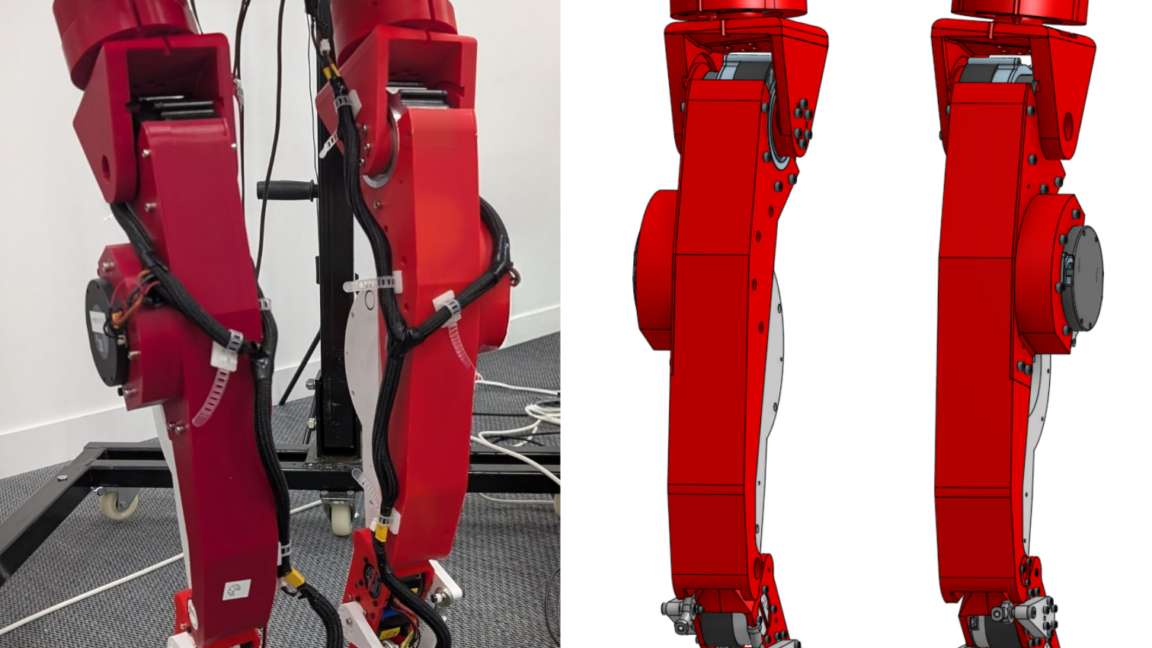
🧠Hugging Face has launched a $2,500 bipedal robot project featuring 3D-printable humanoid legs designed for builders and researchers. The initiative democratizes robotics experimentation by making advanced hardware accessible to a broader community of developers and academics.
🏢 Hugging Face
AIBullishTechCrunch – AI · May 266/10
🧠Human Archive, a startup founded by UC Berkeley and Stanford researchers, is leveraging India's gig economy to collect real-world physical training data for AI and robotics development. Gig workers wear camera-equipped caps and sensor devices to generate datasets that labs worldwide are competing to obtain.
AINeutralAI News · May 266/10
🧠Autonomous AI systems are expanding from software into physical environments like warehouses and delivery networks, exposing gaps in current governance frameworks. Existing AI regulations have primarily addressed online harms and model outputs, leaving physical deployment risks largely unregulated.
AINeutralWired – AI · May 266/10
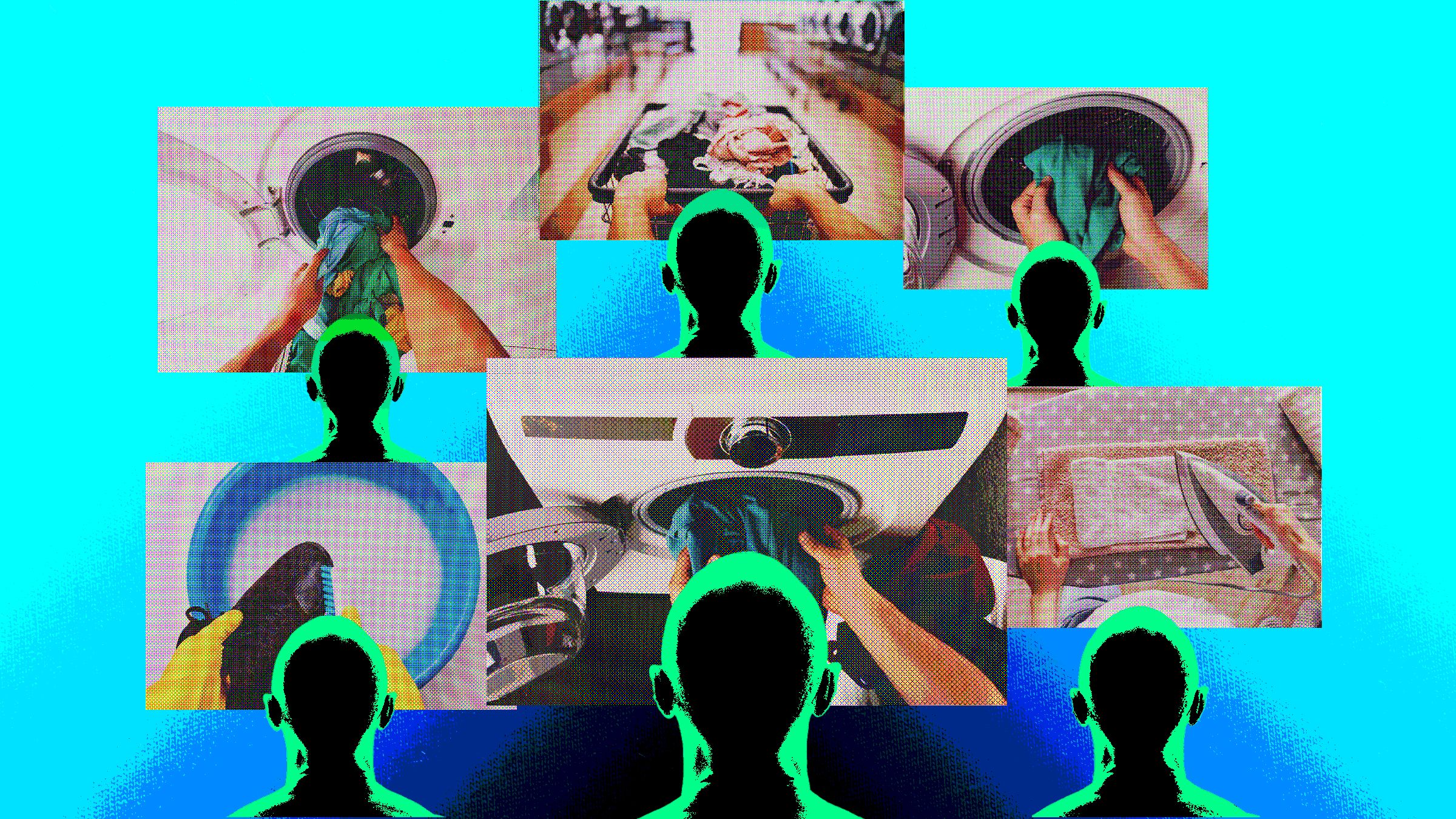
🧠An individual monetized household chores by recording themselves performing everyday tasks to generate training data for humanoid robot development. The experiment highlights the emerging market for human labor data and raises questions about privacy, consent, and the economic implications of automating domestic work.
AIBullishArs Technica – AI · May 206/10
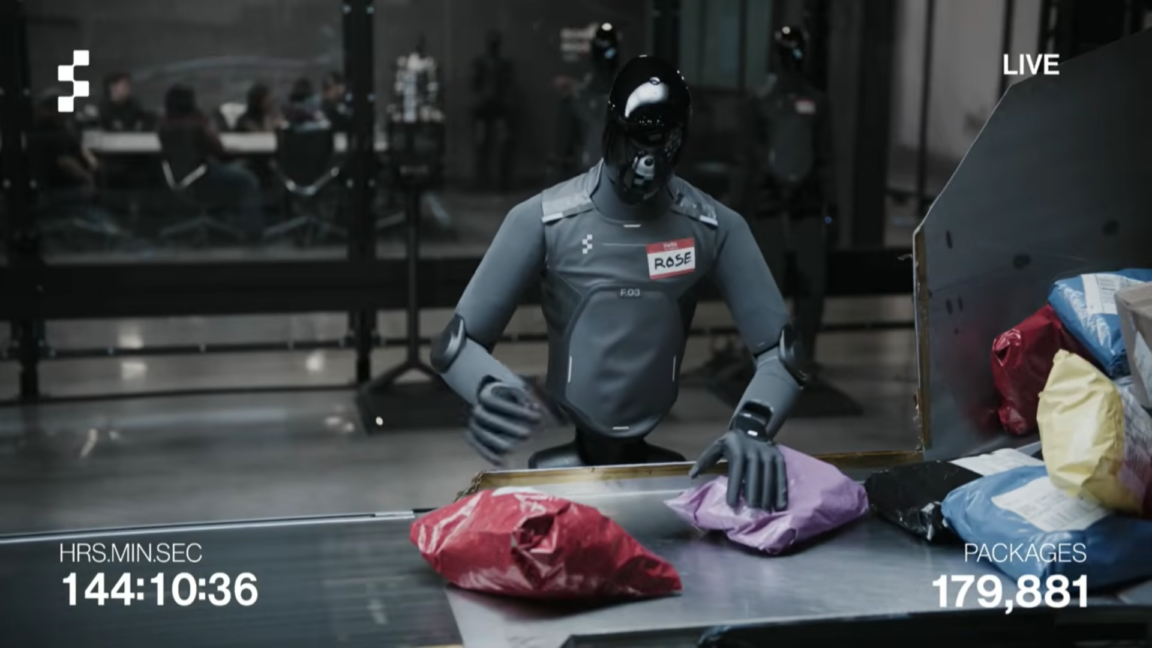
🧠Figure AI's 24/7 livestream of humanoid robots handling packages has captured significant public attention, demonstrating growing consumer fascination with robotics technology. The viral nature of the stream highlights both the technological progress in humanoid robotics and the market's emerging interest in automation solutions for logistics and warehouse operations.
AINeutralarXiv – CS AI · May 126/10
🧠Researchers conduct a comprehensive benchmarking study of expert-guided reinforcement learning methods, revealing three critical failure modes that single-paper evaluations miss. They propose a decision rule based on pre-training observables to guide method selection, introducing EDGE as a new design point that exposes exploitable architectural dimensions.
AINeutralarXiv – CS AI · May 126/10
🧠This research benchmarks RT-DETR object detection models with different ResNet backbones for competitive robotics applications, evaluating how environmental variations like lighting and background contrast affect detection performance. The study finds that intermediate-depth models (ResNet34 and ResNet50) offer optimal balance between accuracy, confidence, and latency, with ResNet50 excelling under illumination changes and ResNet34 performing best under background variations.
AINeutralarXiv – CS AI · May 126/10
🧠Researchers propose embedding the Robotic Service Ontology (RoSO) into the Structural Model of General Intelligence (SMGI) to enable dynamic governance of robotic services during runtime reconfigurations. The framework addresses how service semantics can remain valid and admissible when systems are rebound, recomposed, or redeployed, moving beyond static ontology conformance to formally governed runtime change.
AINeutralarXiv – CS AI · May 126/10
🧠Researchers introduce REAP, a reinforcement learning-based autonomous parking system that uses Gaussian Splatting to simulate real-world environments for training, then transfers the model to physical vehicles. The method addresses limitations of traditional multi-stage parking approaches by jointly optimizing perception and planning, achieving successful parking in extreme scenarios like mechanical slots.
AIBullisharXiv – CS AI · May 126/10
🧠Researchers propose OLSF-TRS, a machine learning framework combining reinforcement learning with combinatorial optimization to improve order fulfillment decisions in tote-handling robotic systems used across e-commerce and logistics. The system achieves near-optimal performance on small-scale deployments and reduces tote movements by 8-12% in large-scale scenarios compared to existing heuristic approaches.
AINeutralarXiv – CS AI · May 126/10
🧠PhysHanDI introduces a physics-based framework for reconstructing 3D hand-object interactions involving deformable materials like cloth and soft objects. By simulating physically plausible object deformations driven by hand movements and using inverse physics to refine hand reconstruction, the method achieves superior performance in reconstruction and prediction tasks compared to existing approaches.
AIBullisharXiv – CS AI · May 116/10
🧠Researchers present a 2.5-D decomposition method that improves LLM-based spatial reasoning for autonomous construction tasks by constraining language models to 2D horizontal planning while deterministic systems handle vertical placement. The approach achieves 94.6% structural accuracy on benchmark tests, significantly outperforming existing methods and demonstrating practical deployment on edge hardware.
🏢 Nvidia🧠 GPT-4
AIBullisharXiv – CS AI · May 116/10
🧠Researchers have developed LC-MAPF, a machine learning model that enables multi-agent systems to coordinate pathfinding tasks through localized communication between neighboring agents. The approach outperforms existing learning-based solutions while maintaining scalability, addressing a critical challenge in autonomous robotics and logistics applications.