#robotics News & Analysis
The #robotics tag covers 249 indexed articles, with 35 published in the last month. Recent coverage leans bullish at 57.1%, though sentiment has softened by 15.8 percentage points compared to the prior quarter, with 40% neutral and 2.9% bearish articles. ArXiv's computer science and AI sections dominate the source list, alongside coverage from AI News and TechCrunch's AI beat. Nvidia and OpenAI appear most frequently in related discussions.
#robotics content intersects regularly with #machine-learning, #reinforcement-learning, #computer-vision, and #ai-research. Scan the articles below for the latest developments and perspectives in the field.
sentiment · last 30d (35 articles) · -15.8pp bullish vs prior 90dTop sources:arXiv – CS AI · 167AI News · 7TechCrunch – AI · 6Crypto Briefing · 4Blockonomi · 3
Most-discussed entities:Nvidia · 5OpenAI · 4Haiku · 1Gemini · 1Hugging Face · 1
AIBullishFortune Crypto · Jun 97/10
🧠MIT researchers, led by professor Xuanhe Zhao, have developed a wristband technology that enables robots to learn physical tasks through human demonstration, with applications spanning household chores and surgical procedures. This advancement represents a shift in AI development toward solving real-world physical challenges rather than purely digital applications.
AIBullishCrypto Briefing · Jun 97/10
🧠Nvidia has partnered with LG to develop humanoid robots and next-generation data centers, positioning the companies to capture emerging opportunities in robotics and AI infrastructure. The collaboration aims to expand Nvidia's ecosystem dominance while leveraging LG's manufacturing and hardware capabilities to bring AI applications into physical-world deployment.
🏢 Nvidia
AINeutralarXiv – CS AI · Jun 97/10
🧠Researchers introduce SpatialWorld, a comprehensive benchmark for evaluating multimodal AI agents' ability to understand and navigate physical spaces in real-world tasks. Testing 15 advanced models reveals significant limitations: GPT-5 achieves only 17.4% task success while open-source alternatives lag further, exposing critical gaps in spatial reasoning and long-horizon planning capabilities.
🧠 GPT-5
AIBullisharXiv – CS AI · Jun 97/10
🧠Researchers have developed a vision-based fault diagnosis and self-recovery system for strawberry-harvesting robots that addresses critical operational failures including gripper misalignment, empty grasps, and fruit slippage. The integrated framework combines advanced computer vision, deep learning classifiers, and real-time feedback mechanisms to achieve significant improvements in positioning accuracy and harvesting success rates while reducing cycle times for failure scenarios.
AIBullisharXiv – CS AI · Jun 97/10
🧠CrossVLA presents a comprehensive empirical study optimizing Vision-Language-Action models across different architectural paradigms, introducing a flow-matching log-probability estimator that enables Direct Preference Optimization on continuous-action models. The research demonstrates significant performance improvements using DoRA over LoRA, achieving up to 20% gains on specific benchmarks, while revealing inference-time bottlenecks that constrain acceleration potential to 21%.
AIBullisharXiv – CS AI · Jun 97/10
🧠Ego-Pi introduces a fine-tuning approach for the π₀.₅ foundation model that leverages egocentric human manipulation data to train humanoid robots with dexterous hands. The research demonstrates that human demonstrations enable robots to learn new task semantics and compose skills into novel behaviors without requiring robot-specific training data, addressing robotics' persistent data scarcity challenge.
AIBullisharXiv – CS AI · Jun 97/10
🧠EgoAERO introduces a framework enabling robots to learn dexterous manipulation skills from single egocentric human videos without requiring pre-scanned object assets or CAD models. The system reconstructs hand-object trajectories and converts them into robot policies, supported by a new large-scale dataset (EgoDex-R) containing 4.3M RGB-D frames, achieving performance comparable to traditional asset-dependent methods.
AIBullisharXiv – CS AI · Jun 97/10
🧠Researchers introduce AHA-WAM, an asynchronous world-action model for robot manipulation that decouples world prediction from action execution at different temporal frequencies. The system achieves 92.80% success on RoboTwin benchmarks and 78.3% on real-world tasks while operating at 24.17 Hz with 4.59x faster inference than existing approaches.
AIBullisharXiv – CS AI · Jun 97/10
🧠HARBOR is an automated framework that uses specialized AI agents to streamline reinforcement learning workflows for robot training, eliminating manual environment setup, reward shaping, and hyperparameter tuning. Demonstrated across 16 robotic tasks, the system reduces engineering effort while maintaining competitive performance and enabling real-world robot deployment.
AIBullisharXiv – CS AI · Jun 97/10
🧠Researchers introduce SpaceVLN, a zero-shot vision-and-language navigation agent that uses spatial cognitive memory and task-guided reasoning to enable autonomous agents to navigate unseen environments without task-specific training. The system achieves state-of-the-art performance across multiple navigation benchmarks and demonstrates real-world robot deployment capability.
AIBullisharXiv – CS AI · Jun 97/10
🧠Researchers present vla.cpp, a C++ inference runtime that enables Vision-Language-Action AI models to run efficiently on robot hardware rather than requiring high-end GPUs. The system achieves comparable accuracy to state-of-the-art models while reducing memory footprint to 1.3 GB and demonstrating 4.5x latency improvements through optimized inference techniques.
AIBullisharXiv – CS AI · Jun 97/10
🧠Researchers introduce CT-VAM, a compact 68M-parameter neural network inspired by cerebellar-thalamic brain architecture for robotic manipulation tasks. The model processes visual inputs and proprioception to predict action sequences efficiently on edge devices, matching larger vision-language-action models while reducing latency and enabling practical deployment on resource-constrained robots.
AIBullisharXiv – CS AI · Jun 97/10
🧠Researchers introduce PACT, a post-training framework that enhances diffusion policies for robotic manipulation by ensuring physical safety constraints without sacrificing task performance. The method reduces safety violations by 31% while improving task success by 30.7% across simulated and real-world benchmarks.
AIBullishcrypto.news · Jun 87/10
🧠Nvidia CEO Jensen Huang announced multiple strategic partnerships with major South Korean conglomerates including SK Hynix, Naver, SK Telecom, Doosan Group, LG Group, and Hyundai Motor Group, spanning chip manufacturing, cloud infrastructure, and robotics. The partnerships signal Nvidia's deepening commitment to the Asian market and South Korea's emergence as a critical hub for AI infrastructure development.
🏢 Nvidia
AIBullisharXiv – CS AI · Jun 87/10
🧠ActQuant introduces a novel post-training quantization framework that compresses Vision-Language-Action models to sub-4-bit weights while maintaining 94-95% performance, enabling practical deployment on edge devices. The method combines action-guided bit allocation with curvature-aware optimization, achieving 5.3× compression on major VLA models and validated performance on physical robotic hardware.
AIBullishCrypto Briefing · Jun 57/10
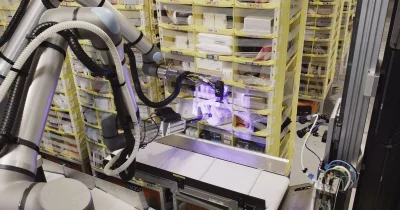
🧠Amazon has unveiled Vulcan, a warehouse robot equipped with tactile sensing technology, marking a significant advancement in robotic automation for logistics operations. The innovation aims to improve warehouse efficiency and reduce operational costs while working alongside human employees rather than replacing them entirely.
AIBullisharXiv – CS AI · Jun 57/10
🧠Researchers demonstrate that vision-language-action (VLA) models can generate robot actions effectively in a single step by simply biasing training toward high-noise states, eliminating the need for complex multi-step diffusion techniques borrowed from image generation. The approach achieves performance matching ten-step decoding on standard benchmarks while reaching 95.6% accuracy on LIBERO-Long with a 1.4B parameter model.
AIBullisharXiv – CS AI · Jun 57/10
🧠Researchers introduce A4D, a machine learning system that enables robots to reason about object functionalities rather than appearances for planning tasks. The approach achieves 94% inference accuracy on existing affordances and over 90% on new affordances while requiring significantly less training data, addressing a fundamental limitation in current robot planning systems.
AIBullisharXiv – CS AI · Jun 57/10
🧠Researchers introduce World-Language-Action (WLA) models, a new class of embodied foundation models that combine world modeling, language reasoning, and action synthesis for robotic control. The WLA-0 prototype demonstrates state-of-the-art performance across multiple benchmarks, achieving 92.94% success on RoboTwin2.0 and 56.5% on RMBench while running at 40ms inference on consumer GPU hardware.
🏢 Nvidia
AIBullisharXiv – CS AI · Jun 57/10
🧠Researchers introduce DRIFT, a framework that adapts pretrained vision-language models to handle continuous numerical outputs rather than discrete tokens. By combining a base predictor with a flow-matching refinement module, DRIFT improves performance on tasks like temporal localization and robotic control across multiple model architectures.
AIBullisharXiv – CS AI · Jun 57/10
🧠Researchers introduce Torque Adaptation Module (TAM), a learned module that adapts robot torque commands to compensate for dynamics differences across robot instances, payload variations, and sim-to-real gaps. TAM enables reusable policy adaptation without requiring robot-specific retraining or real-world data collection, demonstrating robust performance on dynamic manipulation tasks with a real Franka Panda robot.
AIBullishCrypto Briefing · Jun 57/10
🧠Generalist AI secured $400M in Series B funding led by Radical Ventures, achieving a $2B valuation. The funding round underscores significant investor confidence in versatile robotics technology and suggests the sector is poised to reshape labor dynamics across multiple industries.
AIBullishCrypto Briefing · Jun 47/10
🧠Fei-Fei Li presents a framework for world models that could advance AI's spatial understanding and reasoning capabilities. This development has significant implications for robotics and gaming applications, enabling systems to better predict and interact with physical environments.
AIBullisharXiv – CS AI · Jun 47/10
🧠DiffAero is a GPU-accelerated simulation framework that enables efficient quadrotor control policy learning through fully differentiable physics and rendering. The framework demonstrates significant performance improvements over existing simulators, achieving robust flight policy training on consumer hardware in hours rather than days, with code publicly available for research adoption.
AIBullisharXiv – CS AI · Jun 47/10
🧠Researchers introduce SceneDiver, a new method that improves Vision-Language Models and Vision-Language-Action Models by reducing visual hallucinations through progressive scene understanding and focus planning. The approach uses a coarse-to-fine strategy to help AI systems distinguish task-relevant objects from distractors, with applications in robotic manipulation and navigation tasks.