#robotics News & Analysis
The #robotics tag covers 249 indexed articles, with 35 published in the last month. Recent coverage leans bullish at 57.1%, though sentiment has softened by 15.8 percentage points compared to the prior quarter, with 40% neutral and 2.9% bearish articles. ArXiv's computer science and AI sections dominate the source list, alongside coverage from AI News and TechCrunch's AI beat. Nvidia and OpenAI appear most frequently in related discussions.
#robotics content intersects regularly with #machine-learning, #reinforcement-learning, #computer-vision, and #ai-research. Scan the articles below for the latest developments and perspectives in the field.
sentiment · last 30d (35 articles) · -15.8pp bullish vs prior 90dTop sources:arXiv – CS AI · 167AI News · 7TechCrunch – AI · 6Crypto Briefing · 4Blockonomi · 3
Most-discussed entities:Nvidia · 5OpenAI · 4Haiku · 1Gemini · 1Hugging Face · 1
AIBullisharXiv – CS AI · Jun 47/10
🧠DiffAero is a GPU-accelerated simulation framework that enables efficient quadrotor control policy learning through fully differentiable physics and rendering. The framework demonstrates significant performance improvements over existing simulators, achieving robust flight policy training on consumer hardware in hours rather than days, with code publicly available for research adoption.
AIBullishCrypto Briefing · Jun 27/10
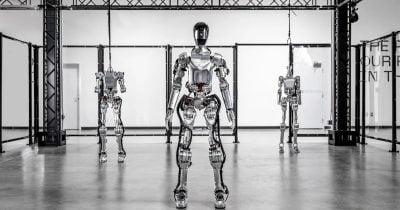
🧠Andrew Kang predicts humanoid robots will become integrated into everyday life within three to five years, with market potential reaching trillions of dollars. He emphasizes that physical intelligence represents a transformative shift in robotics technology, enabling these multipurpose machines to adapt across diverse job functions.
AIBullishFortune Crypto · Jun 27/10
🧠Anthropic's experimental AI-powered vending machine has evolved into fully autonomous AI-run stores and cafes within a year, with Andon Labs co-founder suggesting AI performance now matches or exceeds human operational capability. This development demonstrates practical real-world deployment of autonomous AI systems in retail and food service, signaling accelerating automation in traditionally human-operated commercial spaces.
🏢 Anthropic
AINeutralarXiv – CS AI · Jun 27/10
🧠Researchers introduce VLM4VLA, a minimal adaptation pipeline converting Vision-Language Models into Vision-Language-Action policies for robotic control. The study reveals that strong general VLM performance doesn't reliably predict downstream task success, and that visual encoders—not language components—represent the primary bottleneck for embodied AI applications.
🏢 Meta
AIBullisharXiv – CS AI · Jun 27/10
🧠A comprehensive survey examines the convergence of AI, IoT, and robotics, identifying Small Language Models (SLMs) and Large Language Models (LLMs) as critical components for distributed cognition in edge and cloud environments. The research proposes unified design frameworks and modular architectures to address interoperability gaps, advancing the emerging field of Connected Robotics and Physical AI.
AIBullisharXiv – CS AI · Jun 27/10
🧠Researchers present a novel off-policy learning method that addresses distributional shift and value overestimation in zero-shot reinforcement learning by establishing a theoretical connection between successor measures and stationary density ratios. The approach enables agents to adapt to new tasks without additional training by inferring optimal importance sampling ratios on-the-fly, with successful benchmarks across motion tracking, continuous control, and long-horizon tasks.
AIBullisharXiv – CS AI · Jun 27/10
🧠Researchers introduce Crazyflow, a GPU-accelerated drone simulator built in JAX that achieves orders-of-magnitude speed improvements over existing platforms while maintaining high fidelity and differentiability. The simulator enables novel capabilities including in-flight reinforcement learning, demonstrated by successfully training a recovery policy for a physical drone mid-air in 0.38 seconds.
AIBullisharXiv – CS AI · Jun 27/10
🧠SceneSmith is a new AI framework that generates realistic, physics-accurate indoor environments from natural language descriptions for robot simulation and training. The system produces 3-6x more objects than existing methods with minimal collisions, achieving 92% realism in user evaluations and enabling automated robot policy testing.
AIBearisharXiv – CS AI · Jun 27/10
🧠Researchers have discovered a critical security vulnerability in Vision-Language-Action models used in robotics, demonstrating a stealthy backdoor attack called SILENTDRIFT that exploits action chunking mechanisms. The attack achieves 93.2% success rate while remaining visually undetectable, raising serious concerns about the safety of AI-powered robotic systems in critical applications.
AIBullishCrypto Briefing · Jun 17/10
🧠Nvidia has unveiled Cosmos 3, an open-source world model designed to improve robot navigation and autonomous systems. The open model approach aims to democratize robotics innovation by enabling smaller companies and researchers to develop advanced AI capabilities without requiring extensive computational resources or proprietary infrastructure.
🏢 Nvidia
AIBullishCrypto Briefing · Jun 17/10
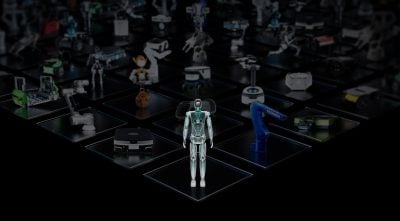
🧠Nvidia has introduced Isaac GR00T, a humanoid robot platform designed for academic research that aims to address labor shortages and advance robotics capabilities across multiple industries. The platform represents a significant step in making sophisticated robotics technology accessible to researchers and institutions.
🏢 Nvidia
AIBullishHugging Face Blog · Jun 17/10
🧠NVIDIA has unveiled Cosmos 3, an open-source omni-model designed for physical AI reasoning and action, representing a significant advancement in AI systems capable of understanding and interacting with the physical world. The model's open-source nature and multi-modal capabilities position it as a foundational tool for developers building autonomous systems and robotics applications.
🏢 Nvidia
AIBullisharXiv – CS AI · Jun 17/10
🧠Researchers introduce DeMaVLA, a Vision-Language-Action foundation model designed to enable robots to generalize deformable-object manipulation across diverse household tasks without requiring category-specific training. The model combines a VLM backbone with an efficient action expert using flow matching and is trained on 5,000 hours of real-world demonstrations plus corrective learning from robot failures, achieving strong performance on folding benchmarks.
AIBullisharXiv – CS AI · Jun 17/10
🧠Researchers introduce Flow Equivariant World Models, a framework that uses time-parameterized symmetries to improve how AI systems predict dynamics in partially observed environments. The approach significantly outperforms existing diffusion and recurrent models by maintaining equivariant memory structures that track both observed and unobserved regions as they evolve over time.
AIBullisharXiv – CS AI · Jun 17/10
🧠GSAM is a new robotic framework that improves articulated object manipulation through vision-based perception, VLM-based refinement with commonsense reasoning, and constraint-based planning to prevent collisions. In experiments across 50 hinge tasks, GSAM achieved 36% higher success rates and 3.1% lower standard deviation compared to existing baselines, demonstrating superior generalization and safety.
AIBullishCrypto Briefing · May 317/10
🧠OpenAI is expanding its robotics division and ramping up hiring efforts to develop general-purpose robots capable of performing diverse tasks. This expansion signals the company's commitment to integrating advanced AI systems into physical automation, with potential implications for industrial automation, labor markets, and the broader AI sector.
🏢 OpenAI
AIBullisharXiv – CS AI · May 297/10
🧠Alibaba's Qwen team released Qwen-VLA, a unified foundation model that combines vision, language, and action capabilities for robotics across multiple tasks and robot types. The model demonstrates strong performance on manipulation, navigation, and trajectory prediction benchmarks while generalizing well to out-of-distribution scenarios and real-world robot deployments.
AIBullisharXiv – CS AI · May 297/10
🧠Researchers introduce dynamic symmetry as a design principle for robotics, where robots are optimized for uniform center-of-mass acceleration capabilities rather than just geometric form. The Argus family of spherical robots demonstrates that achieving extreme dynamic isotropy significantly improves trajectory tracking, robustness, and energy efficiency, with a physical 20-leg prototype exhibiting omnidirectional locomotion and resilience to actuator failures.
AIBullisharXiv – CS AI · May 297/10
🧠Researchers introduce BitTP, a quantization technique that compresses LLM-based trajectory prediction models to 1.58-bit weights while maintaining full-precision activations, enabling deployment on resource-constrained edge devices. The approach not only reduces memory and latency but actually improves prediction accuracy by 14-21% compared to full-precision baselines, demonstrating that strategic quantization can serve as an effective regularizer.
AIBullisharXiv – CS AI · May 297/10
🧠Researchers introduce VLA-Pro, a framework that enhances vision-language-action models for robotics by storing and retrieving task-specific procedural memories during inference. The approach achieves dramatic performance gains—up to 207% improvement in simulation and raising real-world success rates from 5.8% to 65%—demonstrating significant progress in cross-task generalization for robotic manipulation.
AIBullisharXiv – CS AI · May 297/10
🧠Researchers introduce AnyMo, a unified framework for conditional human motion generation that supports arbitrary modality combinations (text, speech, music, trajectory). The work is enabled by OmniHuMo, a large-scale dataset of 5,000+ hours of motion with precisely aligned multimodal annotations, addressing the critical bottleneck of training data scarcity in multimodal synthesis.
AIBullisharXiv – CS AI · May 297/10
🧠Researchers introduce VisualThink-VLA, a vision-language-action framework that uses visual intermediate reasoning instead of text-based chain-of-thought to enable faster, more accurate robotic control. The system achieves 22.8x latency reduction compared to text-reasoning baselines while maintaining superior accuracy across multiple benchmarks.
AIBullisharXiv – CS AI · May 287/10
🧠Researchers have developed CLANE, a neuromorphic hardware system deployed on Intel Loihi 2 that enables continuous learning of human actions from event cameras without forgetting previously learned classes. The system achieves 70.4% accuracy on a 50-class action recognition dataset while consuming 100x less energy and delivering 16x lower latency than conventional GPU-based approaches, advancing on-device AI for AR/VR and robotics applications.
AIBullisharXiv – CS AI · May 287/10
🧠Researchers introduce a hierarchical decomposition method to improve large language models' spatial reasoning capabilities, a persistent weakness limiting their real-world applications. The approach combines task decomposition with a novel MCTS-Guided Group Relative Policy Optimization algorithm to enhance LLM performance on navigation, planning, and strategic games.
AIBullisharXiv – CS AI · May 277/10
🧠Researchers present Inverse Learning (IL), a neuro-inspired framework for embodied AI planning that outperforms offline reinforcement learning and diffusion-based planners on D4RL benchmarks by an average of 24.2% while requiring 1-2 orders of magnitude less inference compute. The approach optimizes entire action sequences through forward models rather than step-by-step decisions, enabling faster, smoother control policies applicable to robotics and quantum gate synthesis.